


















Lesson 27 of 49 · Chemical Kinetics
Reaction Mechanisms, Steady State and Catalysis
Build rate laws from elementary steps: rate-determining steps, pre-equilibrium, the steady-state approximation, Lindemann theory, catalysts and Michaelis-Menten enzyme kinetics.
A balanced equation is a bookkeeping statement: it shows the starting materials and the end products. It says nothing about what molecules do on the way. A mechanism is a proposed sequence of elementary steps that adds up to the overall reaction. Chemists cannot see a mechanism directly; they propose one, derive the rate law it predicts, and test it against the measured rate law. A mechanism that predicts the wrong rate law is wrong. One that predicts the right law is only consistent with the data, never proven.
What you will learn
- Distinguish molecularity from order and write rate laws for elementary steps
- Derive a rate law with the rate-determining step, pre-equilibrium and steady-state methods
- Explain Lindemann pressure dependence of unimolecular reactions
- Describe how catalysts act and use the Michaelis-Menten equation
Key terms
Elementary step: a single molecular event. Its rate law follows directly from its molecularity.
Intermediate: a species made in one step and consumed in a later one; it never appears in the overall equation.
Rate-determining step: the slowest step that controls the overall rate when it is much slower than the others.
Steady-state approximation: assuming an intermediate's concentration stays small and constant, so d[I]/dt = 0.
Elementary steps and molecularity
For an elementary step, and only for an elementary step, the exponents in the rate law equal the coefficients:
| Step | Molecularity | Rate law |
|---|---|---|
| A → products | unimolecular | k[A] |
| A + B → products | bimolecular | k[A][B] |
| 2A → products | bimolecular | k[A]² |
| A + B + C → products | termolecular (rare) | k[A][B][C] |
Termolecular steps are rare because three-body collisions are improbable. A proposed mechanism should use unimolecular and bimolecular steps.
Rate-determining step
Consider 2 NO₂ + F₂ → 2 NO₂F. A plausible mechanism is
NO₂ + F₂ → NO₂F + F(slow)NO₂ + F → NO₂F(fast)
Adding the steps gives the overall reaction with F as an intermediate. The slow step controls the pace, so the predicted law is rate = k[NO₂][F₂], which matches experiment: first order in each reactant, even though the equation has 2 NO₂. The fast step does not matter for the rate law, just as the speed of a highway after a traffic jam does not change how long the trip takes.
Pre-equilibrium
When a fast reversible step comes before the slow step, the intermediate is in equilibrium with reactants. For 2 NO + O₂ → 2 NO₂:
2 NO ⇌ N₂O₂(fast, equilibrium constant K)N₂O₂ + O₂ → 2 NO₂(slow, k₂)
Since [N₂O₂] = K[NO]², the rate is k₂K[NO]²[O₂]: third order overall, as observed. Because K decreases with temperature for an exothermic first step, the overall "activation energy" Ea = Ea₂ + ΔH°₁ can even be negative, and this reaction actually speeds up slightly as it is cooled.
The steady-state approximation
If no step is clearly the slow one, treat the intermediate as steady. Take A + B ⇌ I (k₁ forward, k₋₁ back) followed by I → P (k₂):
d[I]/dt = k₁[A][B] − k₋₁[I] − k₂[I] ≈ 0
so [I] = k₁[A][B] / (k₋₁ + k₂) and
rate = k₂[I] = k₁k₂[A][B] / (k₋₁ + k₂)
Two limits make sense. If k₂ ≫ k₋₁, every intermediate goes forward, and rate = k₁[A][B]: the first step is rate-determining. If k₂ ≪ k₋₁, the first step is a pre-equilibrium and rate = (k₁k₂/k₋₁)[A][B] = K k₂[A][B]. The steady-state result contains both pictures as special cases.
Lindemann mechanism
For a gas-phase "unimolecular" reaction, molecules are energized by collisions with any partner M: A + M ⇌ A* + M, then A* → P. Steady state gives
rate = k₁k₂[A][M] / (k₋₁[M] + k₂)
At high pressure k₋₁[M] ≫ k₂ and the rate is first order in A. At low pressure the collision step is slow and the rate is k₁[A][M]: second order. The measured fall-off in the effective first-order constant at low pressure was the evidence for this picture.
Catalysis
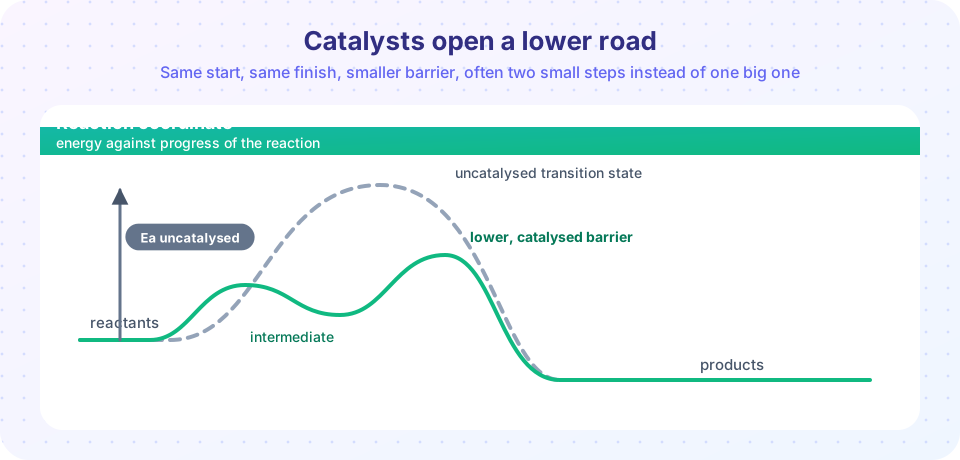
A catalyst takes part in the mechanism but is regenerated. It provides a route with a lower highest barrier, accelerating forward and reverse reactions equally, so it does not change ΔG° or K. Three common types:
- Homogeneous: same phase as the reactants, such as acid catalysis or chlorine atoms destroying ozone in the stratosphere.
- Heterogeneous: a solid surface adsorbs the reactants (platinum in a catalytic converter, iron in the Haber process). Surface steps are covered in a later chapter.
- Enzymes: protein catalysts, extremely selective and fast.
Michaelis-Menten kinetics
For E + S ⇌ ES → E + P, the steady-state treatment of ES gives
v = V_max [S] / (K_M + [S]), where V_max = k_cat [E]₀ and K_M = (k₋₁ + k_cat) / k₁
At low [S] the rate is proportional to [S]; at high [S] the enzyme is saturated and the rate tends to V_max. When [S] = K_M, v = V_max / 2, so K_M is the substrate concentration at half-saturation. The ratio k_cat / K_M is the catalytic efficiency. Inverting the equation gives the Lineweaver-Burk straight line, 1/v = (K_M/V_max)(1/[S]) + 1/V_max, which is easy to read but weights errors badly; modern analyses fit the hyperbola directly.
Common misconceptions
"The slow step is the first step." It can be any step. What matters is which step has the highest effective barrier relative to the earlier equilibria.
"A catalyst is not involved in the reaction." It is involved, and it forms bonds; it is just regenerated at the end.
"Intermediates and transition states are the same." An intermediate is a real species in an energy valley (it could be isolated in principle). A transition state is a fleeting top of a barrier.
Try it
First, a test of the steady-state approximation. The code integrates A → I → P exactly and compares [I] with the steady-state estimate k₁[A]/k₂. The approximation is good once the short start-up period is over, provided I is consumed much faster than it forms (k₂ ≫ k₁), and poor otherwise. This is a numerical experiment with invented rate constants.
Press Run (or Ctrl + Enter) to see the result here.
Program input · what you'd type while the program runs
Type the answers before you press Run, one per line. Each time the program reads a line (with input()), it gets the next line from this box.
Second, an enzyme experiment: the data are invented (true V_max = 12 µM/s, K_M = 30 µM, 4 % scatter) to show how the fit recovers the parameters.
Press Run (or Ctrl + Enter) to see the result here.
Program input · what you'd type while the program runs
Type the answers before you press Run, one per line. Each time the program reads a line (with input()), it gets the next line from this box.
Check your understanding
Quick check · 5 questions
of 5 answered You scored / 5 · perfect!
-
1. A mechanism has a slow first step A + B → I, then a fast I + B → P. What rate law does it predict?
The slow step sets the rate and its rate law follows its stoichiometry: k[A][B]. -
2. Which is true of an intermediate?
An intermediate cancels when the steps are added; a catalyst is consumed and then regenerated. -
3. In the Lindemann mechanism, what happens at very high pressure?
Collisions are so frequent that energized molecules are in equilibrium, and the unimolecular step controls the rate. -
4. When [S] = K_M in Michaelis-Menten kinetics, the rate equals
v = V_max K_M/(2 K_M) = V_max/2. -
5. A catalyst changes which quantity?
It gives a lower-barrier route; thermodynamic quantities of the overall reaction are unchanged.
Summary
- A mechanism is a sequence of elementary steps; its predicted rate law must match experiment.
- Rate-determining step, pre-equilibrium and steady state are three ways to derive the rate law.
- Catalysts offer lower-barrier routes and change k, not K.
- Michaelis-Menten:
v = V_max[S]/(K_M + [S]); K_M is the half-saturation concentration.
Next: Chapter review
Track your progress
Create a free account to tick off lessons and pick up where you left off on any device.
of Physical Chemistry lessons completed