


















Lesson 12 of 49 · Entropy, Free Energy and Equilibrium
Chapter 3 overview: entropy, free energy and equilibrium
Why do things happen? An overview of entropy, the second law, Gibbs free energy and equilibrium constants, with a live simulation of particles spreading out.
The first law says energy is conserved. It cannot explain why a hot cup of coffee cools down but never heats itself back up, since both would conserve energy. Something else decides the direction of change. That something is entropy, and the second law of thermodynamics is the principle that governs it.
This chapter turns that principle into a working tool for chemistry. From entropy we build the Gibbs energy, the quantity that tells you whether a reaction can proceed, and from the Gibbs energy we get the equilibrium constant.
What you will learn
- The qualitative meaning of entropy and the second law.
- How the lessons of this chapter build on each other.
- Why spontaneous change is a statement about probability.
- How a simulation shows a system reaching equilibrium on its own.
Key terms
Spontaneous process: one that occurs without continuous outside intervention, in a definite direction.
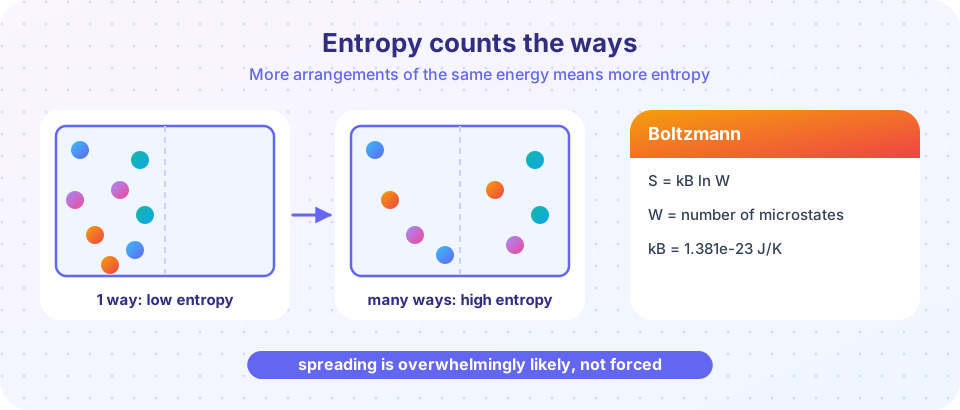
Entropy (S): a state function measuring how many microscopic arrangements correspond to a macroscopic state; S = kB ln W.
Second law: the total entropy of an isolated system never decreases.
Gibbs energy (G): G = H - TS; at constant T and P a process is spontaneous when ΔG < 0.
Equilibrium constant (K): the value of the reaction quotient Q when the reaction is at equilibrium.
Entropy
Second law
Gibbs energy
Equilibrium
The lessons in this chapter
Entropy and the second law. Microstates, Boltzmann's formula, the definition dS = q_rev/T, entropy changes of heating, expansion and phase changes, and the third law.
Gibbs free energy. Combining the system's enthalpy and entropy into one criterion for spontaneity, with the four sign cases and the temperature at which a reaction turns around.
The equilibrium constant. ΔG = ΔG° + RT ln Q and ΔG° = -RT ln K. How the free energy minimum corresponds to the equilibrium composition.
Temperature, pressure and Le Chatelier. The van 't Hoff equation, shifting equilibria, and why catalysts do not change K.
The logic of the chapter
- Heat flows from hot to cold, gases expand, solutes dissolve: these everyday one-way changes all increase the total entropy.
- Keeping track of the entropy of the surroundings is awkward, so we fold it into the system through
ΔG = ΔH - TΔS. - A reaction proceeds until
Ghas reached its lowest point. That point defines the equilibrium composition and therefore K.
Common misconceptions
"Entropy is disorder." A helpful picture, but entropy is a precise count of accessible microstates (and of how energy can be spread among them). Crystals can form spontaneously because the surroundings gain more entropy than the system loses.
"The second law says entropy always increases." Only for isolated systems or the system plus surroundings. A refrigerator lowers the entropy of its contents by raising that of the room.
"Spontaneous processes are fast." Spontaneity says nothing about speed.
Try it
Particles do not need a rule telling them to spread out. This html demo is a simulation of 100 particles in a box with two halves. At every step one randomly chosen particle hops to the other half. We start with all particles on the left. Watch the count drift toward 50 and then fluctuate around it, and almost never return to 100.
Now count the arrangements exactly. The program computes the entropy S = kB ln W for particle numbers on the left and shows how fast the even split dominates as N grows.
Press Run (or Ctrl + Enter) to see the result here.
Program input · what you'd type while the program runs
Type the answers before you press Run, one per line. Each time the program reads a line (with input()), it gets the next line from this box.
Check your understanding
Quick check · 4 questions
of 4 answered You scored / 4 · perfect!
-
1. Why does heat flow from hot to cold spontaneously?
Energy is conserved either way; only flow from hot to cold increases total entropy. -
2. What does S = kB ln W mean?
W is the number of microstates; more ways means higher entropy. -
3. Gibbs energy is defined as
G = H - TS. -
4. A process is spontaneous at constant T and P when
ΔG < 0 combines the system's enthalpy and entropy with the effect on the surroundings.
Summary
- The first law cannot give direction; the second law does, through entropy.
S = kB ln W: spontaneous change goes toward more microstates.G = H - TSpackages the second law for constant T and P.- Equilibrium sits at the minimum of G and defines K.
- Spontaneous does not mean fast.
Track your progress
Create a free account to tick off lessons and pick up where you left off on any device.
of Physical Chemistry lessons completed