


















Lesson 24 of 49 · Chemical Kinetics
Chapter 5 Overview: How Fast Do Reactions Go?
A big-picture tour of chemical kinetics: reaction rates, rate laws, temperature dependence and mechanisms, with a map of the five lessons in this chapter.
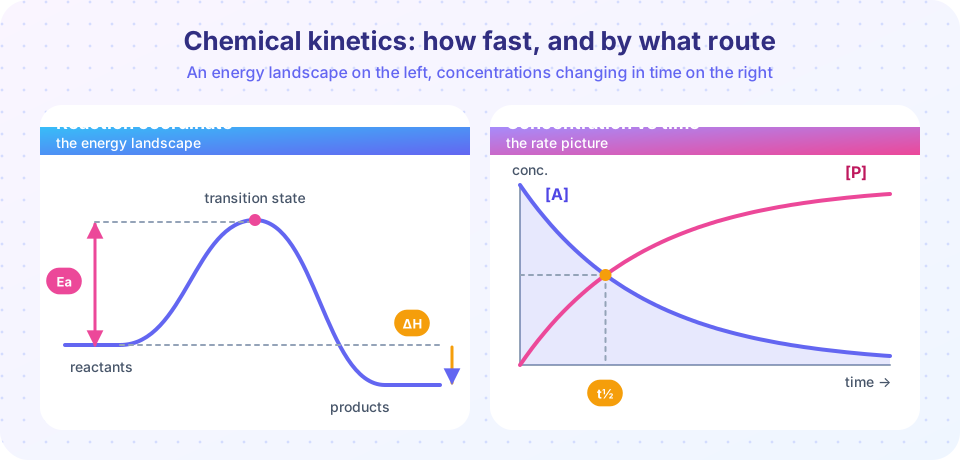
Thermodynamics, the subject of the earlier chapters, tells you where a reaction is allowed to go. Kinetics tells you how fast it gets there and by what route. Diamond is thermodynamically less stable than graphite at room pressure, yet a diamond ring lasts for generations, because the path from one to the other has an enormous barrier. A reaction can be very favorable on paper and still take a million years.
This chapter builds the tools chemists use to measure and explain speed: rate laws, integrated rate laws, the Arrhenius equation, transition-state ideas and mechanisms. Industry uses the same tools to design reactors, pharmacists to set expiry dates, and atmospheric scientists to predict how fast ozone is destroyed.
What you will learn
- Why kinetics and thermodynamics answer different questions
- How a reaction rate is defined and measured
- The roadmap for this chapter: rate laws, integrated laws, temperature, mechanisms
Key terms
Rate of reaction: the change in concentration of a reactant or product per unit time, divided by its stoichiometric coefficient.
Rate law: an equation, found by experiment, that links the rate to the concentrations of the species involved.
Activation energy (Ea): the minimum energy that must be supplied for reactants to turn into products.
Mechanism: the sequence of elementary steps by which a reaction really happens.
Chapter at a glance
Kinetics asks how fast
Favorable is not the same as fast.
Measure a rate
Rate = change in concentration per second.
Rate laws
Temperature
Mechanisms
What is a reaction rate?
Take the reaction 2 N₂O₅ → 4 NO₂ + O₂. N₂O₅ disappears twice as fast as O₂ appears, so if you quote "the rate" you must say which species you mean, or better, use one number that applies to the whole reaction. For aA + bB → cC + dD the rate of reaction is
rate = −(1/a) d[A]/dt = −(1/b) d[B]/dt = (1/c) d[C]/dt = (1/d) d[D]/dt
Dividing by the coefficient makes the rate the same whichever species you watch. The units are mol L⁻¹ s⁻¹ (M s⁻¹) for reactions in solution.
How do you measure concentration while the reaction is running? Any property that changes with composition will do: absorbance of light, pressure (for gas reactions that change the number of moles), electrical conductivity, optical rotation, or the pH. Fast reactions, finished in microseconds, need special methods such as flash photolysis and stopped-flow mixing.
Kinetics versus thermodynamics
| Question | Thermodynamics | Kinetics |
|---|---|---|
| Will it go? | ΔG < 0 means favorable | no answer |
| How far? | equilibrium constant K | no answer |
| How fast? | no answer | rate law, k, Ea |
| By what route? | no answer | mechanism |
| Effect of a catalyst | none on K | changes k |
A catalyst speeds up the forward and reverse reactions equally, so it never changes the equilibrium position. It only gets you there sooner.
What each lesson covers
- Rate laws and integrated rate laws: orders, rate constants, half-lives, the initial-rates method and straight-line plots.
- Temperature, Arrhenius and collision theory: activation energy, collision theory and the Eyring equation.
- Mechanisms and catalysis: elementary steps, the steady-state approximation and enzyme kinetics.
- Chapter review: a one-page picture, a recap table and a ten-question quiz.
Try it
A first-order decay is the simplest rate behavior of all. The code below shows the reactant concentration falling and the half-life staying constant, however far along the reaction is. It is a demonstration with an invented rate constant, not a measurement.
Press Run (or Ctrl + Enter) to see the result here.
Program input · what you'd type while the program runs
Type the answers before you press Run, one per line. Each time the program reads a line (with input()), it gets the next line from this box.
Check your understanding
Quick check · 4 questions
of 4 answered You scored / 4 · perfect!
-
1. A reaction has a large negative ΔG but takes years at room temperature. What does this show?
ΔG decides whether a reaction can go; the activation barrier decides how fast it does. -
2. For 2 N₂O₅ → 4 NO₂ + O₂, how does the rate of O₂ formation compare with the rate of N₂O₅ loss?
Two moles of N₂O₅ give one mole of O₂, so O₂ appears half as fast as N₂O₅ disappears. -
3. Which is NOT changed by adding a catalyst?
A catalyst offers a new path (new mechanism, new k) but leaves ΔG and so K unchanged. -
4. Which unit is typical for a reaction rate in solution?
Rate is concentration change per unit time.
Summary
- Kinetics studies rates and mechanisms; thermodynamics studies direction and extent.
- The reaction rate is defined so that it is the same for every species in the equation.
- Rate laws are measured, the Arrhenius equation gives the effect of temperature, and mechanisms explain both.
- Catalysts change speed, not equilibrium.
Track your progress
Create a free account to tick off lessons and pick up where you left off on any device.
of Physical Chemistry lessons completed