


















Lesson 39 of 49 · Spectroscopy
Chapter 7 Review: Spectroscopy
Review molecular spectroscopy on one page: rotational, infrared, UV-visible and NMR spectra, key equations, selection rules and a ten-question mixed quiz.
Four spectroscopies, four kinds of information. This review lines them up so that you can see what each one measures, what it needs from the molecule and how to extract numbers.
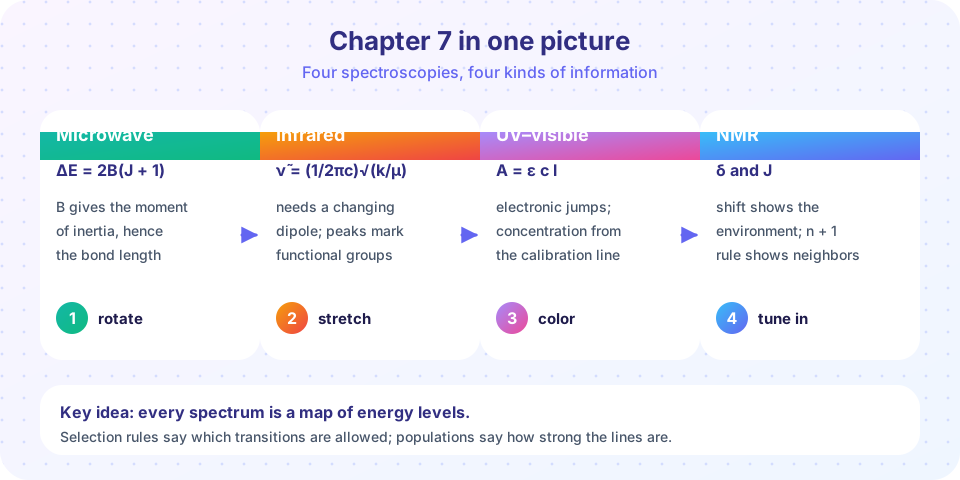
Recap table
| Technique | Transition | Requirement | Key equation | You learn |
|---|---|---|---|---|
| Microwave | rotation, ΔJ = ±1 | permanent dipole | ν̃ = 2B(J+1) |
bond length |
| Infrared | vibration, Δv = ±1 | changing dipole | ν̃ = (1/2πc)√(k/μ) |
force constant, functional groups |
| UV–visible | electronic | allowed transition dipole | A = εcl |
concentration, conjugation |
| NMR | nuclear spin flip | I ≠ 0 | ν = γB₀/2π, δ, n + 1 rule |
environment, connectivity |
Problem-solving checklist
- Convert units first. Everything is an energy:
E = hν = hcν̃. - Ask which selection rule applies. No dipole, no pure rotation or infrared absorption.
- Identify what the line spacing means. Rotation: 2B. Rovibrational gap: 4B. NMR coupling: J in Hz.
- Use populations for intensity. Boltzmann factors times degeneracy.
- Cross-check with order of magnitude. Rotation about 1–100 cm⁻¹, vibration 400–4000 cm⁻¹, electronic 10 000–50 000 cm⁻¹.
Try it
A mini infrared interpreter. Give it absorption wavenumbers and it lists the likely functional groups from the table in the lessons. It is a simple lookup, and real interpretation uses the whole spectrum.
Press Run (or Ctrl + Enter) to see the result here.
Program input · what you'd type while the program runs
Type the answers before you press Run, one per line. Each time the program reads a line (with input()), it gets the next line from this box.
Check your understanding
Quick check · 10 questions
of 10 answered You scored / 10 · perfect!
-
1. The line spacing in a pure rotational spectrum is 7.72 cm⁻¹. What is B?
Spacing = 2B, so B = 3.86 cm⁻¹. -
2. Which molecule is infrared active in its stretching vibration?
Only HCl's dipole moment changes as the bond stretches. -
3. A 400 nm photon corresponds to a wavenumber of
10⁷/400 = 25 000 cm⁻¹. -
4. Absorbance 0.30 corresponds to a transmittance of about
10^(−0.30) = 0.50. -
5. Doubling the concentration of an absorbing solution (Beer-Lambert holds) does what to absorbance?
A is proportional to c. -
6. In ¹H NMR, a quartet signal arises from a proton with how many equivalent neighbors?
n + 1 = 4 so n = 3. -
7. Which has the smallest energy gap?
Rotational gaps are of order 1–100 cm⁻¹. -
8. Why are the rotational lines of a gas not seen in a liquid?
Frequent collisions shorten rotational lifetimes and broaden lines. -
9. A new compound's IR spectrum has a strong band at 1710 cm⁻¹ and none above 3000. It most likely has
1710 cm⁻¹ is a carbonyl; no band near 3300 rules out O–H and N–H. -
10. The proton Larmor frequency at 14.1 T is about
42.577 MHz/T × 14.1 T ≈ 600 MHz.
Summary
- Rotation gives bond lengths, vibration gives force constants and groups, electronic spectra give concentrations and conjugation, NMR gives environments and connectivity.
- Selection rules decide visibility; Boltzmann populations and transition dipoles decide intensity.
- Unit conversions are half the battle:
E = hν = hcν̃.
Track your progress
Create a free account to tick off lessons and pick up where you left off on any device.
of Physical Chemistry lessons completed