


















Lesson 11 of 49 · Gases and Thermodynamics Review
Chapter 2 review: gases and thermodynamics
Review chapter 2: ideal and real gases, kinetic theory, the first law, enthalpy and Hess's law, with a recap table, key derivations and a ten-question quiz.
Chapter 2 gave you the working vocabulary of thermodynamics. You can now describe a gas with an equation of state, say how fast its molecules move, account for energy as heat and work, and predict the heat of a reaction from tables. This review pulls the pieces together.
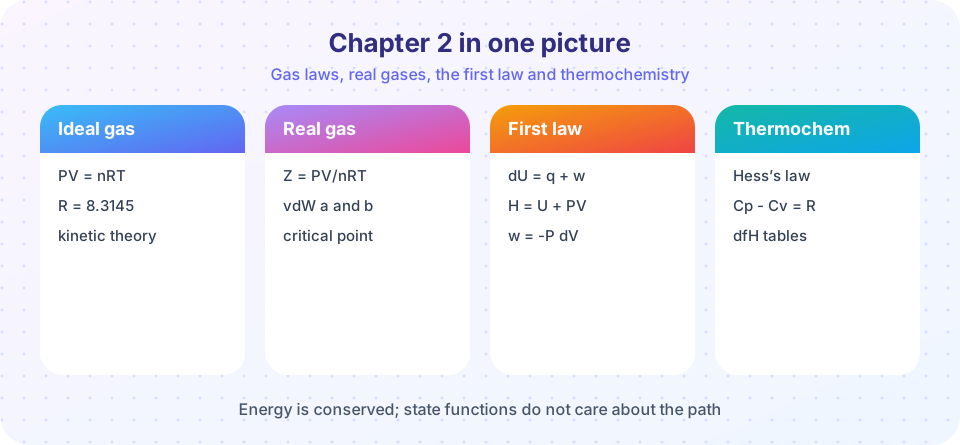
Chapter in a table
| Lesson | Key relations |
|---|---|
| Ideal gas and kinetic theory | PV = nRT; <ε> = (3/2)kT; c_rms = √(3RT/M) |
| Real gases | Z = PV_m/RT; (P + a n²/V²)(V - nb) = nRT; T_c = 8a/27Rb |
| First law | ΔU = q + w; w = -P_ext ΔV; H = U + PV; C_P - C_V = nR |
| Thermochemistry | ΔrH° = ΣνΔfH°; Hess; q = mcΔT; Kirchhoff |
Derivations to practice
- From
P V = (1/3) N m <c²>andPV = N kB T, obtain the average kinetic energy(3/2) kB T. - Show that
C_P,m - C_V,m = Rfor an ideal gas, starting fromH = U + PV. - Derive
w_rev = -nRT ln(V2/V1)for an isothermal reversible ideal gas expansion. - Find
V_c = 3bby setting(∂P/∂V) = 0and(∂²P/∂V²) = 0for the van der Waals equation. - Calculate
ΔrH°for the combustion of ethanol from formation enthalpies.
Common misconceptions
Mixing path and state functions. ΔU and ΔH depend only on the endpoints; q and w also on the path. Sign errors in w are the most common slip: expansion makes w negative in this convention.
Try it
First a self-check of five typical numbers from the chapter; predict each before running.
Press Run (or Ctrl + Enter) to see the result here.
Program input · what you'd type while the program runs
Type the answers before you press Run, one per line. Each time the program reads a line (with input()), it gets the next line from this box.
The second block draws a concept map of heat capacities against temperature for a diatomic gas, showing translational, rotational and vibrational contributions switching on. It is a schematic model (the steps are smoothed), not measured data.
Press Run (or Ctrl + Enter) to see the result here.
Program input · what you'd type while the program runs
Type the answers before you press Run, one per line. Each time the program reads a line (with input()), it gets the next line from this box.
Check your understanding
Quick check · 9 questions
of 9 answered You scored / 9 · perfect!
-
1. Which pair of variables is held fixed in the partial derivative that defines C_V?
C_V = (dU/dT) at constant volume. -
2. The average translational kinetic energy per molecule at 400 K is
It depends only on temperature. -
3. A compression factor of 1.08 at high pressure indicates
Z > 1 means the gas is harder to compress than ideal. -
4. A system does 350 J of work and loses 100 J of heat. ΔU is
q = -100, w = -350, so ΔU = -450 J. -
5. Free expansion of an ideal gas into a vacuum has
No external pressure means no work; with q = 0 the energy and temperature of an ideal gas stay constant. -
6. ΔH of a reaction in a coffee-cup calorimeter is found from
At constant pressure the heat equals ΔH. -
7. If a reaction has ΔrH° = -100 kJ/mol, what is ΔrH° of the reverse reaction?
Reversing flips the sign. -
8. For which gas is the van der Waals a smallest?
Helium atoms attract each other extremely weakly. -
9. Cp,m of a monatomic ideal gas is
C_V,m = 3/2 R and C_P,m = C_V,m + R = 5/2 R.
Summary
PV = nRT; kinetic theory gives(3/2)kTper molecule andc_rms = √(3RT/M).- Real gases: Z, virial and van der Waals; critical constants from
aandb. - First law
ΔU = q + w; reversible work is the maximum;H = U + PV,C_P - C_V = nR. - Thermochemistry: formation enthalpies, Hess's law, calorimetry, Kirchhoff.
- State functions ignore the path; heat and work do not.
Next: Chapter 3 overview: entropy, free energy and equilibrium
Track your progress
Create a free account to tick off lessons and pick up where you left off on any device.
of Physical Chemistry lessons completed