


















Lesson 6 of 49 · Gases and Thermodynamics Review
Chapter 2 overview: gases and thermodynamics
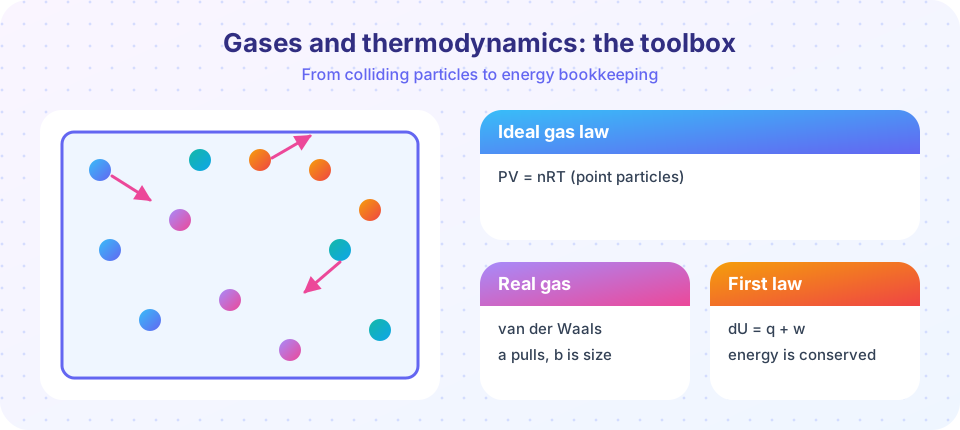
A tour of chapter 2: ideal and real gases, kinetic theory, the first law, enthalpy and thermochemistry, with a live gas simulation you can control.
Gases are where physical chemistry began. A gas is the simplest state of matter: molecules far apart, moving freely, interacting only in brief collisions. Because the molecules barely notice each other, a few simple laws describe almost every gas. That makes gases the ideal training ground for the ideas of thermodynamics: state functions, heat, work and energy conservation.
This chapter reviews those ideas and gives them the precision the rest of the course needs.
What you will learn
- How the lessons in this chapter fit together.
- The qualitative link between molecular motion, pressure and temperature.
- Why gases are the natural first system for thermodynamics.
- How to use a simulation to see Boyle's and Charles's laws emerge.
Key terms
Ideal gas: a gas of point molecules with no interactions; it obeys PV = nRT.
Pressure: force per unit area from molecular collisions with the walls.
Internal energy (U): the total energy of the molecules in the system (kinetic plus potential).
Enthalpy (H): H = U + PV; the heat absorbed at constant pressure equals ΔH.
Heat capacity: the heat needed to raise the temperature by one kelvin.
Ideal gases
Real gases
Energy
Thermochemistry
The big picture
Lesson 1: The ideal gas and kinetic theory. The experimental laws of Boyle, Charles and Avogadro combine into PV = nRT. Kinetic theory explains the law with molecules and shows that temperature is a measure of average molecular kinetic energy.
Lesson 2: Real gases and van der Waals. At high pressure or low temperature, attractions and molecular size matter. The compression factor measures the deviation, and the van der Waals equation captures it with two constants.
Lesson 3: Heat, work and the first law. Energy is conserved. We define heat, work, internal energy and enthalpy and calculate the work done by expanding gases.
Lesson 4: Thermochemistry and Hess's law. Heats of reaction from tables of formation enthalpies, and the idea that enthalpy changes add up along any path.
Lesson 5: Chapter review.
Why start with gases?
Three reasons. The equations are exact enough to do real calculations. The molecular picture is simple enough to derive pressure from collisions. And gases are the first place where you notice a theme that runs through the course: state functions (P, V, T, U, H) depend only on the current condition, while path functions (q, w) depend on how you got there.
Common misconceptions
"Gas molecules sit still until they are heated." They move at hundreds of meters per second at room temperature; heating raises the average.
"A gas fills the container because it is pushed." It fills the volume because molecules move randomly in all directions.
"Pressure is due to molecules pushing each other." It is due to molecules hitting the walls.
Try it
Watch pressure emerge from collisions. This html demo is a simplified two-dimensional model: molecules are dots that bounce off the walls of a box. It is a demonstration, not a calculation of real pressures. Move the sliders to change temperature and volume.
Now the quantitative version with PV = nRT. The block plots Boyle's law (P against V at three temperatures) and Charles's law (V against T).
Press Run (or Ctrl + Enter) to see the result here.
Program input · what you'd type while the program runs
Type the answers before you press Run, one per line. Each time the program reads a line (with input()), it gets the next line from this box.
Check your understanding
Quick check · 4 questions
of 4 answered You scored / 4 · perfect!
-
1. What produces gas pressure, in the molecular picture?
Pressure is the average force per area from wall collisions. -
2. Which is a path function?
Heat and work depend on the path; U, P, V, T, H are state functions. -
3. Enthalpy is defined as
H = U + PV. G = H - TS comes later. -
4. If you double the temperature at fixed volume, an ideal gas pressure
P = nRT/V is proportional to T at fixed V and n.
Summary
- Gases are the simplest matter and the best first system for thermodynamics.
- Pressure comes from molecular collisions; temperature measures average kinetic energy.
- Real gases need corrections for attraction and size.
- Energy is conserved:
dU = q + w; enthalpyH = U + PVtracks heat at constant pressure. - State functions do not depend on the path; q and w do.
Track your progress
Create a free account to tick off lessons and pick up where you left off on any device.
of Physical Chemistry lessons completed