


















Lesson 22 of 49 · Phase Equilibria and Solutions
Real solutions, activity and Henry's law
Understand deviations from Raoult's law, activity and activity coefficients, Henry's law for dissolved gases, azeotropes and the Debye-Hückel law for ionic solutions.
Raoult's law works beautifully for benzene and toluene and badly for almost everything else. Ethanol and water, acetone and chloroform, salt and water: all of these deviate, sometimes dramatically. Yet we want to keep the elegant thermodynamic framework of the previous lessons: K = exp(-ΔG°/RT), chemical potentials, colligative shifts.
The solution is to keep the form of the equations and put all the non-ideal behavior into a single correction factor. The corrected concentration is called the activity.
What you will learn
- The definition of activity and the activity coefficient.
- Henry's law and its use for dissolved gases.
- Positive and negative deviations, and azeotropes.
- How ionic strength changes activity coefficients (Debye-Hückel).
Key terms
Activity (a): effective concentration; μ = μ° + RT ln a.
Activity coefficient (γ): a = γ x (or γ c/c°); equals 1 for an ideal solution.
Henry's law: for a dilute solute, p_B = k_H x_B.
Azeotrope: a mixture whose vapor has the same composition as the liquid, so it cannot be separated by simple distillation.
Ionic strength (I): I = ½ Σ m_i z_i².
Activity
For an ideal solution μ_A = μ*_A + RT ln x_A. For a real one, replace x_A by the activity:
μ_A = μ*_A + RT ln a_A a_A = γ_A x_A
Activities are dimensionless. The activity coefficient γ measures how far the component departs from ideality: γ > 1 means molecules prefer to escape (positive deviation), γ < 1 means they are held (negative deviation).
Activity needs a defined standard state:
- Solvent (Raoult convention): the pure liquid, so
a_A → 1asx_A → 1, anda_A = p_A/P*_A. - Solute (Henry convention): a hypothetical ideal solution at the standard concentration (1 mol/kg or 1 mol/L), chosen so
γ_B → 1as the solution becomes infinitely dilute.
Equilibrium constants should use activities. In dilute solutions γ ≈ 1 and concentrations are fine; in concentrated or ionic solutions the correction matters.
Henry's law
William Henry (1803) found that the amount of gas dissolved in a liquid is proportional to the gas pressure above it. In terms of the solute mole fraction:
p_B = k_H x_B (dilute solute B)
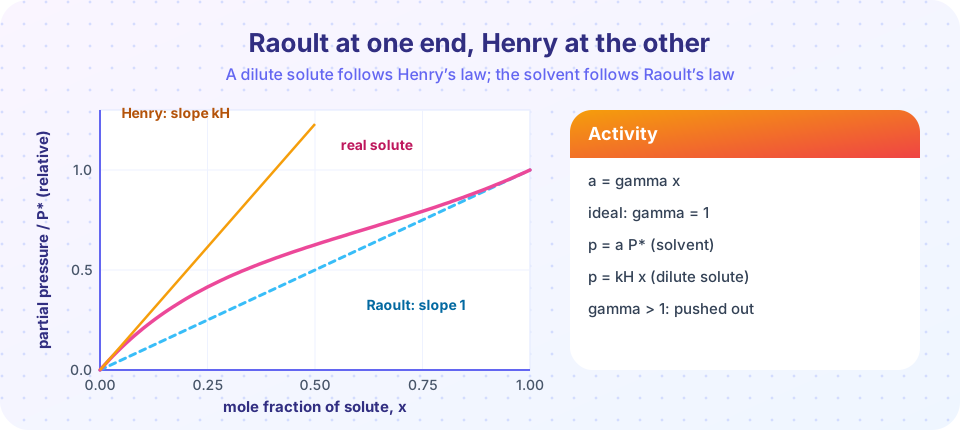
k_H depends on the gas, solvent and temperature, and is not the pure-substance vapor pressure. A real solute follows Henry's law with slope k_H near x_B = 0 and Raoult's law with slope P*_B near x_B = 1; the curve in the figure links them.
Approximate values for solubility in water at 25 °C (mole-fraction basis):
| Gas | k_H (bar) |
|---|---|
| N₂ | 8.6 x 10⁴ |
| O₂ | 4.4 x 10⁴ |
| CO₂ | 1.7 x 10³ |
A smaller k_H means a more soluble gas. CO₂ is about fifty times more soluble than N₂.
Worked example: carbonated water
A bottle is carbonated at 4.0 bar of CO₂: x = p/k_H = 4.0/1670 = 2.4 x 10⁻³. In 1 kg of water (55.5 mol), that is 0.13 mol of dissolved CO₂, about 5.9 g. Open the bottle: the CO₂ pressure over the liquid drops to about 0.0004 bar (air), the solution is supersaturated, and bubbles form. Henry's law also explains decompression sickness: divers breathing air at depth dissolve more nitrogen in blood, and if they surface too fast it comes out as bubbles.
Solubility falls as temperature rises for most gases, which is why warm soda goes flat faster and warm lakes hold less oxygen for fish.
Deviations from Raoult's law
Whether a mixture has γ > 1 or < 1 depends on how A-B attractions compare with A-A and B-B.
- Positive deviation (A-B weaker than A-A and B-B,
γ > 1): vapor pressures higher than ideal,Δ_mix H > 0, mixing is endothermic and entropy-driven. Examples: ethanol with hexane, acetone with carbon disulfide. - Negative deviation (A-B stronger,
γ < 1): vapor pressures lower,Δ_mix H < 0. Examples: acetone with chloroform (hydrogen bond between them), water with nitric acid.
A simple model is the regular solution: G^E = w x_A x_B, with the interaction parameter w positive for positive deviation. It gives ln γ_A = (w/RT) x_B².
If deviations are large enough, the total vapor pressure curve has a maximum (positive) or minimum (negative). At that point the vapor and liquid have the same composition, an azeotrope. Ethanol and water form a minimum-boiling azeotrope at about 89 mol % (95.6 % by mass) ethanol, boiling at 78.2 °C at 1 atm. Simple distillation therefore cannot give pure ethanol; production of "absolute" alcohol uses extra steps such as a molecular sieve.
Large positive deviation can even make the liquids separate into two phases (partial miscibility), such as hexane and nitrobenzene at room temperature.
Ionic solutions: Debye-Hückel
Ions interact over long distances, so electrolyte solutions are non-ideal even when dilute. Debye and Hückel (1923) explained that each ion is surrounded by an "ionic atmosphere" of opposite charge that stabilizes it. In water at 25 °C, at low ionic strength, the mean activity coefficient obeys the limiting law
log₁₀ γ± = -0.509 |z₊ z₋| √I
For 0.010 mol/kg NaCl: I = 0.010, log γ± = -0.509 x 1 x 0.100 = -0.0509, γ± = 0.89. For a 0.010 mol/kg solution of CaCl₂: I = 0.030, |z₊z₋| = 2, log γ± = -0.509 x 2 x 0.173 = -0.176, so γ± = 0.67. The law is accurate only below about 0.01 mol/kg; extended versions work to roughly 0.1 mol/kg. At high concentration γ± may even rise above 1.
Consequences: solubility of a sparingly soluble salt increases when you add an inert salt (the "salt effect"), and pH meters are calibrated in terms of hydrogen ion activity, pH = -log a(H⁺).
Common misconceptions
"Activity is just a fudge factor." It is a rigorous definition: μ = μ° + RT ln a holds always and the standard state is chosen carefully; the information about interactions lies in γ.
"Henry's constant is the vapor pressure of the pure gas." It is an empirical constant that depends on solute-solvent interactions.
"An azeotrope is a pure compound." It is a mixture with a fixed composition at a given pressure; changing pressure changes it.
"The Debye-Hückel limiting law works for any concentration." Only at very low ionic strength.
Try it
First, the regular-solution model: compute activities and partial pressures for different interaction parameters, and see the Henry's law slope P* exp(w/RT).
Press Run (or Ctrl + Enter) to see the result here.
Program input · what you'd type while the program runs
Type the answers before you press Run, one per line. Each time the program reads a line (with input()), it gets the next line from this box.
The next block plots the partial pressure of B against its mole fraction for three interaction strengths, with the Raoult line for comparison and the Henry tangent marked.
Press Run (or Ctrl + Enter) to see the result here.
Program input · what you'd type while the program runs
Type the answers before you press Run, one per line. Each time the program reads a line (with input()), it gets the next line from this box.
Check your understanding
Quick check · 5 questions
of 5 answered You scored / 5 · perfect!
-
1. A component has γ = 1.4. This means
γ > 1 means a higher escaping tendency than ideal, i.e. positive deviation. -
2. Which gas is the most soluble in water (kH in bar)?
The smaller k_H, the larger the solubility at a given pressure. -
3. At low solute concentration a real solute follows
p_B = k_H x_B for dilute solute; the solvent follows Raoult's law. -
4. What is I for 0.010 mol/kg CaCl2?
I = 1/2 (0.010 x 4 + 0.020 x 1) = 0.030. -
5. An azeotrope is a mixture that
Simple distillation cannot separate it.
Summary
- Activity
a = γ xrestoresμ = μ° + RT ln afor real solutions;γcarries the non-ideality. - Solvent: Raoult standard state. Solute: Henry convention,
γ → 1at infinite dilution. - Henry's law
p = k_H x; smallerk_Hmeans higher solubility; solubility generally falls with T. - Positive and negative deviations come from the relative strength of A-B interactions; large ones produce azeotropes.
- Debye-Hückel:
log γ± = -0.509|z₊z₋|√Ifor dilute aqueous solutions at 25 °C.
Next: Chapter 4 review
Track your progress
Create a free account to tick off lessons and pick up where you left off on any device.
of Physical Chemistry lessons completed