


















Lesson 35 of 49 · Spectroscopy
Chapter 7 Overview: Light Meets Molecules
A map of molecular spectroscopy: what microwave, infrared, UV-visible, NMR and X-ray radiation reveal, how to convert between wavelength, wavenumber and energy, and what selection rules mean.
The previous chapter ended with energy levels. Spectroscopy is how we see them. A molecule absorbs a photon only when the photon's energy exactly equals the gap between two levels, so recording which wavelengths are absorbed or emitted gives a fingerprint of the molecule. That fingerprint reveals bond lengths to a hundredth of an angstrom, bond stiffness, the presence of functional groups, concentrations and even the 3D structure of proteins.
This chapter treats four spectroscopies in turn, each tied to a type of energy gap: rotation, vibration, electronic excitation and nuclear spin.
What you will learn
- Which region of the spectrum excites rotation, vibration, electronic transitions and nuclear spins
- How to convert between wavelength, frequency, wavenumber and energy
- What a selection rule is, and what makes a line strong or weak
- How a spectrometer is built
Key terms
Wavenumber (ν̃): the number of waves per centimeter, ν̃ = 1/λ, in cm⁻¹; proportional to energy.
Selection rule: a statement about which transitions are allowed; it comes from symmetry and the conservation of angular momentum.
Transition dipole: the quantity whose square sets how strongly a transition couples to light.
Resonance condition: ΔE = hν: the photon energy must match the gap.
Chapter at a glance
Match the photon
Absorption needs an exact match.
Rotation
Vibration
Electrons
Nuclei
The spectrum and the molecule
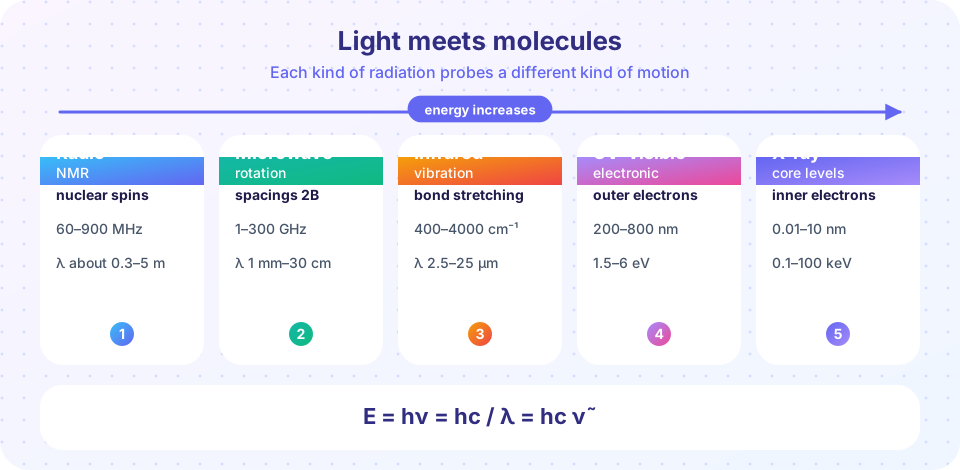
The five regions in the picture are a ladder of energy scales:
| Region | Typical photon energy | Process |
|---|---|---|
| Radio (NMR) | about 10⁻⁶ eV (100–900 MHz) | flip a nuclear spin in a magnetic field |
| Microwave | about 10⁻⁵ to 10⁻³ eV | change the rotational state |
| Infrared | 0.05 to 0.5 eV | change the vibrational state |
| Visible / UV | 1.5 to 6 eV | promote an outer electron |
| X-ray | 0.1 to 100 keV | eject or promote an inner electron |
At room temperature kT = 0.0257 eV (207 cm⁻¹). Rotational gaps are smaller than kT, so many rotational levels are populated; vibrational gaps are much larger than kT, so molecules sit in v = 0; electronic gaps are far larger still.
Units: a spectroscopist's survival kit
Spectroscopists mix units: nanometers for UV–visible, wavenumbers for infrared, hertz for microwave and NMR, electronvolts for X-rays. All are measures of energy:
E = hν = hc/λ = hc ν̃
| To convert | Rule |
|---|---|
| wavelength to wavenumber | ν̃ (cm⁻¹) = 10⁷ / λ (nm) |
| wavenumber to energy | 1 cm⁻¹ = 11.963 J mol⁻¹ = 1.2398×10⁻⁴ eV |
| wavenumber to frequency | 1 cm⁻¹ = 29.979 GHz |
| wavelength to energy | E (eV) = 1239.84 / λ (nm) |
Example: a 500 nm photon has ν̃ = 10⁷/500 = 20 000 cm⁻¹, E = 1239.84/500 = 2.48 eV, ν = 600 THz and, per mole, E = 239 kJ mol⁻¹. That is large enough to break weak chemical bonds.
Selection rules and intensities
Not every gap shows up. A gross selection rule says whether a transition can occur at all:
- Pure rotation requires a permanent dipole moment (HCl yes, N₂ no).
- Infrared absorption requires the dipole moment to change during the vibration (CO₂'s asymmetric stretch yes, N₂ no).
- Electronic and NMR transitions have their own rules, covered later.
A specific selection rule limits the change in the quantum number, such as ΔJ = ±1 for rotation and Δv = ±1 for a harmonic oscillator. Intensity depends on the transition dipole squared and on the population of the starting level, which is why strong rotational lines occur near J_max.
Raman spectroscopy follows a different gross rule (the polarizability must change), so it sees vibrations that infrared misses, such as the N≡N stretch.
Line widths and resolution
Lines are never infinitely sharp. Natural broadening (finite excited-state lifetime), Doppler broadening (random thermal motion shifting the frequency) and pressure broadening (collisions) all add width. In solution, collisions blur everything so strongly that rotational structure vanishes, which is why gas-phase spectra look richer.
How a spectrometer works
Every instrument has a source, something to select a wavelength (a prism, grating or interferometer), a sample, and a detector. Fourier-transform instruments, used for infrared and NMR, collect all frequencies at once and then compute the spectrum with a Fourier transform. This gives better signal-to-noise per unit time (the Fellgett advantage).
What each lesson covers
- Rotational and vibrational spectroscopy
- UV-visible spectroscopy and the Beer-Lambert law
- NMR spectroscopy
- Chapter review
Try it
First, a conversion tool between all the units. Type a value in any one unit (edit the numbers at the top) and print the others.
Press Run (or Ctrl + Enter) to see the result here.
Program input · what you'd type while the program runs
Type the answers before you press Run, one per line. Each time the program reads a line (with input()), it gets the next line from this box.
Second, an interactive explorer. Slide across wavelengths and see the energy, the region and what a photon of that size does to a molecule.
Check your understanding
Quick check · 5 questions
of 5 answered You scored / 5 · perfect!
-
1. Which region of the spectrum mainly excites molecular vibrations?
Vibrational quanta are 0.05–0.5 eV, in the infrared. -
2. A photon has wavelength 2500 nm. What is its wavenumber?
10⁷/2500 = 4000 cm⁻¹. -
3. Which molecule shows a pure rotational microwave spectrum?
CO has a permanent dipole; homonuclear diatomics do not. -
4. At room temperature, why are almost all molecules in v = 0?
ħω of hundreds to thousands of cm⁻¹ exceeds kT ≈ 207 cm⁻¹ by a wide margin. -
5. Which technique needs a change in polarizability instead of dipole moment?
Raman scattering depends on polarizability.
Summary
- Spectroscopy measures energy gaps through the resonance condition
ΔE = hν. - Microwave probes rotation, infrared vibration, UV–visible electrons, radio waves nuclear spins.
- Wavelength, wavenumber, frequency and energy are interchangeable; memorize
10⁷/λ(nm)and1239.84/λ(nm). - Selection rules decide which transitions are visible; populations and transition dipoles decide how strong they are.
Track your progress
Create a free account to tick off lessons and pick up where you left off on any device.
of Physical Chemistry lessons completed