


















Lesson 14 of 49 · Entropy, Free Energy and Equilibrium
Gibbs free energy and spontaneity
Derive the Gibbs energy from the second law, learn the four sign cases of ΔH and ΔS, calculate ΔrG from tables and find the temperature at which a reaction turns around.
Chemists rarely work with isolated systems. They work in flasks open to the air, at constant temperature and pressure, where the surroundings can absorb or supply heat. Testing the total entropy change of system plus surroundings is correct but clumsy. Gibbs found a way to hide the surroundings and keep a criterion that uses only properties of the system.
The result, the Gibbs energy, is probably the most useful quantity in chemical thermodynamics.
What you will learn
- How
ΔG = ΔH - TΔSfollows from the second law. - The four sign cases and the crossover temperature.
- How to calculate
ΔrG°from tables ofΔfG°or fromΔrH°andΔrS°. - What the Gibbs energy means as available work and through its derivatives.
Key terms
Gibbs energy (G): G = H - TS; a state function in joules.
ΔfG°: the standard Gibbs energy of formation, defined like ΔfH° (zero for elements).
Spontaneous: at constant T and P, ΔG < 0.
Crossover temperature: the temperature T = ΔH/ΔS at which ΔG changes sign (when both are of the same sign).
Non-expansion work: useful work other than P ΔV, such as electrical work; ΔG gives its maximum.
Deriving the Gibbs energy
At constant T and P the heat the surroundings receive is -ΔH (what the system gives up), so ΔS_surr = -ΔH/T. The second law requires
ΔS_total = ΔS - ΔH/T ≥ 0
Multiply by -T (reversing the inequality):
ΔH - TΔS ≤ 0
Define G = H - TS. At constant temperature ΔG = ΔH - TΔS, and the criterion becomes
ΔG < 0 spontaneous ΔG = 0 equilibrium ΔG > 0 non-spontaneous (reverse is spontaneous)
All the information about the surroundings has gone into the -TΔS term. The system is said to "minimize its Gibbs energy" at constant T and P, much as a ball rolls downhill to minimize potential energy.
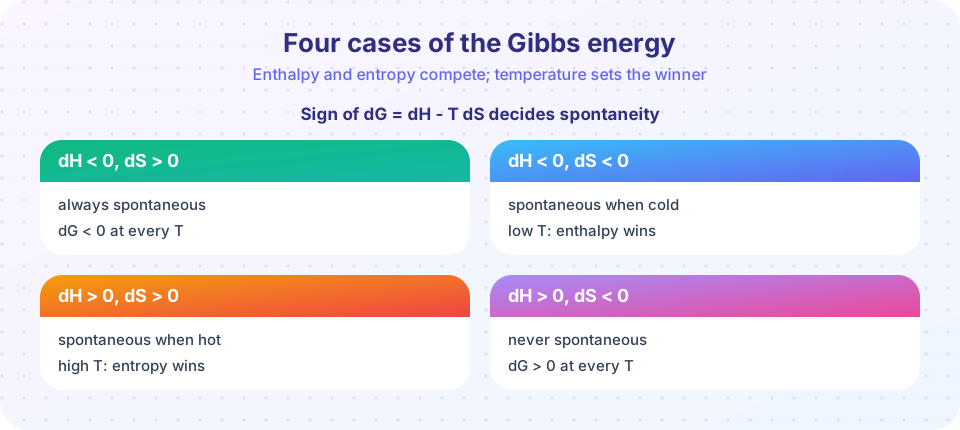
The four cases
| ΔH | ΔS | ΔG = ΔH - TΔS | Spontaneous? | Example |
|---|---|---|---|---|
| - | + | always negative | at every T | combustion of fuels |
| - | - | negative at low T | when cold | freezing; Haber synthesis |
| + | + | negative at high T | when hot | melting; CaCO₃ decomposition |
| + | - | always positive | never | making ozone from O₂ at room T |
In the two middle cases, ΔG changes sign at T = ΔH/ΔS.
Worked example: ammonia synthesis
N₂ + 3H₂ → 2NH₃: ΔrH° = -91.8 kJ, ΔrS° = -198.1 J/K (from the previous lesson).
At 298 K: ΔrG° = -91.8 - 298 x (-0.1981) = -91.8 + 59.0 = -32.8 kJ. Favorable (and indeed 2 x ΔfG°(NH₃) = -32.8).
Crossover: T = ΔH/ΔS = -91.8/-0.1981 = 463 K. Above about 460 K the standard Gibbs energy is positive. Industry runs the process near 700 K and 200 bar anyway, because the reaction is too slow when cold; pressure and recycling make up for the lower equilibrium yield. This tension between thermodynamics and kinetics is a core theme.
Worked example: limestone
CaCO₃(s) → CaO(s) + CO₂(g): ΔrH° = +178.3 kJ, ΔrS° = +160.5 J/K. At 298 K: ΔG = 178.3 - 298 x 0.1605 = 130.5 kJ (not spontaneous). T = 178.3/0.1605 = 1111 K (about 840 °C). That is why lime kilns run hot.
(These calculations assume ΔH and ΔS are independent of temperature, a good first approximation over a few hundred kelvin.)
Standard Gibbs energies of formation
Like enthalpies, Gibbs energies can be tabulated and combined:
ΔrG° = Σν ΔfG°(products) - Σν ΔfG°(reactants)
| Substance | ΔfG° (kJ/mol, 298 K) |
|---|---|
| CO₂(g) | -394.4 |
| H₂O(l) | -237.1 |
| H₂O(g) | -228.6 |
| CH₄(g) | -50.5 |
| CO(g) | -137.2 |
| NH₃(g) | -16.4 |
| C₆H₁₂O₆(s) | -910.4 |
For methane combustion to liquid water: -394.4 + 2(-237.1) - (-50.5) = -818.1 kJ/mol. The ΔG is a little less negative than ΔH (-890.5) because the reaction decreases the entropy slightly.
Meaning of the Gibbs energy
- Maximum non-expansion work. At constant T and P,
w_non-exp,max = ΔG. A fuel cell extracting electrical work from hydrogen and oxygen can deliver at mostΔG, notΔH. For hydrogen at 298 K producing liquid water:ΔG = -237 kJ/molagainstΔH = -286 kJ/mol, so the ideal efficiency is237/286 = 83 %. - Coupling. An unfavorable reaction (
ΔG > 0) can be driven by a favorable one if the sum is negative. Cells couple ATP hydrolysis (about -30 kJ/mol under standard biochemical conditions) to reactions that need energy. - Temperature and pressure dependence. From
dG = V dP - S dT:(∂G/∂T)_P = -Sand(∂G/∂P)_T = V. A higher entropy means G falls faster with temperature; this is why gases, with largeS, become the stable phase at high T. The same relations lead to the Gibbs-Helmholtz equation,(∂(G/T)/∂T)_P = -H/T², which we use for equilibria. - Chemical potential. For a pure substance
μ = G_m. We useμin later chapters for phase and solution equilibria.
Common misconceptions
"ΔG < 0 means the reaction is fast." It says nothing about rate.
"ΔG = 0 means nothing happens." It means no net change: forward and backward rates balance.
"ΔG° tells whether a reaction occurs under any conditions." ΔG° is for standard conditions (every species at standard state). Actual conditions need ΔG = ΔG° + RT ln Q (next lesson).
"Free energy is free." It is the energy available to do useful work, not energy for nothing.
Try it
A solver for crossover temperatures and the sign of ΔG at chosen temperatures.
Press Run (or Ctrl + Enter) to see the result here.
Program input · what you'd type while the program runs
Type the answers before you press Run, one per line. Each time the program reads a line (with input()), it gets the next line from this box.
The next block plots ΔG(T) for the four sign types. The lines are straight because we assume constant ΔH and ΔS; the slope is -ΔS, the intercept ΔH.
Press Run (or Ctrl + Enter) to see the result here.
Program input · what you'd type while the program runs
Type the answers before you press Run, one per line. Each time the program reads a line (with input()), it gets the next line from this box.
Check your understanding
Quick check · 5 questions
of 5 answered You scored / 5 · perfect!
-
1. A reaction has ΔH = +40 kJ and ΔS = +100 J/K. Above which temperature is it spontaneous?
T = ΔH/ΔS = 40000/100 = 400 K. -
2. Which sign combination is spontaneous at every temperature?
Both terms make ΔG negative: ΔG = ΔH - TΔS < 0 for all T. -
3. At constant T and P, the maximum non-expansion work equals
ΔG is the maximum useful non-expansion work. -
4. (∂G/∂T) at constant P equals
From dG = V dP - S dT. -
5. A reaction has ΔG° = -20 kJ/mol. This means it
ΔG° < 0 gives thermodynamic favorability under standard conditions, nothing about rate.
Summary
- At constant T and P:
ΔG = ΔH - TΔS;ΔG < 0spontaneous,ΔG = 0equilibrium. - Four sign cases; crossover
T = ΔH/ΔSwhen signs agree. ΔrG° = ΣνΔfG°(products) - ΣνΔfG°(reactants).ΔGis the maximum non-expansion work;dG = V dP - S dT.- Favorable does not mean fast.
Next: The equilibrium constant
Track your progress
Create a free account to tick off lessons and pick up where you left off on any device.
of Physical Chemistry lessons completed