


















Lesson 18 of 49 · Phase Equilibria and Solutions
Chapter 4 overview: phase equilibria and solutions
Preview chapter 4: phases, phase diagrams, vapor pressure, ideal and real solutions and colligative properties, with an interactive particle model of solid, liquid and gas.
Ice floats in water, water boils faster on a stove than on a mountain top, and salted roads do not freeze at 0 °C. Each of these facts is a statement about phase equilibria: when two or more phases of matter coexist, what decides their temperature, pressure and composition?
The answer comes from the same principle as chemical equilibrium. A system at constant temperature and pressure minimizes its Gibbs energy, and between phases that means each component has the same chemical potential everywhere.
What you will learn
- The vocabulary of phases, components and degrees of freedom.
- How the lessons of this chapter build on one another.
- Why the Gibbs energy decides which phase is stable.
- A first calculation of how boiling point changes with pressure.
Key terms
Phase: a region of uniform composition and properties, separated from others by a boundary.
Component: a chemically independent constituent of the system.
Vapor pressure: the pressure of vapor in equilibrium with its liquid or solid at a given temperature.
Chemical potential (μ): the Gibbs energy per mole of a component in a given phase, μ = (∂G/∂n)_{T,P}.
Solution: a homogeneous mixture; the major component is the solvent, the minor ones are solutes.
Phases
Phase diagrams
Solutions
The lessons in this chapter
Phase diagrams and the Clapeyron equation. Reading a pressure-temperature diagram, the phase rule F = C - P + 2, and the Clapeyron and Clausius-Clapeyron equations that give the slopes of the boundary lines.
Ideal solutions and Raoult's law. Vapor pressures of mixtures, the chemical potential of an ideal solution, and the thermodynamics of mixing.
Colligative properties. Vapor pressure lowering, boiling point elevation, freezing point depression and osmosis, all of which depend on how many solute particles there are, not what they are.
Real solutions, activity and Henry's law. Deviations from ideality, activity coefficients and the limiting laws at both ends of the composition range.
The central idea
If a substance can be in two phases α and β that are in contact, it will move from the phase where its chemical potential is higher to the one where it is lower. At equilibrium
μ(α) = μ(β)
for every component. All the results in this chapter, from the slope of a boiling line to the freezing point of seawater, follow from that single equation.
Common misconceptions
"A liquid only evaporates at its boiling point." Liquids evaporate at any temperature; boiling is when the vapor pressure equals the external pressure.
"Boiling means a fixed temperature." The boiling point depends on pressure: lower on a mountain, higher in a pressure cooker.
"A mixture has the average properties of its components." Only an ideal solution behaves so simply; real ones deviate.
Try it
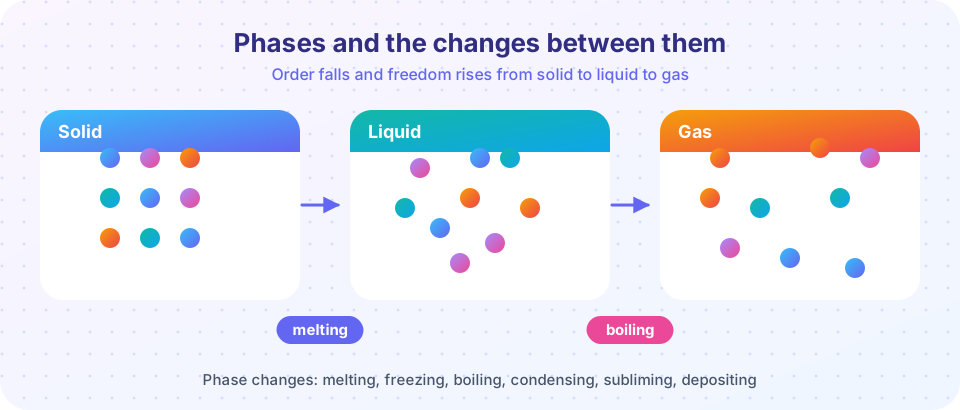
A particle model of the three states. This html demo is a qualitative illustration, not a simulation of a real substance: temperature controls how violently the particles jiggle around their sites, and above set thresholds the "bonds" fail. Drag the slider and watch the picture change from solid to liquid to gas.
Now a calculation: how the boiling point of water depends on pressure, using the constant-enthalpy Clausius-Clapeyron equation. It uses ΔvapH = 40.66 kJ/mol and the normal boiling point of 373.15 K.
Press Run (or Ctrl + Enter) to see the result here.
Program input · what you'd type while the program runs
Type the answers before you press Run, one per line. Each time the program reads a line (with input()), it gets the next line from this box.
Check your understanding
Quick check · 4 questions
of 4 answered You scored / 4 · perfect!
-
1. At equilibrium between two phases, each component has
μ(α) = μ(β) for every component; concentrations may differ. -
2. A liquid boils when
Bubbles of vapor can form once the vapor pressure matches the surrounding pressure. -
3. Why does water boil at a lower temperature on a mountain?
Lower external pressure means the vapor pressure equals it at a lower temperature. -
4. A colligative property depends on
Colligative properties count particles, whatever they are.
Summary
- A phase is a uniform region; phases coexist where chemical potentials match.
- Phase diagrams map the stable phase as a function of T and P.
- Solutions: ideal behavior (Raoult), then real behavior (activity).
- Boiling occurs when vapor pressure equals external pressure, so it varies with altitude.
- Colligative properties depend on particle count.
Track your progress
Create a free account to tick off lessons and pick up where you left off on any device.
of Physical Chemistry lessons completed