


















Lesson 38 of 49 · Spectroscopy
NMR Spectroscopy: Spins, Shifts and Splitting
Learn how nuclear magnetic resonance works: spin levels in a magnetic field, the Larmor frequency, chemical shift in ppm, the n+1 rule for splitting, integration and why NMR is so insensitive.
Place a sample in a strong magnet and listen to the radio waves it absorbs. That is nuclear magnetic resonance (NMR), and it is the most powerful tool for working out the structure of organic molecules. Each ¹H or ¹³C nucleus in a molecule sits in its own electronic neighborhood and resonates at a slightly different frequency, so a spectrum shows how many kinds of hydrogen there are, what they are bonded to, and which neighbors they have. The same physics, with spatial encoding added, is the basis of MRI scanners.
What you will learn
- Explain nuclear spin levels and compute the Larmor frequency
- Define chemical shift in ppm and interpret typical values
- Predict splitting patterns with the n + 1 rule and Pascal's triangle
- Use integration to count hydrogens
- Explain why NMR is intrinsically insensitive and how that is overcome
Key terms
Nuclear spin (I): an intrinsic angular momentum of the nucleus; ¹H, ¹³C, ¹⁹F and ³¹P have I = ½, while ¹²C and ¹⁶O have I = 0 and are NMR silent.
Larmor frequency: the resonance frequency ν = γB₀/2π, where γ is the magnetogyric ratio.
Chemical shift (δ): the position of a signal relative to a reference, in ppm.
Spin–spin coupling (J): splitting of a signal by neighboring nuclei, measured in Hz and independent of field strength.
Spin levels in a magnetic field
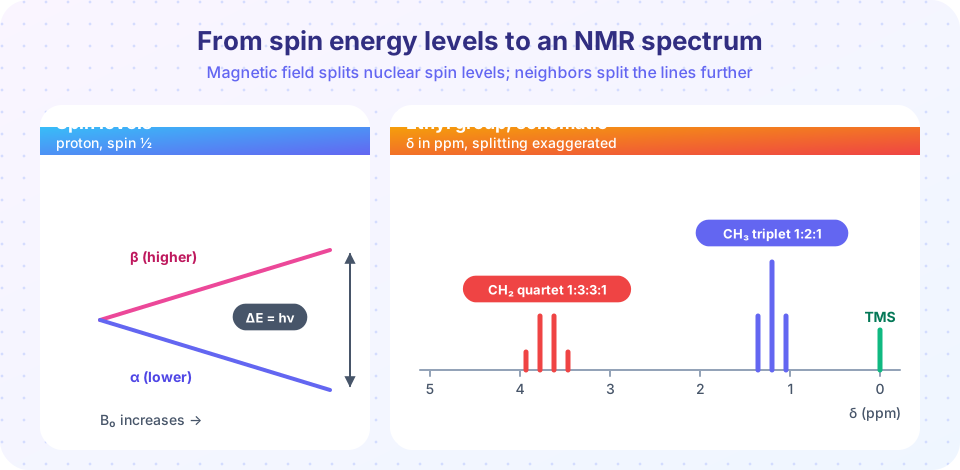
A nucleus with spin ½ has two states with magnetic quantum number m = +½ and −½. In zero field they have equal energy. In a field B₀ they split:
ΔE = γħB₀ = hν, ν = (γ / 2π) B₀
For ¹H, γ/2π = 42.577 MHz T⁻¹. In a 7.05 tesla magnet the proton resonates at 300 MHz; at 11.7 T (a "500") it resonates at 500 MHz. For ¹³C, γ/2π = 10.708 MHz T⁻¹, so a 7.05 T magnet runs ¹³C at 75.5 MHz.
The α state (aligned, m = +½) is slightly lower in energy and slightly more populated. The population difference is ΔN/N ≈ hν / 2kT, which for protons at 300 MHz and 298 K is only about 2.4 × 10⁻⁵, around 24 excess spins per million. This is why NMR is insensitive compared with UV–visible spectroscopy: only a tiny excess of spins absorb net energy. Stronger magnets, more scans (signal grows with the square root of the number of scans) and pulsed Fourier-transform methods are the remedies.
Chemical shift
Electrons circulating around a nucleus produce a small field opposing B₀, which shields the nucleus. A nucleus in an electron-rich environment feels less field and resonates at lower frequency; one next to an electronegative atom (low electron density) is deshielded and resonates at higher frequency. To compare spectra from different magnets, positions are measured relative to a reference compound, tetramethylsilane (TMS, defined as 0):
δ (ppm) = (ν − ν_ref) / ν_ref × 10⁶
At 300 MHz, 1 ppm equals 300 Hz; at 500 MHz it equals 500 Hz. Typical ¹H shifts:
| Environment | δ (ppm) |
|---|---|
| alkyl C–H | 0.8–1.7 |
| H–C–N, H–C–C=O | 2.0–3.0 |
| H–C–O | 3.3–4.2 |
| alkene H | 4.5–6.5 |
| aromatic H | 6.5–8.5 |
| aldehyde H | 9–10 |
| carboxylic acid O–H | 10–13 (broad) |
Chemical shift in ppm is the same at every field. The advantage of a high-field magnet is dispersion: signals that overlap at 60 MHz spread apart at 800 MHz, because the shift in Hz grows with field while coupling does not.
Spin–spin coupling and the n + 1 rule
Neighboring protons feel each other through the bonding electrons. A proton with n equivalent neighbors on adjacent atoms is split into n + 1 lines, with relative intensities given by Pascal's triangle:
| Neighbors n | Pattern | Name | Intensities |
|---|---|---|---|
| 0 | 1 line | singlet | 1 |
| 1 | 2 lines | doublet | 1 : 1 |
| 2 | 3 lines | triplet | 1 : 2 : 1 |
| 3 | 4 lines | quartet | 1 : 3 : 3 : 1 |
The distance between lines is the coupling constant J in Hz. A typical value for protons on adjacent sp³ carbons is 6–8 Hz. Coupling is mutual: if the CH₂ sees three neighbors and splits into a quartet, the CH₃ sees two and splits into a triplet, with the same J. Hydrogens on the same carbon, or that are chemically equivalent, do not split each other.
Worked example: ethanol, CH₃CH₂OH
- The CH₃ group (3 H) has two neighbors on the CH₂, so it appears as a triplet near 1.2 ppm.
- The CH₂ group (2 H) has three neighbors on the CH₃, so it appears as a quartet near 3.7 ppm, shifted downfield by the oxygen.
- The O–H proton usually appears as a broad singlet, because it exchanges rapidly with other molecules and does not couple visibly; its position depends on concentration and solvent.
The areas under the signals, found by integration, are in the ratio of the number of hydrogens: 3 : 2 : 1. Integration tells you how many hydrogens of each type there are, and the shift and splitting say what they are attached to.
Carbon-13 NMR and relaxation
Only 1.1 % of carbon atoms are ¹³C, so ¹³C spectra are weak and need many scans. They are normally recorded with proton decoupling, which collapses every multiplet to a single line: one line per unique carbon, spread over about 0 to 220 ppm. After a radio-frequency pulse, spins return to equilibrium by relaxation, with time constants T₁ (recovery along the field) and T₂ (loss of phase coherence). These times set how fast a spectrum can be repeated and how sharp the lines are, and they provide the contrast in MRI.
Common misconceptions
"Coupling constants get bigger at higher field." J, in Hz, does not depend on B₀. Only the shift in Hz grows.
"A triplet means three different hydrogens." It means the observed proton has two equivalent neighbors.
"NMR is insensitive because radio waves are weak." The limiting factor is the tiny excess population of the lower spin state.
Try it
First, the numbers behind the instrument: Larmor frequencies at several fields, the thermal population difference, and the conversion between ppm and Hz.
Press Run (or Ctrl + Enter) to see the result here.
Program input · what you'd type while the program runs
Type the answers before you press Run, one per line. Each time the program reads a line (with input()), it gets the next line from this box.
Second, simulate the first-order spectrum of an ethyl group at 300 MHz using Pascal's triangle, in three panels: the whole spectrum, and zooms on the quartet and the triplet. The positions and J are typical values for ethanol (not a measured spectrum), and the OH signal is left out.
Press Run (or Ctrl + Enter) to see the result here.
Program input · what you'd type while the program runs
Type the answers before you press Run, one per line. Each time the program reads a line (with input()), it gets the next line from this box.
Check your understanding
Quick check · 5 questions
of 5 answered You scored / 5 · perfect!
-
1. The proton Larmor frequency in a 9.4 T magnet is closest to
42.577 MHz/T × 9.4 T = 400 MHz. -
2. A signal split into a triplet has how many neighboring equivalent hydrogens?
n + 1 = 3 gives n = 2. -
3. Which proton is most deshielded (highest δ)?
Aldehyde protons resonate near 9–10 ppm. -
4. Going from a 300 MHz to a 600 MHz spectrometer, the coupling constant J (in Hz)
J is a property of the molecule, independent of B₀. -
5. Why is NMR relatively insensitive?
The excess of spins in the lower state is only about 10⁻⁵.
Summary
ν = (γ/2π) B₀: a 7.05 T magnet runs ¹H at 300 MHz.- Chemical shift
δ = (ν − ν_ref)/ν_ref × 10⁶measures the electronic environment; electronegative neighbors deshield. - n equivalent neighbors split a signal into n + 1 lines (Pascal's triangle), with J in Hz independent of field.
- Integration counts hydrogens; NMR sensitivity is limited by the small spin population difference.
Next: Chapter review
Track your progress
Create a free account to tick off lessons and pick up where you left off on any device.
of Physical Chemistry lessons completed