


















Lesson 40 of 49 · Statistical Thermodynamics and Surfaces
Chapter 8 Overview: From Molecules to Matter
How statistical thermodynamics links molecular energy levels to bulk properties: microstates, S = k ln W, the Boltzmann distribution and a roadmap for the chapter on partition functions and surfaces.
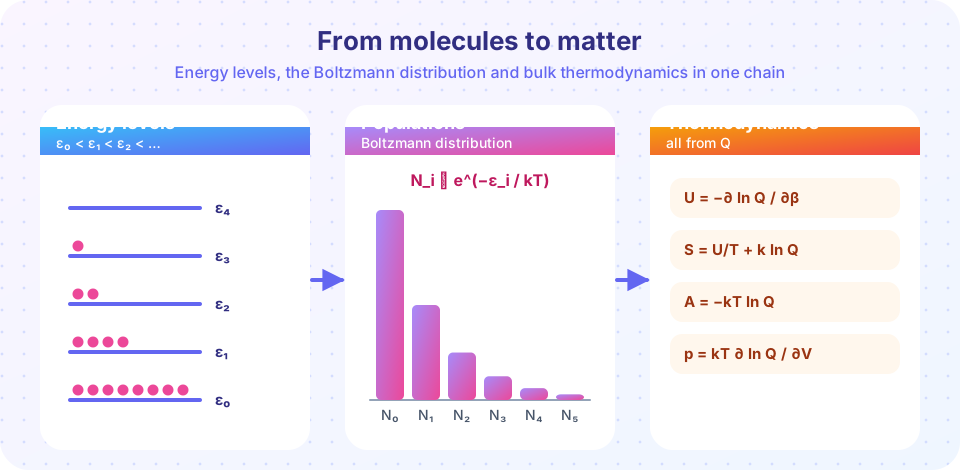
A glass of water holds about 10²⁴ molecules. Nobody can track them one by one, and nobody needs to. Statistical thermodynamics shows that the familiar quantities of thermodynamics, internal energy, entropy, free energy and pressure, are averages over the quantum states of huge numbers of molecules. The bridge between the two worlds is a single function, the partition function, built from the energy levels that quantum mechanics (Chapter 6) and spectroscopy (Chapter 7) provide.
This is the payoff of the whole course. It explains why heat flows from hot to cold, why entropy exists, why heat capacities depend on temperature, and it lets you calculate thermodynamic data from spectroscopic constants without ever running a calorimeter.
What you will learn
- The difference between a microstate and a macrostate
- Boltzmann's entropy formula
S = k ln W - Why the most probable distribution is the Boltzmann distribution
- Why large numbers of molecules make averages sharp
Key terms
Microstate: one complete specification of the quantum state of every molecule in the system.
Macrostate: a description by bulk variables such as N, V and T. Many microstates belong to one macrostate.
Statistical weight (W): the number of microstates consistent with a macrostate.
Boltzmann constant (k): 1.380649 × 10⁻²³ J K⁻¹, the gas constant per molecule, k = R/N_A.
Chapter at a glance
Many microstates
One macrostate, huge numbers of microstates.
Entropy
Boltzmann
Partition function
Surfaces
Counting microstates
Imagine four molecules, each of which can be in one of two states. There is exactly one way to put all four in the lower state, but six ways to put two in each (choose which two). The macrostate with two in each is six times more probable simply because more arrangements produce it. With 100 molecules the even split has W = 100!/(50! 50!) ≈ 1.0 × 10²⁹ arrangements, overwhelming the one way to have everyone in the lower state.
Ludwig Boltzmann proposed that entropy measures this count:
S = k ln W
The logarithm makes entropy additive: two independent systems have W = W₁W₂ and S = S₁ + S₂. At absolute zero a perfect crystal has just one arrangement, so W = 1 and S = 0, which is the Third Law of thermodynamics seen from the molecular side. The second law becomes a statement about probability: the system evolves toward the macrostate with the most microstates, not because of an extra force but because that outcome is overwhelmingly likely.
The Boltzmann distribution
Which distribution of N molecules among energy levels ε₀, ε₁, ε₂, … has the largest W subject to fixed N and fixed total energy? Maximizing W with those two constraints (using Lagrange multipliers) gives
nᵢ / N = gᵢ e^(−εᵢ/kT) / q, where q = Σ gᵢ e^(−εᵢ/kT)
The factor gᵢ is the degeneracy, the number of states with energy εᵢ. The exponential says that a level εᵢ above the ground level is occupied relative to the ground level in the ratio
nᵢ / n₀ = (gᵢ/g₀) e^(−(εᵢ − ε₀)/kT)
Low temperature: only the lowest levels are occupied. High temperature: all accessible levels share the molecules almost equally. The scale for "low" and "high" is kT; at 298 K it is 4.11 × 10⁻²¹ J, or 207 cm⁻¹, or 2.48 kJ mol⁻¹. This is why rotational levels (spacing of order 1–100 cm⁻¹) are well populated at room temperature but vibrational levels (500–4000 cm⁻¹) are not.
Why averages are sharp
In a collection of N molecules, fluctuations in a quantity such as the energy are of order 1/√N of the average. For N = 10²⁰, that relative fluctuation is 10⁻¹⁰: far below any measurement precision. This is why thermodynamics, which deals only with averages, can be exact: the macrostate with the highest W dominates, and the distribution around it is razor sharp.
What each lesson covers
- The partition function: translational, rotational and vibrational contributions, and calculating entropy from spectroscopic data.
- Surfaces and adsorption: surface tension, capillarity, Langmuir adsorption and heterogeneous catalysis.
- Chapter review.
Try it
A two-level system is the simplest model: populations and heat capacity as functions of temperature. The heat capacity shows a peak (a Schottky anomaly) when kT is comparable to the level gap, a signature seen in real solids with two-level defects.
Press Run (or Ctrl + Enter) to see the result here.
Program input · what you'd type while the program runs
Type the answers before you press Run, one per line. Each time the program reads a line (with input()), it gets the next line from this box.
Second, why macroscopic averages are sharp: the distribution of the number of molecules "up" among N two-state molecules becomes narrower, relative to its mean, as N grows.
Press Run (or Ctrl + Enter) to see the result here.
Program input · what you'd type while the program runs
Type the answers before you press Run, one per line. Each time the program reads a line (with input()), it gets the next line from this box.
Check your understanding
Quick check · 5 questions
of 5 answered You scored / 5 · perfect!
-
1. Boltzmann's formula for entropy is
Entropy is k times the logarithm of the number of microstates. -
2. If a level lies 2kT above the ground level (non-degenerate), its relative population is
n₁/n₀ = e^(−ε/kT) = e⁻². -
3. Which has the larger statistical weight: all four molecules in the lower level, or two in each of two levels?
There are C(4,2) = 6 ways to choose the two in the upper level. -
4. Why does the Third Law set S = 0 for a perfect crystal at 0 K?
A single arrangement gives zero entropy. -
5. How does the relative size of fluctuations scale with N?
Fluctuations grow as √N, while the mean grows as N.
Summary
- Thermodynamic properties are averages over microstates;
S = k ln W. - The most probable distribution is Boltzmann:
nᵢ/N = gᵢ e^(−εᵢ/kT)/q. - kT is the energy scale that separates populated from empty levels.
- Fluctuations scale as 1/√N, so macroscopic averages are sharp.
Next: The partition function
Track your progress
Create a free account to tick off lessons and pick up where you left off on any device.
of Physical Chemistry lessons completed