


















Lesson 25 of 49 · Chemical Kinetics
Rate Laws and Integrated Rate Laws
Learn how to find reaction order with the initial-rates method and straight-line plots, and use zero-, first- and second-order integrated laws and half-lives.
A rate law is the equation that tells you how fast a reaction goes for a given set of concentrations. It is the central result of experimental kinetics. Once you have it, you can predict the rate for any mixture, and the form of the law gives clues about the molecular mechanism.
The most important fact to absorb is that the rate law is found by experiment. It is not read off the balanced equation. For H₂ + I₂ → 2 HI you might expect a rate that depends on [H₂][I₂], and in that case you would be lucky, but for H₂ + Br₂ → 2 HBr the measured rate law has a strange fractional form that only a multi-step mechanism can explain.
What you will learn
- Write a rate law, define order and the rate constant, and work out the units of k
- Find orders from initial-rate data
- Use the integrated rate laws for orders 0, 1 and 2, and compute half-lives
- Decide the order of a reaction from linear plots
Key terms
Order: the exponent of a concentration in the rate law. The overall order is the sum of the exponents.
Rate constant (k): the proportionality constant in the rate law. It depends on temperature but not on concentration.
Half-life (t½): the time for the concentration of a reactant to fall to half its value.
Pseudo-first-order: a reaction that behaves as first order because one reactant is in such large excess that its concentration barely changes.
The rate law
For a reaction A + B → products the general form is
rate = k [A]ᵐ [B]ⁿ
Here m is the order in A, n is the order in B, and m + n is the overall order. Orders are usually small integers (0, 1, 2) but can be fractions or even negative.
Units of k follow from the requirement that the rate has units M s⁻¹. For overall order N, k has units M^(1−N) s⁻¹:
| Overall order | Units of k |
|---|---|
| 0 | M s⁻¹ |
| 1 | s⁻¹ |
| 2 | M⁻¹ s⁻¹ |
| 3 | M⁻² s⁻¹ |
The method of initial rates
Measure the rate at the very start, when concentrations are known precisely, for several mixtures, changing one concentration at a time. Suppose the data for A + B → P are:
| Experiment | [A] (M) | [B] (M) | Initial rate (M s⁻¹) |
|---|---|---|---|
| 1 | 0.10 | 0.10 | 2.0 × 10⁻⁴ |
| 2 | 0.20 | 0.10 | 8.0 × 10⁻⁴ |
| 3 | 0.10 | 0.20 | 4.0 × 10⁻⁴ |
From 1 to 2, [A] doubles and the rate grows by a factor of 4, so 2ᵐ = 4 and m = 2. From 1 to 3, [B] doubles and the rate doubles, so n = 1. The rate law is rate = k[A]²[B], third order overall. Put in experiment 1:
k = 2.0×10⁻⁴ / (0.10² × 0.10) = 0.20 M⁻² s⁻¹
The units come out as M⁻² s⁻¹, as required for third order.
Integrated rate laws
The rate law is a differential equation. Integrating it gives concentration as a function of time.
Zero order, rate = k: the rate does not depend on [A].
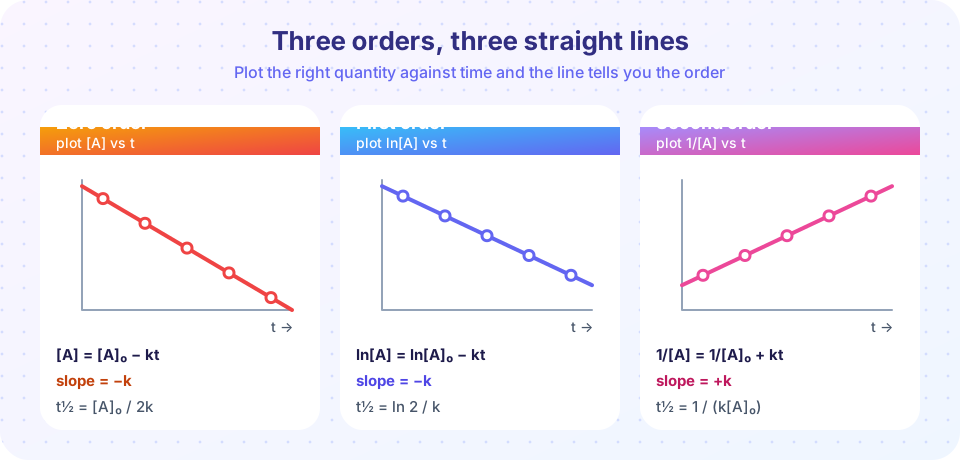
[A] = [A]₀ − kt, t½ = [A]₀ / (2k)
This happens when something other than the reactant concentration limits the speed, for example a reaction on a saturated catalyst surface. A plot of [A] against t is a straight line with slope −k.
First order, rate = k[A]:
ln[A] = ln[A]₀ − kt, equivalently [A] = [A]₀ e^(−kt), t½ = ln 2 / k
The half-life does not depend on the starting concentration: this is the signature of first-order change. Radioactive decay and many unimolecular decompositions follow it.
Second order, rate = k[A]²:
1/[A] = 1/[A]₀ + kt, t½ = 1 / (k[A]₀)
Here the half-life grows as the reaction proceeds, because as [A] falls the reaction slows down more than proportionally.
Worked example
A first-order decomposition has k = 0.0231 min⁻¹. The half-life is ln 2 / 0.0231 = 30.0 min. After 90 minutes, which is three half-lives, [A]/[A]₀ = (1/2)³ = 0.125. Check with the exponential: e^(−0.0231 × 90) = e^(−2.079) = 0.125. Both routes agree.
Quick order test: if successive half-lives are equal, the reaction is first order. If they double each time, it is second order. If they shrink, it is zero order.
Pseudo-first-order conditions
When B is present in huge excess, [B] stays practically constant and the rate law k[A][B] becomes k′[A] with k′ = k[B]₀. This trick lets you study a second-order reaction with first-order tools. It also explains why many reactions in water, where water is the solvent, appear first order in the other reactant.
Common misconceptions
"The orders are the stoichiometric coefficients." Only for an elementary step is this true. For overall reactions the orders come from experiment.
"A larger k always means a faster reaction." It does, at the same temperature and concentrations, provided the orders are equal. Comparing k values of different orders is meaningless because the units differ.
"The half-life is always constant." Only for first-order reactions.
Try it
First, a plot comparing all three orders for the same initial rate, then a tool that decides the order of an unknown data set by testing which linear plot fits best. The data in the second example are invented for the demonstration, with a little noise added.
Press Run (or Ctrl + Enter) to see the result here.
Program input · what you'd type while the program runs
Type the answers before you press Run, one per line. Each time the program reads a line (with input()), it gets the next line from this box.
Press Run (or Ctrl + Enter) to see the result here.
Program input · what you'd type while the program runs
Type the answers before you press Run, one per line. Each time the program reads a line (with input()), it gets the next line from this box.
Check your understanding
Quick check · 5 questions
of 5 answered You scored / 5 · perfect!
-
1. Doubling [A] quadruples the rate while [B] is held fixed. What is the order in A?
2^m = 4 gives m = 2. -
2. What are the units of k for a second-order reaction in solution?
k = rate / concentration², so the units are (M s⁻¹) / M² = M⁻¹ s⁻¹. -
3. The half-life of a first-order reaction is 20 s. How long until 12.5 % remains?
12.5 % is (1/2)³, so three half-lives: 60 s. -
4. A plot of 1/[A] against time is a straight line. The reaction is
The second-order integrated law is 1/[A] = 1/[A]₀ + kt. -
5. Which statement about pseudo-first-order conditions is correct?
The excess reagent's concentration is absorbed into an effective first-order constant.
Summary
- The rate law is measured; the order of each species is an exponent found by experiment.
- Initial rates compare mixtures to find orders; integrated laws give concentration against time.
- Zero:
[A]linear; first:ln[A]linear; second:1/[A]linear. - Only first-order reactions have a constant half-life.
Track your progress
Create a free account to tick off lessons and pick up where you left off on any device.
of Physical Chemistry lessons completed