


















Lesson 1 of 49 · Getting Started
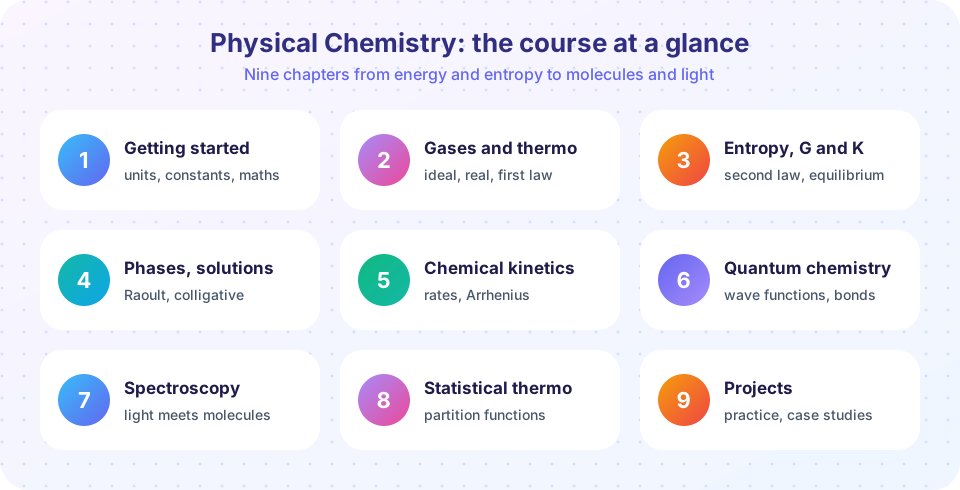
Course map: how this physical chemistry course works
See the whole physical chemistry course at a glance: nine chapters, prerequisites, how to study, and a first calculation with the ideal gas law.
Physical chemistry asks why chemistry behaves the way it does. Why does ice melt at 0 °C and not at 5 °C? Why does a reaction stop halfway? Why does one reaction take a second and another a century? This course answers those questions with energy, probability, a little quantum mechanics and a lot of worked numbers.
It is written for upper secondary and first-year university students, and for adults who want to revisit the subject. You do not need to be a mathematician. You do need to be willing to carry units through every line of a calculation, because in physical chemistry the units are half the answer.
What you will learn
- What physical chemistry covers and which four questions it answers.
- How the nine chapters fit together and in which order to study them.
- The mathematics and units you need, and where each is taught.
- A study routine that works: read, calculate, plot, check.
- Your first real calculation with the ideal gas law.
Key terms
System: the part of the universe you are studying (a flask, a cell, a gas sample).
Surroundings: everything else that can exchange energy or matter with the system.
State function: a property that depends only on the current state, such as temperature, pressure or internal energy, not on how the system got there.
Equilibrium: a state in which no net change occurs and the macroscopic properties stay constant.
Model: a simplified description (like the ideal gas) that is useful because we know exactly where it fails.
The four big questions
Everything in this course answers one of four questions about a chemical system.
- Will it happen? Thermodynamics decides whether a change is spontaneous (chapters 2 and 3).
- How far will it go? Equilibrium tells you the final composition (chapters 3 and 4).
- How fast? Chemical kinetics gives rates and mechanisms (chapter 5).
- What are the molecules like? Quantum chemistry and spectroscopy describe structure and energy levels, and statistical thermodynamics ties them to bulk behavior (chapters 6 to 8).
Notice the order. We begin with the big, measurable properties of matter and finish with the molecular explanation. Many courses go the other way round; both work, but starting with thermodynamics gives you results you can already use in a lab before you meet wave functions.
Chapters 1 to 3
- Getting started
- Gases and thermo
- Entropy and K
Chapters 4 to 6
- Phases, solutions
- Kinetics
- Quantum chemistry
Chapters 7 to 9
- Spectroscopy
- Statistical thermo
- Projects
Prerequisites
You should be comfortable with:
- Algebra: rearranging equations, solving for an unknown, using exponents.
- Basic chemistry: moles, molar mass, balanced equations, the periodic table.
- Calculus ideas: what a derivative (slope) and an integral (area) mean. Chapter 1 refreshes the parts we use, and we never ask you to do hard integrals by hand.
- A little programming: the runnable blocks use Python. You only need to read simple code; every block is complete and you can press Run.
How to study each lesson
Every lesson has the same shape so you always know where you are: learning goals, key terms, a worked body with a picture, common misconceptions, a Try it section, a quiz and a summary. A routine that works:
- Read the learning goals, then skim the figure before the text.
- Work each example on paper first, with units, then compare with the code.
- Change numbers in the Try it blocks. Predict the effect before you run.
- Answer the quiz without looking back. Wrong answers are information.
- Come back to the chapter review and re-derive its key equations.
Keep a one-page formula sheet that you extend lesson by lesson. Writing a relation in your own hand, with the unit of every symbol, is the cheapest way to remember it.
Common misconceptions
"Physical chemistry is just maths." The equations are short; the skill is deciding which one applies and what each symbol means physically.
"Models that are wrong are useless." The ideal gas is wrong for every real gas, yet it predicts pressures to a few percent at ordinary conditions. Knowing when a model breaks is the point.
"Spontaneous means fast." Spontaneous only means the change is thermodynamically allowed. Diamond turning into graphite is spontaneous and takes geological time.
Try it
The first block is the calculation the rest of the course keeps coming back to: how much space does a mole of gas take? Press Run, then change the temperature and pressure.
Press Run (or Ctrl + Enter) to see the result here.
Program input · what you'd type while the program runs
Type the answers before you press Run, one per line. Each time the program reads a line (with input()), it gets the next line from this box.
The second block is a small study planner. It is a simple calculator, not a prediction; adjust the hours to fit your life.
Press Run (or Ctrl + Enter) to see the result here.
Program input · what you'd type while the program runs
Type the answers before you press Run, one per line. Each time the program reads a line (with input()), it gets the next line from this box.
Check your understanding
Quick check · 4 questions
of 4 answered You scored / 4 · perfect!
-
1. Which question does chemical kinetics answer?
Kinetics concerns rates and mechanisms. Whether and how far are thermodynamics and equilibrium. -
2. Which of these is a state function?
Temperature depends only on the state. Heat and work depend on the path. -
3. Why is spontaneous not the same as fast?
Thermodynamics says what is allowed; kinetics says how quickly. Diamond to graphite is allowed but extremely slow. -
4. One mole of ideal gas at 273.15 K and 1 bar occupies about
V = nRT/P = 8.3145 x 273.15 / 100000 = 0.02271 m3 = 22.7 L.
Summary
- Physical chemistry answers four questions: will it happen, how far, how fast, and what are the molecules like.
- The course runs from thermodynamics (chapters 2 to 4) through kinetics (5) to quantum, spectroscopy and statistical thermodynamics (6 to 8).
- You need algebra, basic chemistry and an idea of slopes and areas; everything else is taught.
- Study by predicting, calculating with units, checking and re-deriving.
- A model is valuable because you know where it fails.
Track your progress
Create a free account to tick off lessons and pick up where you left off on any device.
of Physical Chemistry lessons completed