


















Lesson 8 of 49 · Gases and Thermodynamics Review
Real gases and the van der Waals equation
See why real gases deviate from PV = nRT: compression factor, intermolecular forces, the van der Waals equation, critical constants and the law of corresponding states.
The ideal gas law is a limit. Squeeze a gas to high pressure or cool it toward its boiling point and it stops obeying PV = nRT. Carbon dioxide at 300 K squeezed to a molar volume of 1 L exerts about 10 percent less pressure than the ideal law predicts, and a little further down the temperature scale it condenses into a liquid, something no ideal gas can do.
Understanding these deviations does two jobs. It teaches you when the ideal law can be trusted, and it reveals the forces between molecules.
What you will learn
- How to measure deviations with the compression factor Z.
- Why attraction lowers the pressure and molecular size raises it.
- How to use the van der Waals equation and its constants a and b.
- How critical constants follow from a and b, and what corresponding states means.
Key terms
Compression factor Z: Z = PV_m / RT; equal to 1 for an ideal gas.
Virial equation: a power series, Z = 1 + B/V_m + C/V_m² + ..., with temperature-dependent coefficients.
van der Waals equation: (P + a n²/V²)(V - nb) = nRT.
Critical point: the end of the liquid-gas coexistence line, beyond which gas and liquid are indistinguishable.
Boyle temperature: the temperature at which a real gas behaves ideally at low pressure (B = 0).
The compression factor
Define the molar volume V_m = V/n and the compression factor
Z = P V_m / (R T)
For an ideal gas Z = 1 at all pressures. For real gases:
Z < 1means attractive forces dominate; the gas is more compressible than ideal.Z > 1means repulsive forces (molecular size) dominate; the gas is less compressible.
At low pressure all gases approach Z = 1. As pressure rises Z usually first dips below 1 (attraction helps squeezing), reaches a minimum and then climbs above 1 (molecules cannot be pushed into each other). Hydrogen and helium, with extremely weak attractions, show Z > 1 at room temperature already.
The virial equation
The most general description is a series in density:
Z = 1 + B(T)/V_m + C(T)/V_m² + ...
B is the second virial coefficient and is related directly to pair interactions between molecules. It is negative at low temperature (attraction), positive at high temperature (repulsion), and zero at the Boyle temperature. Virial coefficients are tabulated and are the accurate tool for real engineering work.
The van der Waals equation
Johannes van der Waals (Nobel Prize 1910) built a simple, physical model in 1873. He corrected the ideal law in two ways.
- Molecules occupy space. The free volume is not
VbutV - nb, wherebis the volume excluded by one mole of molecules. - Molecules attract. A molecule near the wall is pulled inward by its neighbors, so it hits the wall less hard. The reduction in pressure is proportional to the square of the density,
a n²/V².
The result:
(P + a n²/V²)(V - n b) = n R T
or, per mole, P = RT/(V_m - b) - a/V_m².
| Gas | a (L² bar mol⁻²) | b (L mol⁻¹) |
|---|---|---|
| He | 0.0346 | 0.0238 |
| H₂ | 0.2476 | 0.0266 |
| N₂ | 1.370 | 0.0387 |
| O₂ | 1.382 | 0.0319 |
| CH₄ | 2.283 | 0.0428 |
| CO₂ | 3.640 | 0.0427 |
| H₂O | 5.536 | 0.0305 |
Notice that a is large for gases that liquefy easily (CO₂, H₂O) and tiny for helium; b roughly follows molecular size.
Worked example
One mole of CO₂ in 1.00 L at 300 K. Ideal: P = nRT/V = 0.0831446 x 300/1.00 = 24.9 bar. van der Waals:
P = RT/(V - b) - a/V²
  = 24.94/(1.00 - 0.0427) - 3.640/1.00²
  = 26.05 - 3.64 = 22.4 bar
Z = 22.4/24.9 = 0.90. Attraction dominates, so the real pressure is lower than the ideal one.
The critical point
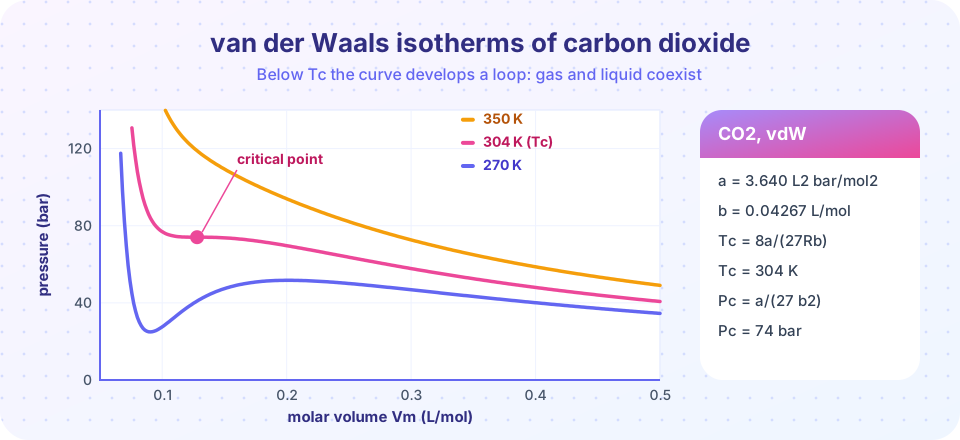
Below a certain temperature the van der Waals isotherm has a loop with a maximum and minimum: it predicts three volumes for one pressure. The central part is unstable; the real system condenses. At the critical temperature the loop shrinks to a point of inflection where both (∂P/∂V)_T = 0 and (∂²P/∂V²)_T = 0. Solving gives
V_c = 3 b P_c = a / (27 b²) T_c = 8 a / (27 R b)
For CO₂: T_c = 8 x 3.640 / (27 x 0.0831446 x 0.04267) = 304 K and P_c = 3.640 / (27 x 0.04267²) = 74 bar. The measured values are 304.1 K and 73.8 bar: remarkably close for such a simple model. Above T_c a substance is a supercritical fluid, used for example to decaffeinate coffee with CO₂ at about 31 °C and above 74 bar.
The model has weaknesses: the loop region is unphysical (we shall see that equal-area constructions repair it), and the predicted critical compression factor Z_c = 3/8 = 0.375 is higher than the measured values of about 0.27 to 0.29.
Corresponding states
Define reduced variables P_r = P/P_c, V_r = V_m/V_c, T_r = T/T_c. Then the vdW equation takes a form containing no gas-specific constants:
P_r = 8 T_r / (3 V_r - 1) - 3 / V_r²
Real gases follow approximately the same reduced equation, so a plot of Z against P_r for different gases at the same T_r nearly overlaps. This is the law of corresponding states.
Common misconceptions
"Real gases always have a smaller pressure than ideal." Only when attraction dominates (Z < 1). At high pressure or high temperature, size dominates and Z > 1.
"The constants a and b are properties of single molecules only." They are fitted parameters of the model and depend slightly on the range of conditions used.
"A liquid and a gas are always different phases." Beyond the critical point there is no distinction.
"The vdW loop shows a real state of the gas." The middle part is mechanically unstable; the real system condenses instead.
Try it
Compare ideal and van der Waals pressures for several gases at the same density, and compute their critical constants.
Press Run (or Ctrl + Enter) to see the result here.
Program input · what you'd type while the program runs
Type the answers before you press Run, one per line. Each time the program reads a line (with input()), it gets the next line from this box.
Now plot the compression factor of CO₂ versus pressure at three temperatures, using the vdW equation solved for the gas-phase volume. This is a model result, not measured data.
Press Run (or Ctrl + Enter) to see the result here.
Program input · what you'd type while the program runs
Type the answers before you press Run, one per line. Each time the program reads a line (with input()), it gets the next line from this box.
Check your understanding
Quick check · 5 questions
of 5 answered You scored / 5 · perfect!
-
1. A gas has Z = 0.85. What does this say?
Z < 1 means the molar volume is smaller than ideal: attractive forces dominate. -
2. In the van der Waals equation, what does the constant a describe?
The a n^2/V^2 term corrects the pressure for intermolecular attraction; b corrects the volume for molecular size. -
3. Which gas has the largest vdW constant a (in the table)?
Water has a = 5.536 L2 bar mol^-2, reflecting strong hydrogen bonding. -
4. What is the critical volume in the vdW model?
V_c = 3b, P_c = a/(27 b^2), T_c = 8a/(27 R b). -
5. Above its critical temperature a substance
Beyond T_c there is no liquid-gas transition; the fluid is supercritical.
Summary
- The compression factor
Z = PV_m/RTmeasures deviations; Z < 1 means attraction, Z > 1 means repulsion. - The virial equation expands Z in powers of 1/V_m; the Boyle temperature is where B = 0.
- van der Waals:
(P + a n²/V²)(V - nb) = nRTwith a for attraction and b for size. - Critical constants:
V_c = 3b,P_c = a/27b²,T_c = 8a/27Rb. - The reduced form is the same for all vdW gases (corresponding states).
Track your progress
Create a free account to tick off lessons and pick up where you left off on any device.
of Physical Chemistry lessons completed