


















Lesson 23 of 49 · Phase Equilibria and Solutions
Chapter 4 review: phase equilibria and solutions
Review chapter 4: phase diagrams, the Clapeyron equation, Raoult's law, colligative properties, activity and Henry's law, with a recap table and a ten-question quiz.
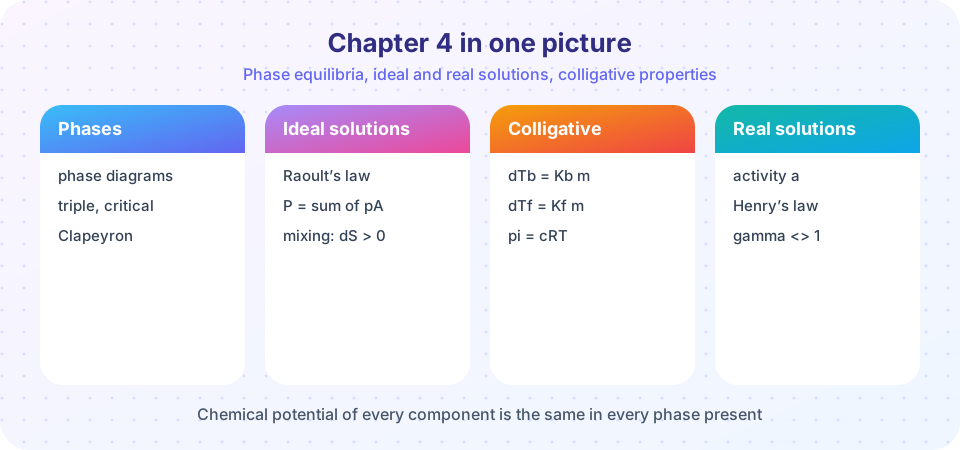
Chapter 4 extended the idea of equilibrium from reactions to phases and mixtures. One principle, that a component has the same chemical potential in every phase present, produced phase diagrams, vapor-pressure curves, freezing and boiling shifts, osmosis and the laws that govern dissolved gases.
Chapter in a table
| Lesson | Key relations |
|---|---|
| Phase diagrams | F = C - P + 2; dP/dT = ΔH/(TΔV); ln(P₂/P₁) = -(ΔH_vap/R)(1/T₂ - 1/T₁) |
| Ideal solutions | p_A = x_A P*_A; μ_A = μ*_A + RT ln x_A; Δ_mix S = -nRΣ x ln x |
| Colligative properties | ΔT_b = K_b m; ΔT_f = K_f m; π = cRT; factor i |
| Real solutions | a = γ x; p_B = k_H x_B; log γ± = -0.509|z₊z₋|√I |
Chapter in one idea
Every equation in the chapter is a consequence of μ(α) = μ(β). When you meet a new problem, ask: which phases are in equilibrium, and what is the chemical potential of the component I care about in each?
Common misconceptions
Mixing up K and the colligative constants, or molality and molarity. Use molality (mol per kg of solvent) in ΔT_f and ΔT_b, molarity in π = cRT, and mole fractions in Raoult's law.
Try it
A drill with the chapter's main formulas. Predict each result first.
Press Run (or Ctrl + Enter) to see the result here.
Program input · what you'd type while the program runs
Type the answers before you press Run, one per line. Each time the program reads a line (with input()), it gets the next line from this box.
The second block shows a freezing-point depression picture: the solid-liquid and liquid-gas lines of a solvent shift when a solute is added, giving the "boiling up, freezing down" pattern in one chart. The curves are schematic, built from the Clausius-Clapeyron form with an assumed solute effect.
Press Run (or Ctrl + Enter) to see the result here.
Program input · what you'd type while the program runs
Type the answers before you press Run, one per line. Each time the program reads a line (with input()), it gets the next line from this box.
Check your understanding
Quick check · 10 questions
of 10 answered You scored / 10 · perfect!
-
1. The phase rule for pure water with liquid and vapor coexisting gives F =
F = C - P + 2 = 1 - 2 + 2 = 1: only T or P can be chosen freely. -
2. Water boils at lower temperature at altitude because
Boiling occurs when vapor pressure equals external pressure. -
3. A liquid mixture has x_B = 0.30, P*_A = 60 kPa, P*_B = 20 kPa (ideal). What is y_B?
p_B = 6, p_A = 42, P = 48, y_B = 6/48 = 0.125. -
4. Which has the greater freezing point depression at 0.5 m in water?
NaCl gives about two particles per formula unit; the others one. -
5. The osmotic pressure of 0.200 mol/L at 310 K is about
π = 200 x 8.3145 x 310 = 5.2 x 10^5 Pa = 5.1 atm. -
6. Positive deviation from Raoult's law means
Weaker mixed attractions let molecules escape more easily. -
7. A smaller Henry's constant kH means the gas is
x = p/kH is larger when kH is smaller. -
8. In the Clapeyron equation for ice melting, dP/dT is negative because
Liquid water is denser than ice, so ΔV < 0 on melting. -
9. The ideal Δ_mix H is
Ideal mixing releases no heat; entropy drives it. -
10. Debye-Hückel's limiting law gives γ± < 1 because
The ionic atmosphere lowers the ion's chemical potential, hence its activity.
Summary
- Equal chemical potential in all phases is the basis of the chapter.
- Phase diagrams, the phase rule and Clapeyron/Clausius-Clapeyron describe the boundaries.
- Raoult's law and
Δ_mix Sdefine the ideal solution; vapor is enriched in the volatile component. - Colligative properties count particles; osmosis gives
π = cRT. - Activity
a = γxand Henry's law repair the equations for real solutions.
Next: continue with chapter 5 on the course page
Track your progress
Create a free account to tick off lessons and pick up where you left off on any device.
of Physical Chemistry lessons completed