


















Lesson 19 of 49 · Phase Equilibria and Solutions
Phase diagrams and the Clapeyron equation
Read pressure-temperature phase diagrams, apply the Gibbs phase rule, and use the Clapeyron and Clausius-Clapeyron equations to find slopes of phase boundaries and vapor pressures.
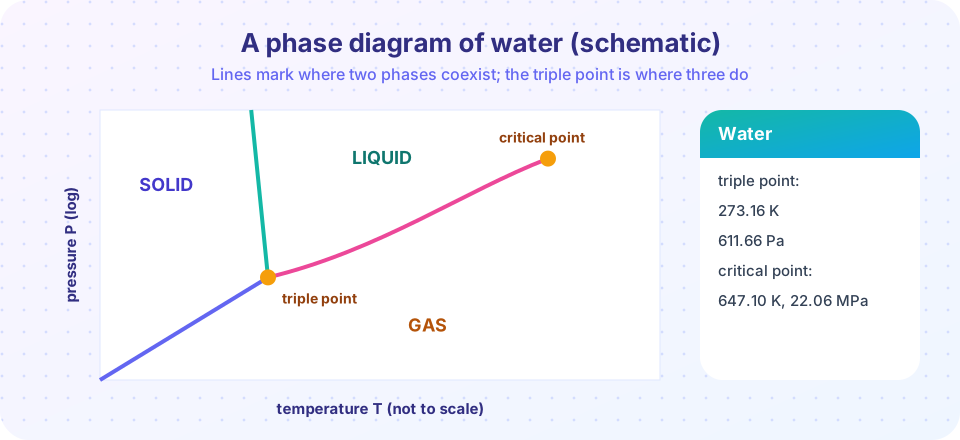
A phase diagram is a map. Its axes are temperature and pressure, and each region is colored by the phase that is most stable there. Cross a line and the substance changes phase; stand on a line and two phases coexist. Read well, one diagram tells you whether a substance can be liquefied by pressure, what happens to the melting point under compression, and where dry ice goes when it warms.
Behind the map lies a short list of equations that give the shape of every boundary.
What you will learn
- How to read a one-component phase diagram, including triple and critical points.
- The Gibbs phase rule and what degrees of freedom mean.
- How the Clapeyron equation gives the slope of a boundary.
- How to use the Clausius-Clapeyron equation for vapor pressure.
Key terms
Triple point: the unique T and P at which solid, liquid and gas coexist (water: 273.16 K, 611.66 Pa).
Critical point: the end of the liquid-gas line; beyond it there is a single supercritical fluid (water: 647.10 K, 22.06 MPa).
Phase rule: F = C - P + 2 for C components, P phases and F degrees of freedom.
Normal boiling point: the temperature at which the vapor pressure is 1 atm (101.325 kPa); the standard boiling point uses 1 bar.
Sublimation: solid to gas without passing through the liquid.
Reading a phase diagram
In the single-phase regions you can vary T and P independently. On a line, two phases coexist and fixing T fixes P: the pressure on the liquid-gas line at a given temperature is the vapor pressure. At the triple point all three phases coexist and T and P have no freedom at all. That is why the triple point of water (273.16 K) was used as the definition of the kelvin until 2019.
Features of water's diagram:
- The solid-liquid line leans backward (negative slope), because ice is less dense than liquid water. Increasing pressure lowers the melting point slightly: about 0.0075 K per atm. (The explanation that pressure alone makes skate blades glide is now considered incomplete; surface effects and friction matter.)
- The liquid-gas line ends at the critical point, where meniscus disappears.
- The triple pressure is only 611.66 Pa (0.006 atm), so at ordinary atmospheric pressure ice melts rather than sublimes.
Carbon dioxide differs in two ways. Its triple point (216.55 K, 5.18 bar) lies above atmospheric pressure, so at 1 atm solid CO₂ cannot melt: it sublimes at 195 K, which is why it is called dry ice. And its solid-liquid line leans forward because the solid is denser than the liquid. Its critical point is 304.1 K and 73.8 bar.
The phase rule
For a system with C components and P phases in equilibrium,
F = C - P + 2
The number 2 stands for T and P. For pure water (C = 1): one phase gives F = 2; two phases coexisting give F = 1; three phases give F = 0 (the triple point). The rule comes from counting variables (T, P and C - 1 mole fractions in each phase) and subtracting equations (equal chemical potentials between phases). We use it again for mixtures.
Where do boundary lines come from?
On a boundary line between phases α and β, the molar Gibbs energies are equal: G_m(α) = G_m(β). If we move a little along the line, the changes must also be equal. Using dG_m = V_m dP - S_m dT for each phase:
V_m(α) dP - S_m(α) dT = V_m(β) dP - S_m(β) dT
dP/dT = ΔS_m / ΔV_m = ΔH_m / (T ΔV_m)
using ΔS = ΔH/T at the transition. This is the Clapeyron equation, exact for any first-order phase transition.
Worked example: melting of ice
At 273.15 K: ΔfusH = 6010 J/mol; molar volume of ice is 19.65 cm³, of water 18.02 cm³, so ΔV = -1.63 x 10⁻⁶ m³/mol.
dP/dT = 6010 / (273.15 x -1.63e-6) = -1.35 x 10⁷ Pa/K = -135 bar/K
To lower the melting point of ice by 1 K you need roughly 135 bar. That is why the effect is small for everyday pressures.
Liquid-gas and solid-gas boundaries: Clausius-Clapeyron
For vaporization ΔV ≈ V_gas = RT/P (the liquid volume is negligible, and we treat the vapor as ideal). Then
dP/dT = P ΔH_vap / (R T²) or d ln P/dT = ΔH_vap / (R T²)
With ΔH_vap constant, integrate:
ln(P₂/P₁) = -(ΔH_vap/R)(1/T₂ - 1/T₁)
A plot of ln P against 1/T is a straight line of slope -ΔH_vap/R. This is the same form as the van 't Hoff equation, because vaporization is just an "equilibrium" with K = P/p°.
Example. Water at 298.15 K, given 101.325 kPa at 373.15 K and ΔH_vap = 40.66 kJ/mol:
ln(P/101.325) = -(40660/8.3145)(1/298.15 - 1/373.15) = -3.297
P = 101.325 x e^-3.297 = 3.7 kPa
The measured vapor pressure at 25 °C is 3.17 kPa. The estimate is 18 percent too high, because ΔH_vap is not constant: it is 44.0 kJ/mol at 298 K. The same equation with sublimation enthalpies describes vapor pressure over solids.
Trouton's rule, ΔH_vap ≈ 88 J K⁻¹ mol⁻¹ x T_b, is a quick way to estimate ΔH_vap from the normal boiling point for non-associated liquids.
Supercritical fluids
Above both T_c and P_c a substance is a single fluid with gas-like viscosity and liquid-like solvent power. Supercritical CO₂ (above 31.0 °C and 73.8 bar) extracts caffeine from coffee beans and flavor compounds without leaving residual organic solvent.
Common misconceptions
"Triple point and boiling point are the same kind of thing." The boiling point depends on external pressure; the triple point is one unique state.
"Ice melts under a skate because pressure lowers the melting point, and that is the whole story." The pressure effect is too small; surface premelting and frictional heating contribute.
"Beyond the critical point the substance is a gas." It is a supercritical fluid with properties of both.
"Clausius-Clapeyron is exact." With constant ΔH and ideal vapor it is an approximation, good over modest ranges.
Try it
First, the Clapeyron slope for a few substances and transitions.
Press Run (or Ctrl + Enter) to see the result here.
Program input · what you'd type while the program runs
Type the answers before you press Run, one per line. Each time the program reads a line (with input()), it gets the next line from this box.
The second block plots the vapor pressure of water on a logarithmic scale against 1/T, comparing the Antoine equation (a fit to data in the 1 to 100 °C range) with the constant-enthalpy Clausius-Clapeyron line.
Press Run (or Ctrl + Enter) to see the result here.
Program input · what you'd type while the program runs
Type the answers before you press Run, one per line. Each time the program reads a line (with input()), it gets the next line from this box.
Check your understanding
Quick check · 5 questions
of 5 answered You scored / 5 · perfect!
-
1. How many degrees of freedom does water have at its triple point?
F = C - P + 2 = 1 - 3 + 2 = 0: T and P are both fixed. -
2. Why does ice have a negative dP/dT on the melting line?
dP/dT = ΔH/(TΔV); ΔH > 0 and ΔV < 0 give a negative slope. -
3. A plot of ln P against 1/T has slope -4890 K. ΔH_vap is about
ΔH = -slope x R = 4890 x 8.3145 = 40.7 kJ/mol. -
4. Dry ice sublimes at 1 atm because
The CO2 triple point is at 5.18 bar; below that pressure the liquid cannot exist. -
5. The critical point is where
Beyond it the fluid is supercritical.
Summary
- Phase diagrams map stable phases; lines are two-phase equilibria, the triple point is three-phase.
- Phase rule
F = C - P + 2. - Clapeyron:
dP/dT = ΔH/(TΔV); for water melting the slope is about -135 bar/K. - Clausius-Clapeyron:
ln(P₂/P₁) = -(ΔH_vap/R)(1/T₂ - 1/T₁), assuming constant ΔH and ideal vapor. - Dry ice sublimes at 1 atm because CO₂'s triple point lies above atmospheric pressure.
Track your progress
Create a free account to tick off lessons and pick up where you left off on any device.
of Physical Chemistry lessons completed