


















Lesson 47 of 49 · Projects and Practice
Glossary and Symbols
A searchable glossary of physical chemistry terms from kinetics, quantum chemistry, spectroscopy, statistical thermodynamics and surfaces, with a constants table and symbol guide.
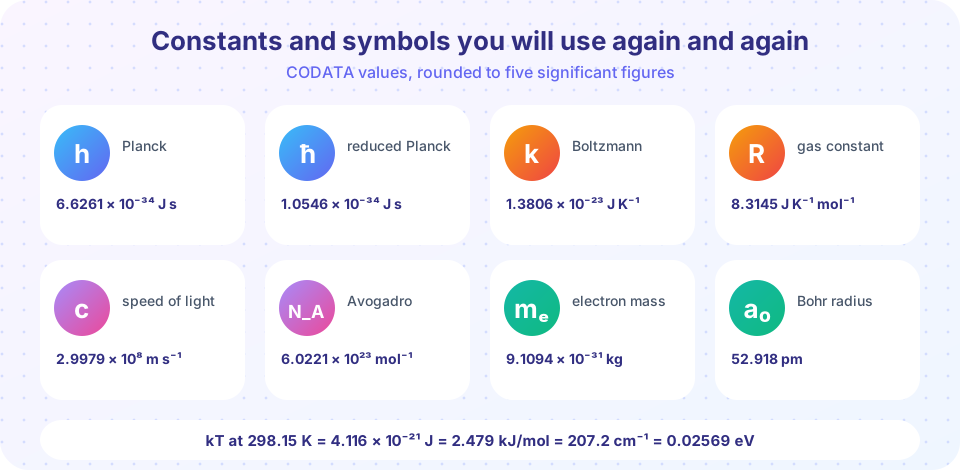
A good glossary is a map back to the idea you half remember. The terms below are grouped by chapter, one line each, with the key equation where there is one. Use the search tool at the bottom to filter them, and the poster for the constants you will use most often.
What you will learn
- Find any term from chapters 5 to 8 quickly
- Recall the standard symbols and their units
- Look up CODATA constants in code
Chemical kinetics
| Term | Meaning |
|---|---|
| Rate of reaction | Change of concentration per unit time, divided by the stoichiometric coefficient. |
| Rate law | Experimental equation rate = k[A]ᵐ[B]ⁿ. |
| Order | The exponent of a concentration in the rate law. |
| Rate constant (k) | Proportionality constant in the rate law; depends on temperature. |
| Half-life (t½) | Time for a reactant to fall to half; ln 2/k for first order. |
| Integrated rate law | Concentration as a function of time. |
| Pseudo-first-order | Apparent first order because one reactant is in large excess. |
| Activation energy (Ea) | Energy barrier in the Arrhenius equation. |
| Pre-exponential factor (A) | Prefactor in k = A e^(−Ea/RT); collision frequency times orientation factor. |
| Collision theory | Rate depends on collision frequency, energy and orientation. |
| Transition state | Highest-energy structure along the reaction path. |
| Eyring equation | k = (kBT/h) e^(−ΔG‡/RT). |
| Elementary step | A single molecular event, with order equal to molecularity. |
| Intermediate | A species formed and consumed during a mechanism. |
| Rate-determining step | The slowest step controlling the overall rate. |
| Steady-state approximation | d[I]/dt ≈ 0 for a reactive intermediate. |
| Pre-equilibrium | A fast reversible step before the slow step. |
| Catalyst | A substance that speeds up a reaction without being consumed; it changes the path, not K. |
| Michaelis–Menten | v = V_max[S]/(K_M + [S]) for enzymes. |
Quantum chemistry
| Term | Meaning |
|---|---|
| Quantum | Smallest packet of energy exchange; E = hν for light. |
| Photoelectric effect | Electron ejection by light above a threshold frequency. |
| de Broglie wavelength | λ = h/p. |
| Wavefunction (ψ) | Function whose square gives probability density. |
| Schrödinger equation | Ĥψ = Eψ. |
| Operator | A rule acting on a function, such as the Hamiltonian. |
| Boundary condition | Requirement on ψ at edges that produces quantization. |
| Node | Point where ψ is zero. |
| Zero-point energy | Lowest allowed energy, above the potential minimum. |
| Reduced mass (μ) | m₁m₂/(m₁+m₂). |
| Rigid rotor | Model of a rotating diatomic with fixed bond length. |
| Harmonic oscillator | Model of vibration in a parabolic potential. |
| Orbital | One-electron wavefunction labeled n, l, m_l. |
| Quantum numbers | n, l, m_l and m_s. |
| Z_eff | Effective nuclear charge after shielding. |
| LCAO | Linear combination of atomic orbitals to form molecular orbitals. |
| Bond order | (bonding − antibonding electrons)/2. |
| Variational principle | Trial energies are never below the true ground-state energy. |
Spectroscopy
| Term | Meaning |
|---|---|
| Wavenumber (ν̃) | 1/λ, in cm⁻¹. |
| Selection rule | Which transitions are allowed. |
| Gross selection rule | Needed property of the molecule: dipole (rotation), dipole change (IR). |
| Rotational constant (B) | h/(8π²cI); sets the rotational spacing. |
| Anharmonicity | Deviation from a parabolic potential. |
| Overtone | Transition with Δv > 1, weak but allowed by anharmonicity. |
| P and R branches | Lines of a rovibrational band with ΔJ = −1 and +1. |
| Normal mode | Independent collective vibration; 3N − 6 or 3N − 5 of them. |
| Chromophore | The light-absorbing part of a molecule. |
| Beer–Lambert law | A = εcl. |
| Absorbance (A) | log₁₀(I₀/I). |
| Fluorescence | Emission from S₁, nanoseconds. |
| Phosphorescence | Spin-forbidden emission from T₁, ms to s. |
| Franck–Condon principle | Electronic transitions are vertical on the nuclear coordinate. |
| Larmor frequency | ν = γB₀/2π. |
| Chemical shift (δ) | NMR position in ppm relative to a reference. |
| Shielding | Reduction of the local field by circulating electrons. |
| Spin–spin coupling (J) | Splitting of lines through bonding electrons, in Hz. |
| Integration | NMR peak area, proportional to the number of nuclei. |
Statistical thermodynamics and surfaces
| Term | Meaning |
|---|---|
| Microstate | A complete quantum specification of the system. |
| Statistical weight (W) | Number of microstates of a macrostate. |
| Boltzmann entropy | S = k ln W. |
| Boltzmann distribution | nᵢ/N = gᵢe^(−εᵢ/kT)/q. |
| Degeneracy (g) | Number of states at the same energy. |
| Partition function (q, Q) | Sum over states weighted by Boltzmann factors. |
| Characteristic temperature (θ) | Temperature at which kT equals the level spacing. |
| Symmetry number (σ) | Number of indistinguishable rotational orientations. |
| Thermal wavelength (Λ) | h/√(2πmkT). |
| Equipartition | Each quadratic energy term contributes ½kT when active. |
| Sackur–Tetrode | Entropy of a monatomic ideal gas. |
| Surface tension (γ) | Energy per unit area of an interface. |
| Physisorption | Weak adsorption by van der Waals forces. |
| Chemisorption | Adsorption with chemical bonding. |
| Coverage (θ) | Fraction of occupied surface sites. |
| Langmuir isotherm | θ = KP/(1 + KP). |
| BET | Multilayer adsorption model used for surface areas. |
| Langmuir–Hinshelwood | Surface reaction between two adsorbed species. |
Symbols and typical units
| Symbol | Quantity | Unit |
|---|---|---|
| k | rate constant (or Boltzmann constant) | s⁻¹ for first order; J K⁻¹ |
| Ea | activation energy | J mol⁻¹ or kJ mol⁻¹ |
| B | rotational constant | cm⁻¹ |
| ν̃ | wavenumber | cm⁻¹ |
| ε | molar absorption coefficient (or energy) | M⁻¹ cm⁻¹ (or J) |
| γ | surface tension (or magnetogyric ratio) | N m⁻¹ (or rad s⁻¹ T⁻¹) |
| θ | coverage or characteristic temperature | dimensionless; K |
Note that several letters are reused: always read the context and the units.
Try it
First, look up constants straight from scipy, which carries the CODATA values, and convert them into the forms used in this course.
Press Run (or Ctrl + Enter) to see the result here.
Program input · what you'd type while the program runs
Type the answers before you press Run, one per line. Each time the program reads a line (with input()), it gets the next line from this box.
Second, a searchable glossary. Type part of a term or its definition and the list narrows.
Check your understanding
Quick check · 3 questions
of 3 answered You scored / 3 · perfect!
-
1. Which pair is correctly matched?
B is quoted in cm⁻¹; first-order k has units s⁻¹. -
2. A characteristic temperature θ is the temperature where
It sets when a motion starts to be thermally active. -
3. The Beer–Lambert law relates absorbance to
A = εcl.
Summary
- Use the glossary tables to jump back to definitions and key equations.
- Symbols are reused (k, ε, γ, θ), so check units to see which quantity is meant.
scipy.constantsgives CODATA values for calculations.
Next: Cheat sheet
Track your progress
Create a free account to tick off lessons and pick up where you left off on any device.
of Physical Chemistry lessons completed