


















Lesson 16 of 49 · Entropy, Free Energy and Equilibrium
Temperature, pressure and Le Chatelier's principle
Predict how equilibria shift with temperature and pressure: derive the van 't Hoff equation, use K at different temperatures, and apply Le Chatelier's principle to ammonia synthesis.
Industrial chemists have a simple question: how do I get more product? The equilibrium constant tells where a reaction ends up, and conditions such as temperature and pressure can move that end point. Le Chatelier's principle gives the quick qualitative answer. Thermodynamics gives the exact one, through the van 't Hoff equation.
This lesson shows how K varies with temperature, why pressure moves the composition but not K, and why a catalyst does neither.
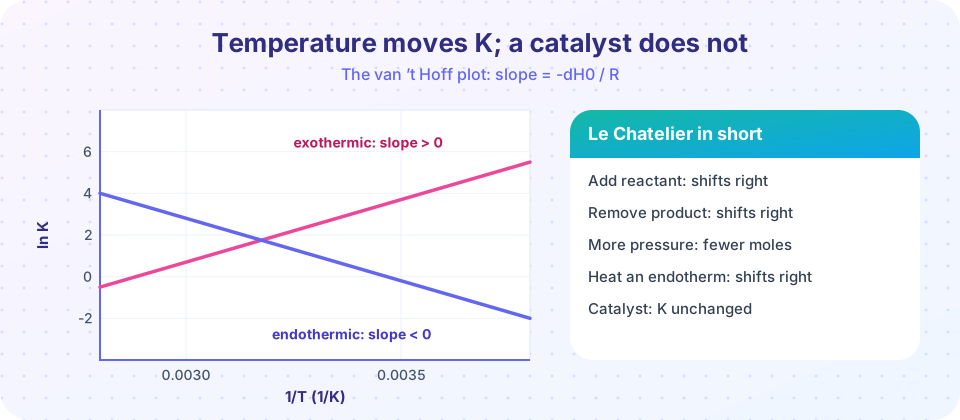
What you will learn
- How
Kchanges with temperature, using the van 't Hoff equation. - How pressure changes the equilibrium composition but not
K. - How to apply Le Chatelier's principle correctly, including to inert gases.
- Why catalysts and compromises matter in industrial processes.
Key terms
Le Chatelier's principle: when a system at equilibrium is disturbed, it shifts in the direction that partly counteracts the disturbance.
van 't Hoff equation: d ln K/dT = ΔrH°/(RT²).
Exothermic / endothermic: heat is released / absorbed (ΔrH° < 0 / > 0).
Mole fraction form Kx: K rewritten with mole fractions, so it depends on pressure.
Catalyst: a substance that speeds up the approach to equilibrium without being consumed.
Temperature: the van 't Hoff equation
Start with ln K = -ΔG°/RT = -ΔH°/RT + ΔS°/R. If ΔH° and ΔS° are roughly constant,
ln K = -ΔH°/(R) x (1/T) + ΔS°/R
This is a straight line in 1/T with slope -ΔH°/R and intercept ΔS°/R, the picture above. The Gibbs-Helmholtz equation gives the same result in differential form:
d ln K / dT = ΔH° / (R T²)
Between two temperatures:
ln(K₂/K₁) = -(ΔH°/R)(1/T₂ - 1/T₁)
- Endothermic (
ΔH° > 0): K rises with T. Heat is a "reactant", and adding it favors products. - Exothermic (
ΔH° < 0): K falls with T. Heat is a "product".
Worked example
For N₂O₄ ⇌ 2NO₂, ΔH° = +57.2 kJ/mol and K(298 K) = 0.150. At 350 K:
ln(K₂/K₁) = -(57200/8.3145)(1/350 - 1/298.15)
          = -6879.6 x (0.0028571 - 0.0033540) = +3.42
K₂ = 0.150 x e^3.42 = 4.6
K increases about thirty-fold. At 1 bar the fraction dissociated rises from 19 % to about 73 %. That is why the brown NO₂ gas becomes darker when you warm a sealed tube of the mixture and fades when you cool it.
Pressure and composition
K for gas-phase reactions depends only on temperature (at fixed standard pressure p°). The composition can still change with pressure. Write the mole-fraction form:
K = Kx (P/p°)^Δn so Kx = K (P/p°)^(-Δn)
where Δn is the change in the number of moles of gas.
- If
Δn < 0(fewer moles of gas in products, such as N₂ + 3H₂ → 2NH₃,Δn = -2), raising P increasesKxand favors products. - If
Δn > 0(as in N₂O₄ → 2NO₂), raising P favors reactants. - If
Δn = 0, pressure does nothing.
For reactions of solids and liquids the effect of ordinary pressures is negligible, because their molar volumes are small.
Le Chatelier's principle
The principle packages the results into a rule of thumb:
| Disturbance | Shift |
|---|---|
| Add a reactant | forward (toward products) |
| Remove a product | forward |
| Raise pressure by compression | toward fewer moles of gas |
| Raise temperature | toward the endothermic direction |
| Add a catalyst | no shift; K unchanged |
| Add an inert gas at constant volume | no shift: partial pressures unchanged |
| Add an inert gas at constant pressure | toward more moles of gas (volume increases, partial pressures fall) |
Adding or removing species changes Q and then the system moves until Q = K again. Changing temperature changes K itself.
The principle is a qualitative guide and sometimes needs care. Adding reactant raises the amount of product but can lower the fractional conversion of the reactant you added, and the principle gives no numbers.
A real compromise: ammonia
For N₂ + 3H₂ ⇌ 2NH₃, ΔH° = -91.8 kJ, Δn = -2. Thermodynamics says: cold and high pressure give a high yield. Kinetics says: the N≡N bond is so strong that the reaction is imperceptibly slow without both heat and a catalyst. The Haber-Bosch process runs at roughly 400 to 500 °C and 150 to 300 bar over an iron catalyst, removes ammonia continuously by condensation and recycles unreacted gas. The yield per pass is modest (around 15 percent); the recycle makes it economical. Fritz Haber and Carl Bosch (Nobel prizes 1918 and 1931) changed global agriculture with it.
Common misconceptions
"Raising pressure changes K." K depends only on temperature. Pressure changes composition when Δn ≠ 0.
"Adding a catalyst increases the yield." It reaches equilibrium faster; the equilibrium yield is the same.
"Heating always favors products." Only for endothermic reactions.
"An inert gas always has no effect." At constant volume it does nothing; at constant total pressure it dilutes the reactants.
Try it
First the van 't Hoff calculation for the N₂O₄ equilibrium over a range of temperatures.
Press Run (or Ctrl + Enter) to see the result here.
Program input · what you'd type while the program runs
Type the answers before you press Run, one per line. Each time the program reads a line (with input()), it gets the next line from this box.
Now the ammonia equilibrium. The block uses ΔH = -91.8 kJ and ΔS = -198.1 J/K (assumed constant) with an ideal-gas model and a 1:3 feed of N₂ and H₂. At several hundred bar the real gases are not ideal, so the numbers are only a qualitative guide; the trends are the real ones.
Press Run (or Ctrl + Enter) to see the result here.
Program input · what you'd type while the program runs
Type the answers before you press Run, one per line. Each time the program reads a line (with input()), it gets the next line from this box.
Check your understanding
Quick check · 5 questions
of 5 answered You scored / 5 · perfect!
-
1. The plot of ln K against 1/T has a slope of -5000 K. ΔH° is about
slope = -ΔH°/R, so ΔH° = 5000 x 8.3145 = +41.6 kJ/mol (endothermic). -
2. Raising the total pressure on N2 + 3 H2 <=> 2 NH3 at equilibrium
Fewer moles of gas on the product side (Δn = -2). -
3. An exothermic reaction is heated. K
d ln K/dT = ΔH°/RT² < 0 when ΔH° < 0. -
4. Adding a catalyst to an equilibrium mixture
A catalyst accelerates both directions equally. -
5. Which reaction is unaffected by pressure (gases, ideal)?
Δn = 0 for H2 + I2 <=> 2 HI.
Summary
d ln K/dT = ΔH°/RT²; the van 't Hoff plot has slope-ΔH°/R.- Endothermic reactions gain K on heating; exothermic ones lose it.
Kx = K(P/p°)^(-Δn): pressure shifts composition whenΔn ≠ 0but K stays fixed.- Le Chatelier gives the direction; catalysts change rates, not equilibria.
- Real processes balance thermodynamic yield against rate, as in Haber-Bosch.
Next: Chapter 3 review
Track your progress
Create a free account to tick off lessons and pick up where you left off on any device.
of Physical Chemistry lessons completed