


















Lesson 30 of 49 · Quantum Chemistry
The Particle in a Box
Solve the particle in a one-dimensional box, see why energy is quantized as n squared, and use the free-electron model to estimate absorption in conjugated molecules.
The particle in a box is the simplest problem that shows quantization at work. A particle is free to move along a line of length L but cannot escape: the walls are infinitely high. It sounds artificial, yet it captures a real effect, called quantum confinement, that appears wherever an electron is squeezed: in conjugated dyes, in semiconductor quantum dots and in the nanoscale wires of modern electronics.
You will see how the Schrödinger equation, plus the demand that ψ vanish at the walls, produces discrete energies without any extra assumption.
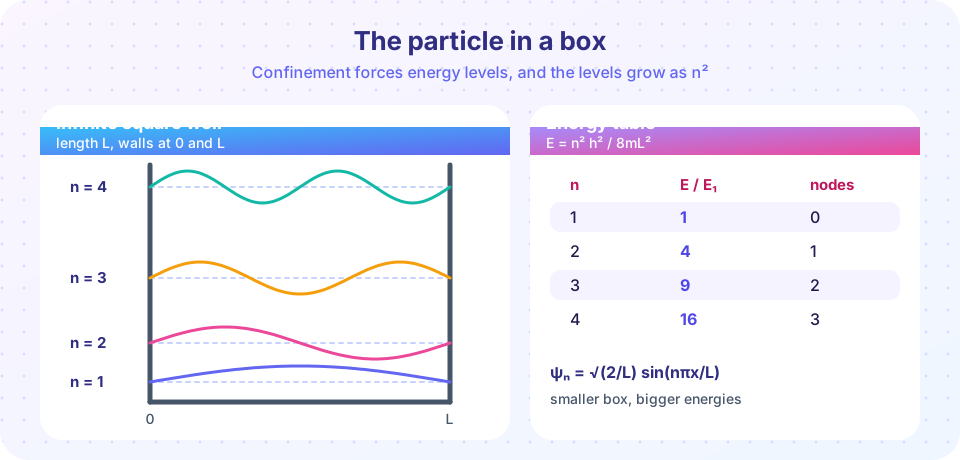
What you will learn
- Solve the particle-in-a-box problem and write down ψₙ and Eₙ
- Explain nodes, zero-point energy and the probability density
- Calculate transition energies and wavelengths
- Apply the free-electron model to conjugated polyenes
Key terms
Boundary condition: a requirement on ψ at the edges; here ψ(0) = ψ(L) = 0.
Node: a point where ψ passes through zero, so the probability of finding the particle there is zero.
Zero-point energy: the lowest allowed energy, which is above the potential minimum.
Normalization: the requirement ∫ |ψ|² dx = 1: the particle is somewhere in the box.
The solution
Inside the box V = 0, so the equation is −(ħ²/2m) ψ″ = Eψ. General solutions are sines and cosines. Because the wavefunction must be zero at x = 0, only the sine survives. Because it must also be zero at x = L, we need sin(kL) = 0, so kL = nπ, with n = 1, 2, 3, … The result:
ψₙ(x) = √(2/L) · sin(nπx / L)
Eₙ = n² h² / (8 m L²), n = 1, 2, 3, …
Several lessons are packed in these lines.
- Quantization comes from the boundary conditions. A guitar string pinned at both ends can vibrate only at certain frequencies for exactly the same reason.
- n = 0 is not allowed. The lowest energy is
E₁ = h²/(8mL²) > 0. A confined particle cannot be at rest; this is the zero-point energy and is consistent with the uncertainty principle. - The spacing grows with n:
Eₙ₊₁ − Eₙ = (2n + 1) E₁. - Smaller box, larger energies. Energies scale as
1/L²and1/m. Lighter particles are more strongly quantized, which is why electrons show it and golf balls do not. - Nodes: ψₙ has n − 1 nodes inside the box. The ground state has none and the number of nodes increases with energy, a pattern that holds for all quantum systems.
Worked example: an electron in a 1 nm box
With m = 9.109 × 10⁻³¹ kg and L = 1.00 × 10⁻⁹ m:
E₁ = (6.626×10⁻³⁴)² / (8 × 9.109×10⁻³¹ × 10⁻¹⁸) = 6.02 × 10⁻²⁰ J = 0.376 eV
The 1 → 2 transition costs E₂ − E₁ = 3E₁ = 1.13 eV, so the photon needed has λ = hc/ΔE = 1240 eV nm / 1.13 eV ≈ 1100 nm, in the infrared. Make the box 0.5 nm long and every energy quadruples, moving the absorption to about 275 nm. Squeezing the electron blue-shifts the absorption. That is exactly how quantum dots are tuned: smaller dots, bluer light.
Now the macroscopic check: a 1.0 g bead in a 1 cm box has E₁ = h²/(8mL²) = 5.5 × 10⁻⁶¹ J. The levels are so close that quantization is immeasurable, which is the correspondence principle in action.
Probability density
The probability of finding the particle between x and x + dx is ψₙ² dx = (2/L) sin²(nπx/L) dx. For n = 1 it peaks in the middle. For large n the peaks become so closely spaced that the distribution looks uniform, which is what a classical particle bouncing back and forth would give. Quantum predictions merge into classical ones at high n.
The free-electron model of conjugated molecules
In a conjugated polyene such as hexatriene (CH₂=CH–CH=CH–CH=CH₂), the π electrons move along the whole chain. Treat them as non-interacting particles in a box of length L, roughly the chain length. Each level holds two electrons (opposite spins, Pauli principle). With N π electrons the highest filled level is n_H = N/2 and the lowest empty level is n_H + 1, so
ΔE = (2n_H + 1) h² / (8 m L²)
Longer chains have a bigger L and so a smaller gap, which predicts that absorption moves to longer wavelength as conjugation grows, exactly as observed: butadiene absorbs in the ultraviolet, while β-carotene, with eleven conjugated double bonds, absorbs blue light and looks orange. The model is crude (the chain length must be estimated and electron repulsion is ignored), but it gets the trend and the order of magnitude right.
Beyond one dimension
For a rectangular 2D box, E = (h²/8m)(nₓ²/Lₓ² + n_y²/L_y²). In a square box, different pairs (nₓ, n_y), such as (1,2) and (2,1), have the same energy: they are degenerate. Degeneracy comes from symmetry and returns in the hydrogen atom. A finite wall height allows ψ to leak into the wall, an effect called tunneling, which scanning tunneling microscopes exploit.
Common misconceptions
"The particle moves along the sine wave." The wave is the probability amplitude, not the trajectory.
"If ψ₂ is zero in the middle, how does the particle get from one side to the other?" The question assumes a trajectory. The wavefunction gives a probability distribution in a stationary state; there is no path that has to pass through the node.
"A particle in a box can have any energy if you push hard enough." Only the specific Eₙ are stationary states.
Try it
First, plot wavefunctions and probability densities for n = 1 to 3, with the energy of each level for an electron in a 1 nm box.
Press Run (or Ctrl + Enter) to see the result here.
Program input · what you'd type while the program runs
Type the answers before you press Run, one per line. Each time the program reads a line (with input()), it gets the next line from this box.
Second, the free-electron model for polyenes CH₂=(CH–CH=)ₘCH₂. This is a simple model with an assumed box length of 1.40 Å per carbon atom, so treat the numbers with caution: the trend (longer chain, longer wavelength) is right, but the absolute wavelengths drift too long for long chains.
Press Run (or Ctrl + Enter) to see the result here.
Program input · what you'd type while the program runs
Type the answers before you press Run, one per line. Each time the program reads a line (with input()), it gets the next line from this box.
Check your understanding
Quick check · 5 questions
of 5 answered You scored / 5 · perfect!
-
1. If the box length L is doubled, E₁ becomes
E ∝ 1/L², so doubling L divides E by 4. -
2. How many nodes (excluding the walls) does ψ₄ have?
ψₙ has n − 1 nodes. -
3. Why is n = 0 not allowed?
sin(0) = 0 for all x, so no particle would exist in the box. -
4. In the free-electron model of hexatriene, which levels are the HOMO and LUMO?
Six π electrons fill levels 1, 2 and 3 (two each), so HOMO is n = 3 and LUMO n = 4. -
5. A particle of larger mass in the same box has
E ∝ 1/m.
Summary
- The boundary conditions
ψ(0) = ψ(L) = 0giveψₙ = √(2/L) sin(nπx/L)andEₙ = n²h²/8mL². - There is a zero-point energy; ψₙ has n − 1 nodes; levels spread as n².
- Lighter particles and smaller boxes have larger spacings: that is why quantum effects live at the nanoscale.
- The free-electron model explains why longer conjugated systems absorb at longer wavelengths.
Next: Vibration and rotation
Track your progress
Create a free account to tick off lessons and pick up where you left off on any device.
of Physical Chemistry lessons completed