


















Lesson 34 of 49 · Quantum Chemistry
Chapter 6 Review: Quantum Chemistry
Review quantum chemistry on one page: quantization, the particle in a box, vibration and rotation, hydrogen orbitals and molecular orbitals, with a ten-question mixed quiz.
Quantum chemistry can feel like a collection of unrelated model problems. They are all the same method: write the energy operator, impose boundary conditions, and read off the allowed energies and wavefunctions. This page puts the results side by side.
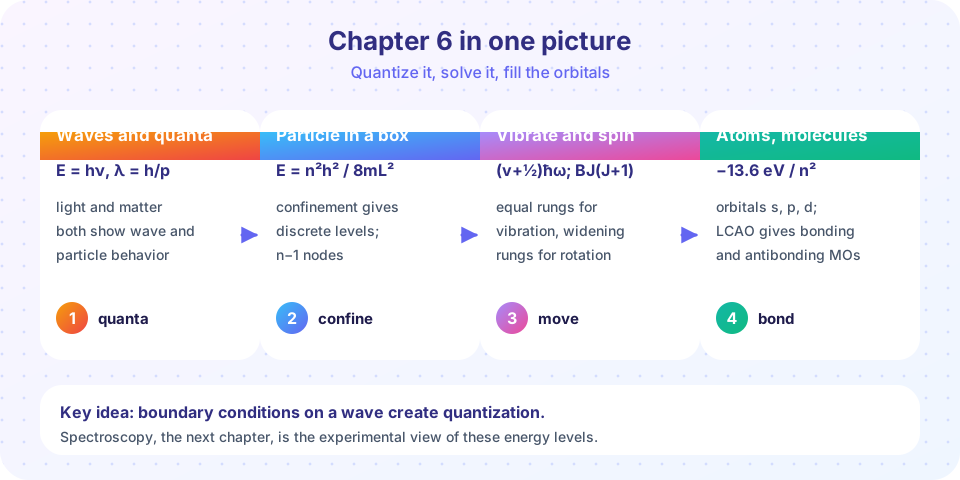
Recap table
| System | Energy | Quantum numbers | Key lesson |
|---|---|---|---|
| Photon | E = hν |
none | light comes in packets |
| Free particle wave | λ = h/p |
none | matter has wavelength |
| Particle in a box | n²h²/8mL² |
n = 1, 2, … | levels grow as n²; n − 1 nodes |
| Harmonic oscillator | (v + ½)ħω |
v = 0, 1, … | equal spacing; zero-point energy |
| Rigid rotor | ħ²J(J+1)/2I |
J = 0, 1, … | spacing grows; degeneracy 2J + 1 |
| Hydrogen atom | −13.6 eV/n² |
n, l, m_l, m_s | nodes: l angular, n − l − 1 radial |
| H₂ LCAO | σ₁ₛ below σ*₁ₛ | none | bond order (b − a)/2 |
Patterns worth noticing
- Nodes and energy. In every system, higher energy means more nodes. The ground state is nodeless.
- Zero-point energy. No bound quantum system sits at the bottom of its potential well.
- Reduced mass and size. Lighter particles and smaller spaces mean larger level spacings: electrons in boxes and atoms, protons in bonds, whole molecules in rotation.
- Degeneracy from symmetry. 2J + 1 for rotations, n² in hydrogen, two π orbitals in a diatomic.
Try it
A calculator for the most common chapter formulas. Change the inputs and compare with your hand calculations.
Press Run (or Ctrl + Enter) to see the result here.
Program input · what you'd type while the program runs
Type the answers before you press Run, one per line. Each time the program reads a line (with input()), it gets the next line from this box.
Check your understanding
Quick check · 10 questions
of 10 answered You scored / 10 · perfect!
-
1. An electron in a box is moved to a box twice as long. Its ground-state energy becomes
E₁ ∝ 1/L². -
2. Which system has equally spaced energy levels?
E_v = (v + ½)ħω gives constant spacing ħω. -
3. How many total nodes does a 3d orbital have?
Total nodes = n − 1 = 2 (both angular; radial = 3 − 2 − 1 = 0). -
4. The wavelength of an electron with momentum p is
de Broglie relation. -
5. Which molecule has bond order 2 and is paramagnetic?
O₂ has two unpaired π* electrons. C₂ also has bond order 2 but is diamagnetic. -
6. Replacing H by D in a bond leaves which quantity unchanged?
k reflects the electronic structure; μ changes the frequency and zero-point energy. -
7. In a rigid rotor, the energy gap between J = 0 and J = 1 is
E₁ − E₀ = 2B. -
8. What does the Balmer series in hydrogen involve?
Balmer lines are the visible ones, ending at n = 2. -
9. What does a node in a wavefunction imply?
ψ = 0 there, so |ψ|² = 0. -
10. What is the main idea of the variational principle?
That allows optimization of coefficients by minimizing the energy.
Summary
- Boundary conditions create quantization; nodes increase with energy.
- Box ∝ n², oscillator ∝ (v + ½), rotor ∝ J(J + 1), hydrogen ∝ −1/n².
- Molecular orbitals combine atomic orbitals; bond order and unpaired electrons follow from filling.
Track your progress
Create a free account to tick off lessons and pick up where you left off on any device.
of Physical Chemistry lessons completed