


















Lesson 17 of 49 · Entropy, Free Energy and Equilibrium
Chapter 3 review: entropy, free energy and equilibrium
Review chapter 3: entropy and the second law, Gibbs free energy, the equilibrium constant, the van 't Hoff equation and Le Chatelier's principle, with a ten-question quiz.
This chapter answered the first two of our four questions: will it happen and how far will it go. Entropy gave a direction to time, the Gibbs energy turned that direction into a criterion for chemists, and the equilibrium constant gave the end point of every reaction in terms of a single tabulated quantity.
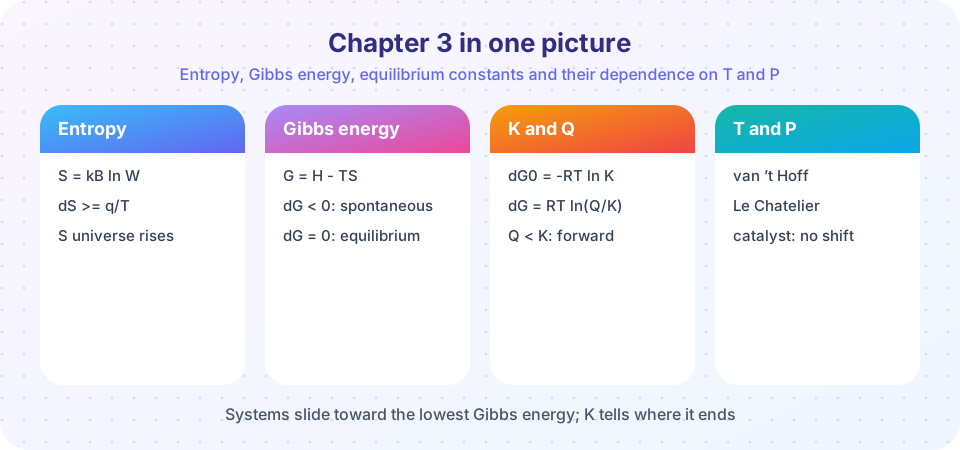
Chapter in a table
| Lesson | Key relations |
|---|---|
| Entropy and the second law | S = kB ln W; dS = δq_rev/T; ΔS_total ≥ 0; ΔS_surr = -ΔH/T |
| Gibbs free energy | ΔG = ΔH - TΔS; crossover T = ΔH/ΔS; w_max = ΔG |
| Equilibrium constant | ΔG = ΔG° + RT ln Q; ΔG° = -RT ln K |
| T and P effects | ln(K₂/K₁) = -(ΔH°/R)(1/T₂ - 1/T₁); Kx = K(P/p°)^(-Δn) |
A worked synthesis
Question: for 2 SO₂(g) + O₂(g) ⇌ 2 SO₃(g), ΔH° = -198 kJ and ΔS° = -188 J/K (approximate values). Is it favorable at 298 K? At which temperature does K = 1? What conditions favor SO₃?
ΔG° (298 K) = -198 + 298 x 0.188 = -142 kJ: strongly favorable,Kenormous.K = 1whereΔG° = 0:T = ΔH/ΔS = 198/0.188 = 1053 K.- Exothermic,
Δn = -1: low temperature and high pressure raise the SO₃ fraction, but the reaction is slow when cold, so sulfuric acid plants use a vanadium catalyst at about 700 to 800 K with several stages and cooling in between.
Common misconceptions
Treating spontaneity, speed and extent as the same thing. ΔG says whether, K says how far, kinetics says how fast. Keep the three questions separate.
Try it
First a drill for typical calculations; predict the answers first.
Press Run (or Ctrl + Enter) to see the result here.
Program input · what you'd type while the program runs
Type the answers before you press Run, one per line. Each time the program reads a line (with input()), it gets the next line from this box.
The second block gathers the whole chapter into one interactive-style plot: for a reaction with chosen ΔH and ΔS, it shows ΔG, K and the equilibrium fraction of product against temperature (for the simple model A ⇌ B).
Press Run (or Ctrl + Enter) to see the result here.
Program input · what you'd type while the program runs
Type the answers before you press Run, one per line. Each time the program reads a line (with input()), it gets the next line from this box.
Check your understanding
Quick check · 9 questions
of 9 answered You scored / 9 · perfect!
-
1. Two moles of ideal gas expand isothermally from 3.0 L to 12.0 L. ΔS is
ΔS = nR ln 4 = 2 x 8.3145 x 1.386 = 23.1 J/K. -
2. For ΔH = +66 kJ and ΔS = +180 J/K, the reaction becomes spontaneous above
T = 66000/180 = 367 K. -
3. ΔG° = -22.5 kJ/mol at 298 K gives K of about
ln K = 22500/(8.3145 x 298.15) = 9.08; K = 8.7 x 10^3. -
4. A reaction has Q = 50 and K = 10. It will
Q > K means too many products; ΔG = RT ln(Q/K) > 0. -
5. An exothermic reaction's K when T rises
Heat acts like a product; adding heat favors reactants, so K decreases. -
6. Which condition shifts N2 + 3 H2 <=> 2 NH3 toward ammonia?
Four moles of gas become two, so compression favors NH3. -
7. For melting, ΔH = +6.0 kJ/mol and ΔS = +22 J/(K mol). At 300 K, ΔG is
ΔG = 6000 - 300 x 22 = -600 J/mol < 0, above the melting temperature 273 K. -
8. The maximum non-expansion work available at constant T and P is
ΔG is the maximum useful non-expansion work. -
9. Which statement about K is correct?
K = exp(-ΔG°/RT) depends only on T.
Summary
- Entropy counts microstates; the total entropy of system plus surroundings never falls.
ΔG = ΔH - TΔSis the constant-T, constant-P criterion; crossoverT = ΔH/ΔS.ΔG° = -RT ln KandΔG = RT ln(Q/K)give direction and extent.- van 't Hoff: slope of
ln Kagainst1/Tis-ΔH°/R; Le Chatelier gives the qualitative shifts. - Catalysts change rate, never K.
Track your progress
Create a free account to tick off lessons and pick up where you left off on any device.
of Physical Chemistry lessons completed