


















Lesson 15 of 49 · Entropy, Free Energy and Equilibrium
The equilibrium constant and the reaction quotient
Link Gibbs energy to the equilibrium constant with ΔG = ΔG° + RT ln Q and ΔG° = -RT ln K, define Kp and Kc, and calculate equilibrium compositions from thermodynamic data.
Most reactions do not run to completion. Mix nitrogen dioxide and its dimer N₂O₄ in a flask, and the mixture settles at a definite composition and then stops changing. The composition depends on temperature and pressure, but not on which side you started from. That composition is the equilibrium, and the equilibrium constant K is a single number that summarizes it.
Thermodynamics makes this precise. The equilibrium constant is not an empirical curiosity; it is determined by the standard Gibbs energy of the reaction. If you can look up ΔfG° values, you can predict equilibria without ever running the experiment.
What you will learn
- The relation between
ΔG,ΔG°and the reaction quotientQ. - How
ΔG° = -RT ln Kconnects thermodynamic tables to equilibrium. - How to write K for gases, solutions and heterogeneous systems.
- How to calculate an equilibrium composition from K.
Key terms
Reaction quotient (Q): the product of activities of products over reactants, each raised to its stoichiometric power, at any moment.
Equilibrium constant (K): the value of Q at equilibrium; dimensionless.
Activity (a): the effective concentration relative to the standard state; for an ideal gas p/p°, for an ideal solute c/c°, for pure solids and liquids 1.
Extent of reaction (ξ): the amount reacted, measured in moles of reaction.
Kp, Kc: equilibrium constants written with partial pressures or concentrations.
Why a minimum?
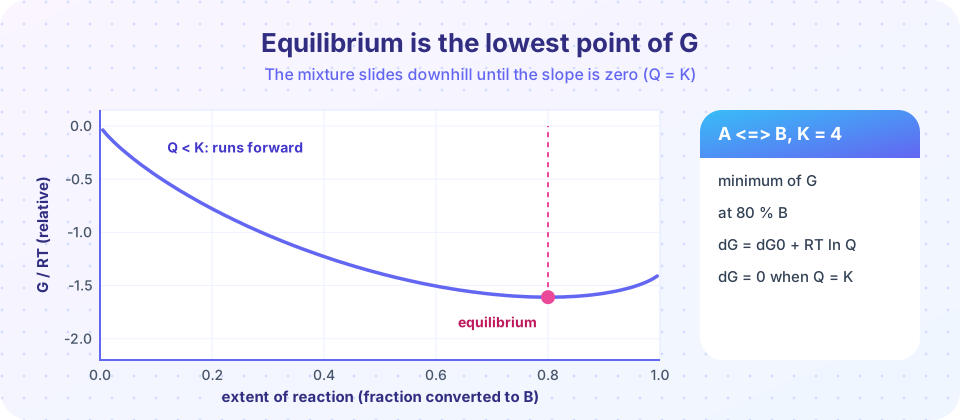
Suppose one mole of A turns into B: A ⇌ B. Let ξ be the fraction converted. The mixture has (1-ξ) of A and ξ of B, so the Gibbs energy of the mixture (per mole, ideal) is
G/RT = (1-ξ) μ°_A/RT + ξ μ°_B/RT + (1-ξ) ln(1-ξ) + ξ ln ξ
The last two terms are the Gibbs energy of mixing: always negative, steepest near the ends. So G falls as the first few molecules of B appear (mixing wins), then climbs back as pure B is approached. There is always a minimum inside the range: reactions "stop" before completion because a mixture is more stable than either pure state. The slope of G with respect to ξ is the reaction Gibbs energy:
ΔG = (∂G/∂ξ)_{T,P} = ΔG° + RT ln Q
and at the minimum the slope is zero. So at equilibrium ΔG = 0 and Q = K:
ΔG° = -RT ln K or K = exp(-ΔG°/RT)
Reading the equation
ΔG° < 0givesK > 1: products favored. Each -5.7 kJ/mol (at 298 K) multiplies K by 10.ΔG° = 0givesK = 1.ΔG° > 0givesK < 1: reactants favored. It does not mean the reaction never goes: a tiny but non-zero amount of product always forms.- Away from equilibrium
ΔG = RT ln(Q/K): ifQ < K,ΔG < 0and the reaction runs forward; ifQ > K, it runs backward.
| ΔG° at 298 K | K |
|---|---|
| -40 kJ/mol | 1 x 10⁷ |
| -10 kJ/mol | 57 |
| 0 | 1 |
| +10 kJ/mol | 0.018 |
| +40 kJ/mol | 1 x 10⁻⁷ |
Writing K
For aA + bB ⇌ cC + dD:
K = (a_C^c a_D^d) / (a_A^a a_B^b)
with activities, which makes K dimensionless.
- Ideal gases:
a = p/p°withp° = 1 bar, soK_p = (p_C/p°)^c (p_D/p°)^d / .... - Dilute solutes:
a = c/c°withc° = 1 mol/L:K_c. - Pure solids and liquids:
a = 1. ForCaCO₃(s) ⇌ CaO(s) + CO₂(g),K = p_CO₂/p°only. - Solvent in dilute solution:
a ≈ 1. - If you multiply the equation by 2, K is squared; reversing inverts K; adding reactions multiplies their K's.
For gases K_p = K_c (c° RT/p°)^Δn, where Δn is the change in moles of gas and c°RT/p° = 24.8 at 298 K (c° = 1 mol/L = 1000 mol/m³, p° = 10⁵ Pa).
Worked example: N₂O₄ dissociation
N₂O₄(g) ⇌ 2 NO₂(g). Data at 298 K: ΔfG°(N₂O₄) = 97.9 kJ/mol, ΔfG°(NO₂) = 51.3 kJ/mol.
ΔrG° = 2(51.3) - 97.9 = +4.7 kJ/mol.K = exp(-4700/(8.3145 x 298.15)) = exp(-1.896) = 0.150.- Start with 1.00 mol N₂O₄ and let a fraction
αdissociate at a total pressure of 1.00 bar. Moles: N₂O₄1-α, NO₂2α, total1+α. Partial pressures:p(N₂O₄) = (1-α)/(1+α)bar,p(NO₂) = 2α/(1+α)bar. ThenK = 4α² / (1 - α²) = 0.150, soα² = 0.150/4.150 = 0.0361andα = 0.19.
About 19 percent has dissociated. Compressing the mixture (higher P) would lower α, a preview of Le Chatelier's principle.
ICE tables
For solution equilibria, set up an Initial-Change-Equilibrium table with amounts and solve for x. If K is small, x is small compared with the initial concentration and you can simplify, then check the assumption.
Common misconceptions
"At equilibrium the concentrations of products and reactants are equal." Only when K = 1. What is equal is the forward and backward rate.
"A reaction with K < 1 never produces products." It produces a smaller amount; K = 10⁻⁷ still gives product molecules.
"K depends on the concentrations." K depends only on temperature (for a given standard state). The composition changes with conditions; K does not.
"Catalysts increase K." They speed up approach to equilibrium but leave K (and ΔG°) unchanged.
"Include solids in K." Pure solids and liquids have activity 1.
Try it
Compute K from ΔG° and solve for the composition of the N₂O₄ equilibrium at different total pressures.
Press Run (or Ctrl + Enter) to see the result here.
Program input · what you'd type while the program runs
Type the answers before you press Run, one per line. Each time the program reads a line (with input()), it gets the next line from this box.
Now see the Gibbs energy landscape for different K values. Each curve is the model A ⇌ B from the text, with ΔG°/RT = -ln K.
Press Run (or Ctrl + Enter) to see the result here.
Program input · what you'd type while the program runs
Type the answers before you press Run, one per line. Each time the program reads a line (with input()), it gets the next line from this box.
Check your understanding
Quick check · 5 questions
of 5 answered You scored / 5 · perfect!
-
1. ΔG° = -11.4 kJ/mol at 298 K. K is approximately
ln K = 11400/(8.3145 x 298) = 4.6, so K = 100. -
2. If Q < K for a reaction, which way does it run?
ΔG = RT ln(Q/K) < 0 so the forward reaction is spontaneous. -
3. In K for CaCO3(s) = CaO(s) + CO2(g), which activities appear?
Pure solids have activity 1, so K = p(CO2)/p°. -
4. Doubling all coefficients of a balanced equation changes K to
K for the doubled equation is K^2. -
5. What does a catalyst do to K?
K depends on ΔG°, which a catalyst does not change; it only speeds up approach to equilibrium.
Summary
ΔG = ΔG° + RT ln Q; at equilibriumΔG = 0andQ = K, soΔG° = -RT ln K.- At 298 K, every -5.7 kJ/mol multiplies K by 10.
- K uses activities:
p/p°for gases,c/c°for solutes, 1 for pure solids and liquids. Q < Kruns forward,Q > Kbackward;ΔG = RT ln(Q/K).- K depends on temperature only; catalysts do not change it.
Track your progress
Create a free account to tick off lessons and pick up where you left off on any device.
of Physical Chemistry lessons completed