


















Lesson 20 of 49 · Phase Equilibria and Solutions
Ideal solutions and Raoult's law
Learn Raoult's law, the chemical potential of an ideal solution, the Gibbs energy and entropy of mixing, vapor composition and why distillation separates volatile liquids.
Pour two similar liquids together, such as benzene and toluene, or hexane and heptane, and they mix without any heat change or volume change. They behave almost as if the molecules of one kind did not notice which kind their neighbors were. Such a mixture is an ideal solution, and it is the reference point for every real solution.
Ideal solutions obey a simple rule discovered by François-Marie Raoult in the 1880s: the vapor pressure of each component is proportional to its mole fraction in the liquid. From that rule comes the thermodynamics of mixing and the physical basis of distillation.
What you will learn
- Raoult's law and the definition of an ideal solution.
- The chemical potential of a component in an ideal solution.
- Thermodynamic functions of mixing.
- How to find the composition of the vapor above a solution and why distillation works.
Key terms
Mole fraction (x): the amount of a component divided by the total amount, x_A = n_A/(n_A + n_B).
Raoult's law: p_A = x_A P*_A, where P*_A is the vapor pressure of pure A.
Ideal solution: one in which every component obeys Raoult's law at all compositions.
Mixing functions: Δ_mix G, Δ_mix S, Δ_mix H, Δ_mix V: the changes on forming a solution from pure components.
Volatility: the tendency to evaporate; high P* means volatile.
Raoult's law
For a binary solution of A and B in equilibrium with its vapor:
p_A = x_A P*_A        p_B = x_B P*_B
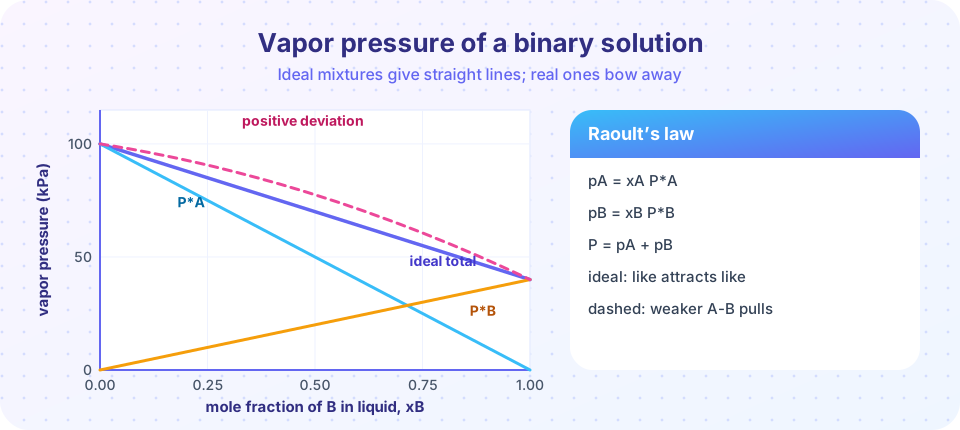
P = p_A + p_B = P*_A + x_B (P*_B - P*_A)
The last form shows that the total vapor pressure is a straight line in x_B from P*_A (pure A) to P*_B (pure B). The figure above also shows a dashed curve above this line: a solution with positive deviation, which we meet in a later lesson.
A molecular reason: if A and B have similar sizes and interactions, then replacing some A by B changes nothing about how easily an A molecule can escape; the escaping rate is simply proportional to the fraction of the surface occupied by A.
Chemical potential and mixing
At equilibrium the chemical potential of A in the liquid equals that in the vapor. Using the ideal-gas expression for the vapor and Raoult's law gives, for the liquid,
μ_A = μ*_A + RT ln x_A
where μ*_A is the chemical potential of pure A. Mixing two components therefore changes the Gibbs energy of the system:
Δ_mix G = n R T (x_A ln x_A + x_B ln x_B)
Because x < 1, the logarithms are negative, and Δ_mix G < 0 at every composition: ideal liquids always mix spontaneously. The entropy follows from S = -(∂G/∂T)_P:
Δ_mix S = -n R (x_A ln x_A + x_B ln x_B) > 0
Δ_mix H = 0        Δ_mix V = 0
So mixing in an ideal solution is purely entropy-driven: no heat released or absorbed, no change of volume. For equal amounts, x = 0.5: Δ_mix S = nR ln 2 = 5.76 J/K per mole of mixture and Δ_mix G = -nRT ln 2 = -1.72 kJ per mole at 298 K.
Vapor composition
Components differ in volatility, so the vapor is richer in the more volatile one. Let y_B be the mole fraction of B in the vapor. Dalton's law gives y_B = p_B/P.
Worked example: benzene and toluene
At about 20 °C, pure benzene has P* = 10.0 kPa and pure toluene 2.9 kPa (approximate values). A liquid contains x_B = 0.40 benzene.
p_B = 0.40 x 10.0 = 4.00 kPap_T = 0.60 x 2.9 = 1.74 kPaP = 5.74 kPay_B = 4.00/5.74 = 0.70
The vapor is 70 % benzene though the liquid is only 40 %. If you condense that vapor and evaporate it again, the next vapor has y = 0.89, and then 0.96. This repeated enrichment is distillation; a fractionating column provides many such steps ("theoretical plates") in one tower. Petroleum refining, spirits production and air separation all rely on it.
The relationship between the composition of liquid and vapor is shown on a pressure-composition diagram with two lines: the liquid line P(x) and the vapor line P(y), which lies below it. Between them both phases coexist, and the lever rule gives their relative amounts.
Limits of ideality
Real mixtures are ideal only when the molecules are alike. Benzene-toluene, hexane-heptane and the isotopic mixtures are close. Ethanol-water, acetone-chloroform and others deviate strongly (next lessons). Raoult's law is also the limiting law for the solvent in any dilute solution: as x_solvent → 1, the solvent's behavior approaches Raoult's line even if the solution is not ideal elsewhere.
Common misconceptions
"An ideal solution has no intermolecular forces." It has forces; they are the same strength between all pairs, so replacing one molecule with another changes nothing.
"Vapor and liquid compositions are the same." The vapor is enriched in the more volatile component.
"Mixing always needs energy input." For ideal solutions Δ_mix H = 0 and entropy drives mixing.
"Raoult's law holds for gas mixtures." It describes the equilibrium between a liquid solution and its vapor.
Try it
Compute liquid and vapor compositions for the benzene-toluene model and the repeated-distillation enrichment.
Press Run (or Ctrl + Enter) to see the result here.
Program input · what you'd type while the program runs
Type the answers before you press Run, one per line. Each time the program reads a line (with input()), it gets the next line from this box.
Now draw the pressure-composition diagram: the liquid line, the vapor line, and the two-phase region between them.
Press Run (or Ctrl + Enter) to see the result here.
Program input · what you'd type while the program runs
Type the answers before you press Run, one per line. Each time the program reads a line (with input()), it gets the next line from this box.
Check your understanding
Quick check · 5 questions
of 5 answered You scored / 5 · perfect!
-
1. A solution has x_A = 0.25 and P*_A = 80 kPa. The partial pressure of A (ideal) is
p_A = x_A P*_A = 0.25 x 80 = 20 kPa. -
2. Which is true for forming an ideal solution at constant T and P?
Ideal mixing is purely entropic: no heat, no volume change, positive entropy. -
3. The vapor above an ideal binary solution is
The component with the higher P* contributes proportionally more to the vapor. -
4. The chemical potential of A in an ideal solution is
Because ln x_A < 0, μ_A is lower than in the pure liquid. -
5. Mixing 1 mol A with 1 mol B ideally at 298 K gives ΔG of about
ΔmixG = -nRT ln 2 with n = 2: -2 x 8.3145 x 298 x 0.693 = -3.43 kJ.
Summary
- Raoult:
p_A = x_A P*_A; ideal total pressure is linear in composition. μ_A = μ*_A + RT ln x_A;Δ_mix G = nRT Σ x ln x < 0;Δ_mix S = -nR Σ x ln x;Δ_mix H = Δ_mix V = 0.- The vapor is enriched in the more volatile component, the basis of distillation.
- Raoult's law is exact for the solvent as
x → 1in any solution. - Ideality needs similar molecules and similar interactions.
Next: Colligative properties
Track your progress
Create a free account to tick off lessons and pick up where you left off on any device.
of Physical Chemistry lessons completed