


















Lesson 45 of 49 · Projects and Practice
Project: Entropy of N₂ from Spectroscopic Constants
Calculate the standard molar entropy of nitrogen and carbon monoxide from molecular constants using translational, rotational and vibrational partition functions, and compare with tables.
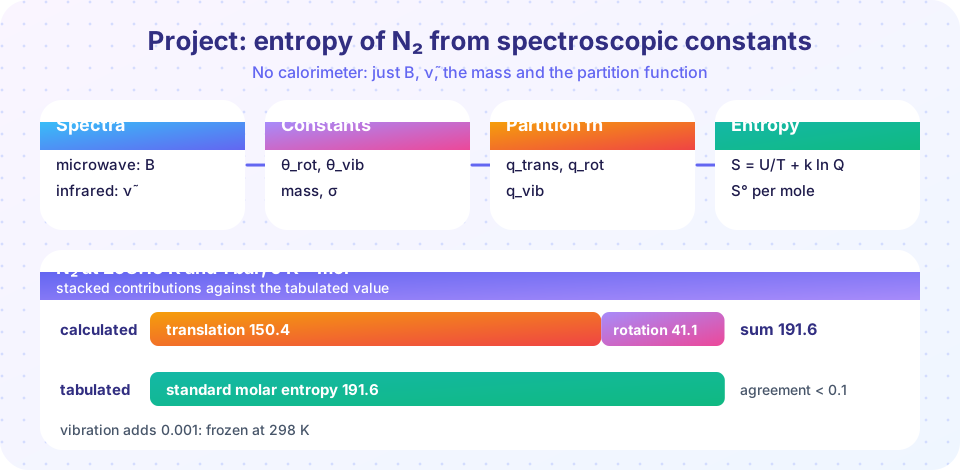
This project closes the loop of the whole course. Spectroscopy (Chapter 7) gives molecular constants: a rotational constant B and a vibrational wavenumber ν̃. Statistical thermodynamics (Chapter 8) turns those constants into a partition function, and the partition function gives the entropy. The final number, the standard molar entropy of nitrogen, can be compared with the value found in thermodynamic tables, which came from heat-capacity measurements in a calorimeter. Agreement means that molecular quantum mechanics and macroscopic thermodynamics describe the same reality.
What you will learn
- Combine the entropy contributions of translation, rotation and vibration
- Use B, ν̃, mass and symmetry number as inputs
- Check a computed entropy against tabulated data
- Understand the meaning of residual entropy
Key terms
Standard molar entropy (S°): entropy of one mole of substance at 1 bar and the stated temperature.
Symmetry number (σ): number of indistinguishable orientations a molecule can reach by rotation; σ = 2 for N₂ and 1 for CO.
Residual entropy: entropy that remains at 0 K because a crystal freezes in a disordered arrangement.
The formulas
All three contributions come from Chapter 8. At temperature T and pressure p (1 bar):
| Motion | Molar entropy |
|---|---|
| Translation (Sackur–Tetrode) | S_trans = R [ ln( kT / (pΛ³) ) + 5/2 ], Λ = h / √(2πmkT) |
Rotation (linear, T ≫ θ_rot) |
S_rot = R [ ln( T / (σ θ_rot) ) + 1 ], θ_rot = hcB/k |
| Vibration | S_vib = R [ x/(eˣ − 1) − ln(1 − e⁻ˣ) ], x = θ_vib/T = hcν̃/kT |
| Electronic | R ln g₀ (zero for the singlet ground states of N₂ and CO) |
The inputs for nitrogen are the mass 28.0134 u, B = 1.998 cm⁻¹, ν̃ = 2358.6 cm⁻¹ and σ = 2.
Step 1: compute S° for N₂ and CO
The code below is a direct implementation. It uses CODATA constants from scipy and prints each contribution. CO has a similar mass but σ = 1, and a different B and ν̃.
Press Run (or Ctrl + Enter) to see the result here.
Program input · what you'd type while the program runs
Type the answers before you press Run, one per line. Each time the program reads a line (with input()), it gets the next line from this box.
You should find that the sums land within a fraction of a J K⁻¹ mol⁻¹ of the tabulated values. The small differences come from using round input constants, from treating the rotor as rigid and the oscillator as harmonic, and from the tabulated data themselves.
Step 2: how does S depend on temperature?
Entropy rises with temperature because more states become accessible. Use the function to plot the three contributions from 100 K to 2000 K. Vibration is negligible at first and then switches on, as in the heat-capacity story of Chapter 8. The rotational formula assumes T ≫ θ_rot, which is safe for N₂ above about 20 K.
Press Run (or Ctrl + Enter) to see the result here.
Program input · what you'd type while the program runs
Type the answers before you press Run, one per line. Each time the program reads a line (with input()), it gets the next line from this box.
Interpreting the results
- Translation dominates (about 150 J K⁻¹ mol⁻¹) because a gas molecule has an enormous number of translational states: the ratio V/Λ³ is of order 10⁷.
- Rotation contributes about 41 for N₂, and the symmetry number matters: forgetting σ = 2 would overestimate S by
R ln 2 = 5.76 J K⁻¹ mol⁻¹. - Vibration is negligible at 298 K (θ_vib ≈ 3400 K) but grows with temperature.
- Spectroscopic versus calorimetric entropy. For N₂ the two agree. For carbon monoxide the entropy from calorimetry is lower than the spectroscopic one by roughly 4 to 5 J K⁻¹ mol⁻¹, a bit less than
R ln 2. The reason is that the CO crystal freezes with the molecules pointing in random C–O or O–C directions (their dipoles are tiny), so even at absolute zero the crystal keeps some disorder: a residual entropy. The calorimeter never sees it, but statistical mechanics, which assumes a perfectly ordered crystal at 0 K for the gas, does.
Try changing σ for N₂ to 1, or replace the mass with that of ¹⁵N₂ (30.0001 u), and see how each term responds. Isotopic substitution changes the mass and the rotational constant (B scales as 1/μ) but not the electronic structure.
Check your understanding
Quick check · 4 questions
of 4 answered You scored / 4 · perfect!
-
1. Which contribution to the entropy of N₂ at 298 K is the largest?
Translation contributes about 150 of the 191.6 J K⁻¹ mol⁻¹. -
2. What happens to S_rot if you mistakenly use σ = 1 for N₂?
S_rot contains −R ln σ, so removing σ = 2 adds R ln 2 = 5.76 J K⁻¹ mol⁻¹. -
3. Why is the vibrational entropy of N₂ negligible at 298 K?
A single occupied state contributes essentially zero entropy. -
4. A calorimetric entropy lower than the spectroscopic value suggests
Frozen-in disorder at 0 K, as in solid CO, gives the difference.
Summary
S = S_trans + S_rot + S_vib + S_el, each from a closed-form partition-function result.- Inputs: mass, B, ν̃, σ and the electronic degeneracy.
- N₂ comes out near 191.6 J K⁻¹ mol⁻¹, matching tables; translation dominates and σ matters.
- Residual entropy explains why calorimetric values can sit below spectroscopic ones.
Next: Practice set
Track your progress
Create a free account to tick off lessons and pick up where you left off on any device.
of Physical Chemistry lessons completed