


















Lesson 9 of 44 · What Is Philosophy
Chapter 2 Review: What Is Philosophy
Review the meaning of philosophy, its six branches, Socrates and the elenchus, and philosophical traditions worldwide, with a recap table and a ten-question quiz.
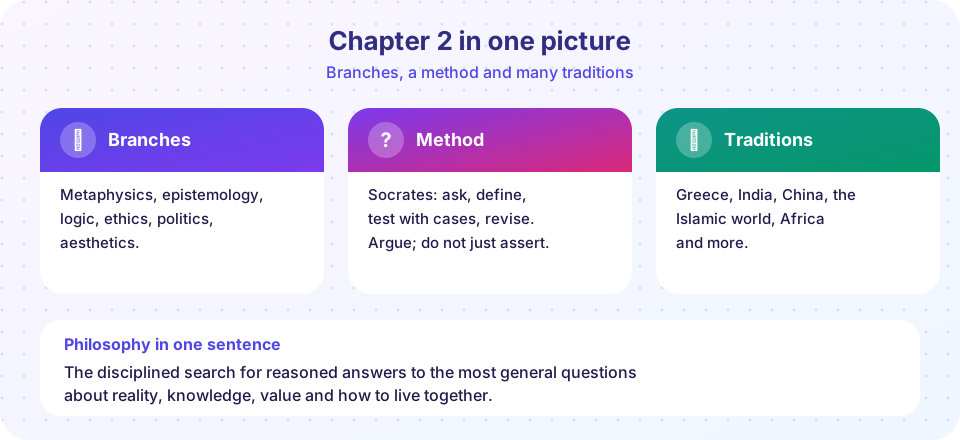
You have now seen what philosophy is, how it is organized, how one of its founders worked and how widely it has been practiced. This review gathers the chapter into one picture, then tests the details. Take the quiz without looking back first, then reread any lesson behind a missed question.
What you will learn
- A compact recap of chapter 2.
- Which lesson to revisit for each idea.
- How to use the ideas together on a new question.
Recap table
| Idea | Summary | Lesson |
|---|---|---|
| Meaning of the word | philosophia, love of wisdom; sciences once belonged to natural philosophy | The Big Picture |
| Philosophy vs science | Mostly conceptual and normative questions versus empirical ones | The Big Picture |
| Six branches | Metaphysics, epistemology, logic, ethics, political philosophy, aesthetics | The Branches |
| Three parts of ethics | Metaethics, normative ethics, applied ethics | The Branches |
| Methods | Conceptual analysis, argument, thought experiments, empirical input, dialogue | The Branches |
| Socrates | Athenian questioner, tried and executed in 399 BCE; known through Plato, Xenophon, Aristophanes | Socrates |
| Elenchus | Ask, define, test, notice tension, revise or reach aporia | Socrates |
| Euthyphro dilemma | Is the pious loved because pious, or pious because loved? | Socrates |
| World traditions | India, China, the Islamic world, Africa, Indigenous thought, Europe | Across Cultures |
Putting it together
Take any question, say "Is it wrong to copy a friend's homework if they agree?" First place it on the map: it is mainly ethics (what is right?), with a touch of political philosophy if you ask about school rules. Next apply the Socratic method to the key word, "fair" or "cheating", by writing a definition and testing it with cases. Then look beyond one tradition: how would a Confucian emphasis on roles and relationships, or Ubuntu's stress on community, frame the problem? You will not always reach a final answer, but you will reach a clearer question.
Chapter 3 now gives you the formal tools to check whether the arguments you build while doing this are valid and sound.
Try it
Press Run (or Ctrl + Enter) to see the console output here.
No output.
Check your understanding
Quick check · 10 questions
of 10 answered You scored / 10 · perfect!
-
1. The word 'philosophy' comes from Greek words meaning
Philos (loving) plus sophia (wisdom). -
2. Which is NOT one of the six traditional branches in this chapter?
Astronomy is a science. Philosophy of science can ask about it, but it is not a branch of philosophy. -
3. Metaethics asks
Normative ethics asks which acts are right; applied ethics tackles concrete issues; metaethics asks what morality itself is. -
4. Why is 'the Socratic problem' a problem?
Plato, Xenophon and Aristophanes portray him differently. -
5. In the elenchus, what typically happens after the partner offers a definition?
He tests the definition, usually with cases, until the partner revises it or ends in aporia. -
6. The Euthyphro dilemma in modern form asks whether something is good
It transposes the question about piety and the gods' love to goodness and divine command. -
7. Which pair were contemporaries?
Descartes (1596 to 1650) and Zera Yacob (1599 to 1692) lived at the same time, while the others are centuries apart. -
8. Which work was written by al-Ghazali?
Al-Ghazali wrote the Incoherence of the Philosophers; Ibn Rushd replied with the Incoherence of the Incoherence; Ibn Khaldun wrote the Muqaddimah. -
9. Which statement about philosophy and science is most accurate?
Philosophy overlaps with science, using its results, while working on questions that experiments alone cannot settle. -
10. Why is it risky to treat 'Eastern philosophy' as one thing?
Indian, Chinese, Japanese, Persian and other traditions differ widely, as do the many Western ones.
Summary
- Philosophy is the reasoned study of general questions about reality, knowledge, value and how to live.
- Six branches organize the field, with overlapping borders and many "philosophy of X" fields.
- Socrates' elenchus (ask, define, test, revise) is the model of philosophical conversation.
- Philosophy has been practiced in India, China, the Islamic world, Africa and elsewhere, often at the same time.
- Chapter 3 teaches you to judge arguments with logic.
Track your progress
Create a free account to tick off lessons and pick up where you left off on any device.
of Introduction to Philosophy lessons completed