


















Lesson 41 of 44 · Projects and Practice
Lab: Thought Experiments in Action
A practical lab on thought experiments: vary the trolley problem, test Nozick's experience machine and learn what each case isolates and what it cannot show.
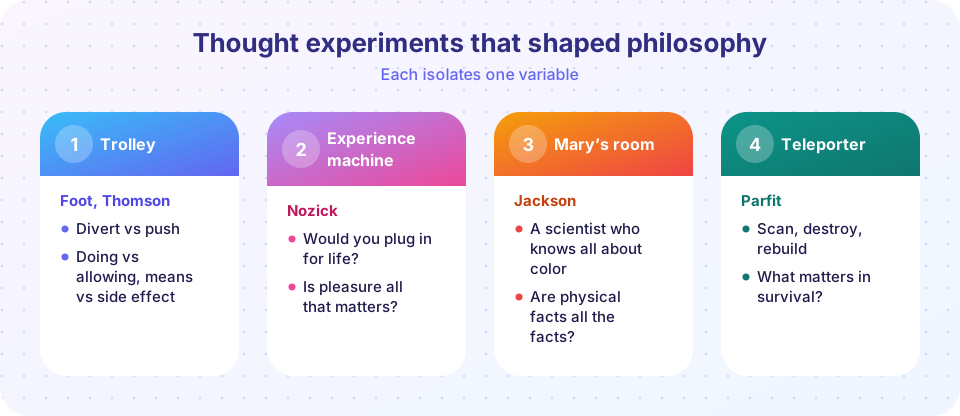
Scientists run experiments in laboratories. Philosophers run them in the imagination. A thought experiment describes a carefully designed scenario, asks what we should say about it, and uses the answer as evidence for or against a theory. You have already met several: Mary's room, the zombie, the Chinese Room, the teleporter, the veil of ignorance. In this lab you will learn a method for analyzing them, run a set of trolley variations, and see both the power and the limits of the technique. For the general idea, see also Thought experiments.
What you will learn
- A four-step method for analyzing any thought experiment.
- What the trolley variants isolate: doing versus allowing, and means versus side effects.
- What Nozick's experience machine tests.
- Limits: unreliable intuitions, framing effects and unrealistic cases.
Key terms
Intuition: a considered, immediate judgment about a case.
Doing/allowing distinction: the moral difference some see between causing harm and failing to prevent it.
Doctrine of double effect: a harm may be permissible as a foreseen side effect even if it would be wrong as an intended means.
Consequentialism / deontology: judging acts by outcomes / by duties and constraints.
The method: I-P-V-L
- I (Intuition). What is your immediate judgment about the case? Write it down before analyzing it.
- P (Principle). What principle would explain the judgment? Try to state it generally.
- V (Variation). Change one detail at a time. Does your answer change? If so, the detail matters; if not, it does not.
- L (Limits). What does the case not show? Could the intuition be due to framing, unfamiliarity or bias?
The trolley problem
Philippa Foot introduced the case in 1967, and Judith Jarvis Thomson developed it in the 1970s. A runaway trolley will kill five people on the track. In the switch case, you can divert it to a side track where it will kill one person. In the footbridge case, you can stop the trolley only by pushing a large stranger off a bridge onto the track, killing him but saving the five. Many surveys find that large majorities approve the switch but not the push, though results vary with wording and culture.
The arithmetic is identical in both: one dies, five live. So what explains the difference? Candidate principles:
- Means versus side effect (doctrine of double effect). In the switch case, the death is a foreseen side effect; in the footbridge case, the man's body is used as a means to stop the trolley.
- Doing versus allowing. Both cases involve doing something, so this does not distinguish them, but it separates them from a case where you simply watch.
- Personal force. Joshua Greene and colleagues proposed that up-close physical force triggers a strong emotional response, which is why the push feels worse; philosophers disagree about whether emotional responses are signals of moral truth or biases.
Other variants test the principles further: the loop case (the side track loops back, so the one person's body is needed to stop the trolley), the trapdoor (you pull a lever that drops the man), and the transplant case (a surgeon takes the organs of a healthy patient to save five). Each variation controls one detail.
The experience machine
In 1974 Robert Nozick asked: suppose a machine could give you any experiences you desired, indistinguishable from reality. Neuroscientists could stimulate your brain so that you think you are writing a great novel or making a friend. Would you plug in for life? Nozick thought many people would refuse, which suggests that we care about more than pleasant experiences: we want to do things and to be a certain person, and to be in contact with reality. If so, a simple hedonist view of well-being (pleasure is all that matters) is in trouble.
Critics note that the intuition may reflect status quo bias: people are less willing to leave their real lives than to stay in a machine if told they were already in one (this "reverse" version was explored in work by Felipe De Brigard in 2010). The case therefore shows how sensitive intuitions can be to framing, which is a lesson about the method.
Common misconceptions. (1) "A thought experiment proves a theory." It provides evidence that can be challenged. (2) "The scenario is unrealistic, so it is useless." Unreal cases can isolate a variable that real life mixes; but when a case is so bizarre that our intuitions are unreliable, that is a legitimate criticism. (3) "There is one right answer." The aim is to understand your reasoning, not to find an answer key.
Try it
Press Run (or Ctrl + Enter) to see the result here.
Program input · what you'd type while the program runs
Type the answers before you press Run, one per line. Each time the program reads a line (with input()), it gets the next line from this box.
Lab report template
Write a short report (200 words) for one thought experiment: (1) state the case in your own words; (2) your intuition; (3) the principle that explains it; (4) one variation and how your answer changes; (5) one limit of the case. You can compare your answers with a friend and look for where you differ: finding the principle behind the disagreement is the real result.
Check your understanding
Quick check · 4 questions
of 4 answered You scored / 4 · perfect!
-
1. What does the trolley problem's footbridge case add to the switch case?
The arithmetic is the same; the difference lies in means and force. -
2. What does the doctrine of double effect say?
Intention and means matter in this principle. -
3. What was Nozick's experience machine meant to test?
If we would refuse the machine, we care about more than experience. -
4. Which is a legitimate limit of thought experiments?
Status quo bias in the experience machine shows this.
Summary
- Analyze a case with Intuition, Principle, Variation and Limits.
- Trolley variants isolate means versus side effect, doing versus allowing and personal force.
- The experience machine challenges simple hedonism, but framing can change the intuition.
- Thought experiments give evidence, not proof, and their limits belong to the method.
Next: Glossary
Track your progress
Create a free account to tick off lessons and pick up where you left off on any device.
of Introduction to Philosophy lessons completed