


















Lesson 32 of 44 · Religion and Meaning
The Problem of Evil
Why suffering challenges belief in a good, powerful God: Mackie's logical problem, Rowe's evidential version, Plantinga's defense, and the main theodicies.
A child falls ill. An earthquake kills thousands. People hurt each other in ways that are hard to describe. For many people, such events are the single strongest reason to doubt that the universe is governed by a being who is both all-powerful and perfectly good. For many others, a faith in God is what helps them live through the same events. Philosophers treat this tension as the problem of evil. This lesson sets out the argument precisely, because it is easier to think clearly about suffering when the logic is visible, and then presents the main responses.
What you will learn
- The difference between the logical and the evidential problem of evil.
- Why most philosophers think Plantinga's free will defense answered the logical problem.
- Rowe's evidential argument and what theodicies attempt.
- The costs of each response.
Key terms
- Moral evil: suffering caused by the free actions of agents (cruelty, war).
Natural evil: suffering caused by nature (disease, earthquakes).
Defense: a possible reason God might have; it only needs to be possible. Theodicy: a claimed actual reason; it aims to be plausible.
Omnipotent, omnibenevolent: all-powerful; perfectly good.
The classical form of the problem
The ancient question is often attributed to Epicurus: is God willing to prevent evil but not able? Then not omnipotent. Able but not willing? Then not good. Both able and willing? Then whence evil? In 1955, J. L. Mackie gave it a sharp modern form, "Evil and Omnipotence". The claim is that these statements are logically inconsistent:
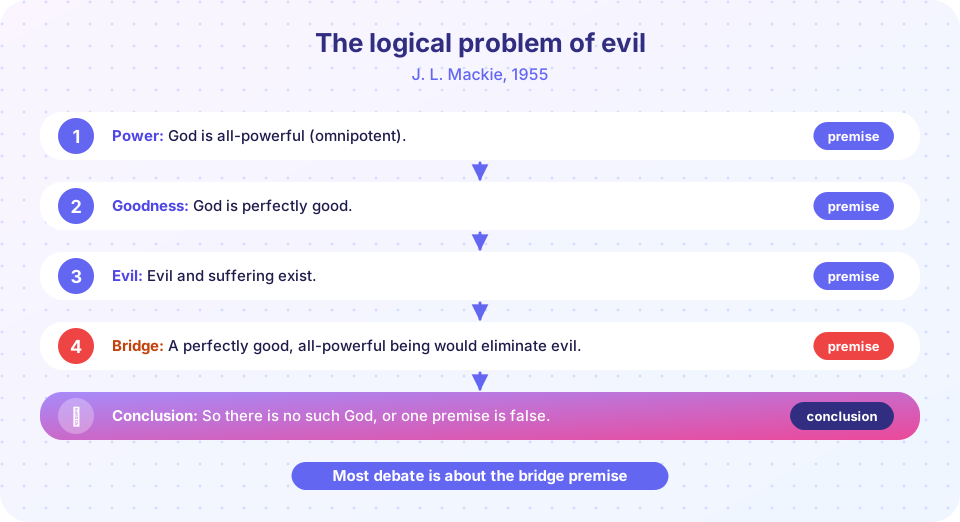
Notice that the argument depends on the bridge premise: a perfectly good, all-powerful being would eliminate evil. That is what defenders deny. They say that a good being may have reasons to permit some evils, such as the value of free choice, and that omnipotence does not include doing the logically impossible (for example, creating free beings who are guaranteed to choose well).
Free will defense
Alvin Plantinga's God, Freedom and Evil (1974) is the best-known reply to the logical problem. He argued that it is possible that: God could not create a world with moral good (freely chosen) without risking moral evil; and it is possible that every free creature God might have created would have gone wrong at least once (Plantinga's term is transworld depravity). If this is even possible, then the claim that God and evil are logically inconsistent is not established. Most philosophers on both sides now accept that the logical problem has been answered, in the sense that no strict contradiction has been shown. Mackie himself conceded that the free will defense was a serious reply. This does not make the evidential problem go away.
The evidential problem
William Rowe (1979) argued instead that there is a great deal of evil in the world that seems pointless: it appears that no outweighing good required it. His famous example is a fawn burned in a forest fire caused by lightning, which suffers for days, unobserved by anyone. We cannot prove there is no reason for such suffering, he said, but the existence of such cases makes it likely that some evil is gratuitous, and that makes the existence of a perfect God unlikely. Notice that this argument concerns probability, not logical consistency.
Responses
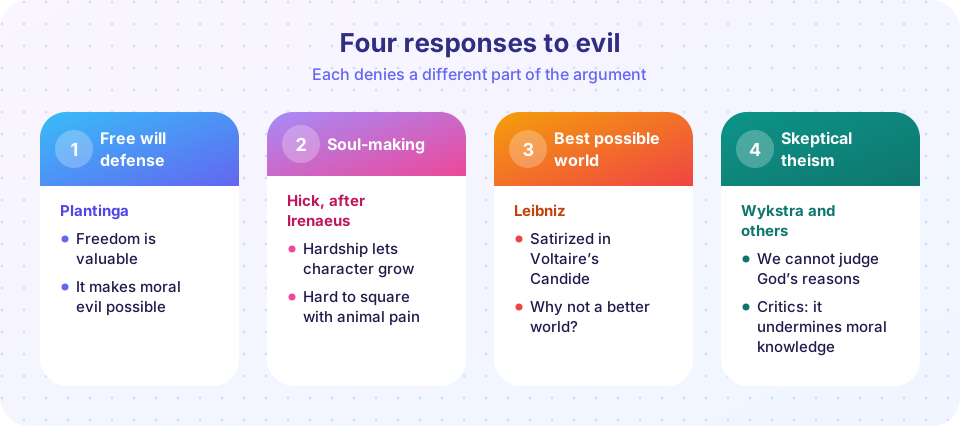
- Free will defense/theodicy. Freedom is a great good that makes moral evil possible. It does not obviously cover natural evil, so some add the idea that natural evils make moral choices meaningful (we need a predictable world in which actions matter).
- Soul-making (John Hick, drawing on the early Christian thinker Irenaeus). The world is a place for character to develop through challenge. Critics ask why so much suffering is needed, and about animals and about people who die very young.
- Best possible world (Gottfried Leibniz, Théodicée, 1710). Among all possible worlds God chose the best. Voltaire's Candide (1759) mocked this view; philosophers also question whether there is a best world, since for any world we might imagine a better one.
- Skeptical theism (Stephen Wykstra and others). Our limited understanding gives us no reason to expect that we would grasp God's reasons, so seemingly pointless evil is not good evidence of real pointlessness. Critics reply that this reasoning undermines our moral knowledge generally.
- Revising the concept of God. Process theologians and others reject full omnipotence (God persuades and does not control). Others emphasize God's suffering with the world.
Non-theists also use evil in positive arguments: if the universe has no moral designer, the pattern of suffering and flourishing we observe is not surprising.
Common misconceptions. (1) "The problem of evil proves there is no God." Philosophers disagree about how strong it is; atheists such as Rowe took it to make theism unlikely, while many theists think the replies work. (2) "Religious people have never faced the problem." Many religious thinkers have treated it seriously, including the biblical book of Job. (3) "Any answer makes suffering less real." Philosophical replies are about explanation; they do not need to minimize suffering, and many thinkers say that comfort and explanation are different tasks.
This lesson is an educational discussion of arguments. If you are dealing with grief or suffering of your own, a philosophical argument is not a substitute for support from people and professionals who can help.
Try it
Press Run (or Ctrl + Enter) to see the console output here.
No output.
Check your understanding
Quick check · 5 questions
of 5 answered You scored / 5 · perfect!
-
1. What is the logical problem of evil?
Mackie argued the set of statements cannot all be true. -
2. What did Plantinga's free will defense aim to show?
A defense only needs a possible reason; it answers the logical, not the evidential, problem. -
3. What is Rowe's evidential argument about?
He argued that the likelihood of pointless evil lowers the probability of a perfect God. -
4. Which response says we are not in a position to know God's reasons?
Skeptical theists appeal to our cognitive limits. -
5. What does a theodicy attempt?
A defense gives a possible reason; a theodicy aims higher.
Summary
- The logical problem claims inconsistency; the free will defense is widely thought to answer it.
- The evidential problem claims that apparently pointless evil makes God unlikely.
- Responses: free will, soul-making, best possible world, skeptical theism, revised concepts of God.
- Each response pays a different price, and philosophers judge those prices differently.
Next: The meaning of life
Track your progress
Create a free account to tick off lessons and pick up where you left off on any device.
of Introduction to Philosophy lessons completed