


















Lesson 27 of 44 · Free Will and Personal Identity
Compatibilism and Moral Responsibility
Hume, Frankfurt cases, Strawson's reactive attitudes and reasons-responsiveness: how philosophers defend freedom and blame in a world of causes.
Suppose you accept the lesson of the last page: every event, including your choices, has causes. Does it follow that nobody deserves praise or blame? Compatibilists say no. Their reasoning is that what matters for responsibility was never an escape from causes; it is the way your actions flow from your own reasons, desires and values. This lesson explains three classic ideas behind that claim, and the objections each faces.
What you will learn
- The classical compatibilist analysis of "could have done otherwise" and why it was challenged.
- How Frankfurt cases attack the principle of alternate possibilities.
- What P. F. Strawson's "reactive attitudes" add.
- Reasons-responsiveness, and the manipulation argument against compatibilism.
Key terms
- Compatibilism: free will and moral responsibility are compatible with determinism.
Liberty of spontaneity (Hume): acting according to your own will, without external constraint.
Frankfurt case: a scenario where someone could not have done otherwise but acts entirely on their own.
Reactive attitudes: emotional responses such as resentment, gratitude and indignation that we direct at people as responsible agents.
Reasons-responsiveness: being sensitive to reasons, so that you would act differently if the reasons were different.
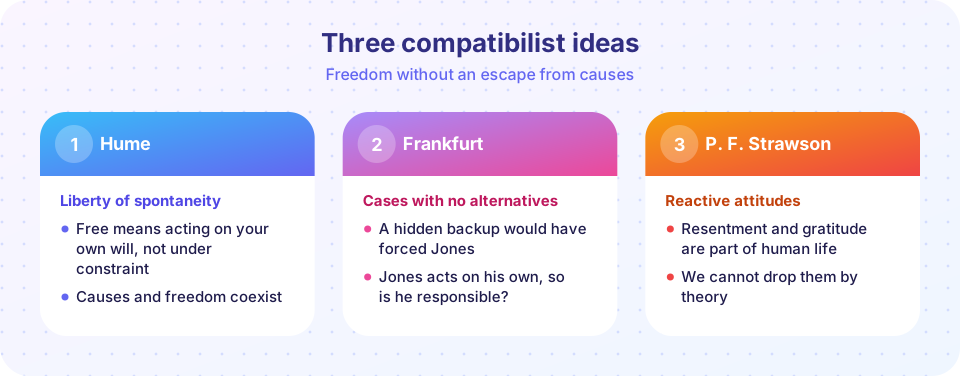
Hume: freedom as acting on your will
David Hume (An Enquiry Concerning Human Understanding, 1748) argued that the free will debate was largely a dispute about words. He distinguished two things you might mean by liberty. Liberty of indifference would be a power to act with no cause at all, which he thought neither real nor desirable. Liberty of spontaneity, the ability to do what you will when nothing stops you, is real, and it is just what we have in mind when we call a prisoner unfree and a free citizen free. A person who is chained is not free; a person who simply follows their own desires is. Both are caused.
The classical way to cash this out is the conditional analysis: "I could have done otherwise" means "I would have done otherwise if I had chosen to". This looks sensible: the chained prisoner would have left if he had chosen, but could not. Critics reply that it dodges the question. If determinism is true, perhaps I could not have chosen otherwise, which is what matters. A person under hypnosis would also act as they chose, though their choice was installed by someone else.
Frankfurt: do we need alternatives at all?
A widely held thought, the principle of alternate possibilities, says you are responsible only if you could have done otherwise. In 1969 Harry Frankfurt proposed a counterexample. Black wants Jones to carry out a certain act and is prepared to intervene, by a hidden device, if Jones shows any sign of deciding to do something else. But Jones decides on his own to do what Black wants, so Black never acts. Jones could not have done otherwise (Black would have forced him), yet he seems fully responsible, because everything that actually led to his act was his own deliberation.
If that is right, then the ability to do otherwise is not required, and the consequence argument loses its target: even if determinism removes alternatives, responsibility may survive. Critics respond in two ways: they say there is some alternative left (for example, a "flicker" at the moment Jones shows a sign of changing his mind), or they say that the case sneaks in an assumption that Jones's decision is not determined, in which case it does not help compatibilists.
Strawson: what blame is for
In his 1962 paper "Freedom and Resentment", Peter F. Strawson changed the question. We do not decide whether to hold people responsible by first settling the metaphysics. We already respond to others with gratitude, resentment, forgiveness and indignation, and these reactive attitudes are central to human relationships. These responses are not suspended by general theories: when someone steps on your foot deliberately, you resent it; when they do it accidentally, or are acting under extreme duress or are mentally ill, you change your attitude. Strawson held that what shifts the attitude is not discovering determinism but learning about how the act came about. We are not going to drop these attitudes just because of a metaphysical thesis, and it would not be rational to ask us to.
Reasons-responsiveness
More recent compatibilists (John Martin Fischer and Mark Ravizza, building on Susan Wolf) specify what makes the difference between the free agent and the compulsive one. Your action flows from a mechanism that is responsive to reasons: if you had had good reason to act differently, you would have. The compulsive hand-washer or the addict in the grip of craving is not moved by reasons; the ordinary decider is. Notice how this handles Frankfurt's Jones: the mechanism that actually produced his act is reasons-responsive, whatever Black's backup device might have done.
The manipulation argument
Derk Pereboom's four-case argument (2001) is the most-discussed challenge. In case one, scientists manipulate a person's brain so that she reasons in a certain way and does a bad act. In case four, ordinary determinism has done the same job by natural means. Pereboom asks: what relevant difference is there? If the manipulated person is not responsible, he says, neither is the determined one. Compatibilists answer in different ways: some deny that case one is non-responsible (a "hard-line reply"); others point to differences in history, such as whether the agent had a chance to form her own values over time.
Common misconceptions. (1) "Compatibilists say determinism is harmless, so nothing changes." Many accept that some folk beliefs (for example, about deep desert or ultimate sourcehood) may need revision. (2) "If it is determined, you cannot be blamed." Whether this follows is exactly what is under dispute. (3) "Responsibility is all or nothing." Most views allow degrees: coercion, ignorance and mental illness reduce it.
Try it
Press Run (or Ctrl + Enter) to see the console output here.
No output.
Check your understanding
Quick check · 5 questions
of 5 answered You scored / 5 · perfect!
-
1. What did Hume mean by 'liberty of spontaneity'?
It is the freedom of the person who is not chained or coerced. -
2. What do Frankfurt cases attack?
Jones is responsible though he could not have done otherwise. -
3. According to Strawson, why do we hold people responsible?
Strawson shifted focus to our actual attitudes and what changes them. -
4. What is reasons-responsiveness?
That is the mark that separates ordinary agency from compulsion in these theories. -
5. What is the point of Pereboom's four-case argument?
If manipulation removes responsibility and nothing relevant separates it from determinism, compatibilism is in trouble.
Summary
- Compatibilists locate freedom in how actions flow from the agent's own reasons, not in escaping causes.
- Hume's spontaneity, Frankfurt's cases and Strawson's reactive attitudes are three supports.
- Reasons-responsiveness separates ordinary agency from compulsion.
- The manipulation argument is the leading challenge; replies disagree about relevant differences.
Next: Personal identity
Track your progress
Create a free account to tick off lessons and pick up where you left off on any device.
of Introduction to Philosophy lessons completed