


















Lesson 37 of 44 · Political and Social Philosophy
Justice and Fairness: Who Should Get What?
Utilitarianism, Rawls's veil of ignorance and difference principle, Nozick's entitlement theory and Sen's capabilities, with a simulation of choosing behind the veil.
Imagine you could design the rules of a society, but you had to choose before you knew who you would be: rich or poor, healthy or disabled, born into one family or another, talented or ordinary. Which rules would you pick? That thought experiment, from John Rawls, has shaped modern debates about fairness more than almost any other. This lesson explains it, sets it beside its main rivals, and gives you a way to run the experiment with numbers.
What you will learn
- What "distributive justice" asks, and why utilitarianism alone does not satisfy many people.
- Rawls's original position, the veil of ignorance and the two principles of justice.
- Nozick's entitlement theory and the Wilt Chamberlain argument.
- Sen and Nussbaum's capability approach, and how Lorenz curves and the Gini coefficient measure inequality.
Key terms
- Distributive justice: what makes a distribution of income, opportunity and burdens fair.
Veil of ignorance: a device that hides your own position so that you choose impartially.
Maximin: choose the option whose worst outcome is best.
Difference principle (Rawls): inequalities are acceptable only if they work to the benefit of the least advantaged.
Entitlement theory (Nozick): a distribution is just if it arose by just acquisition and just transfer.
The utilitarian starting point
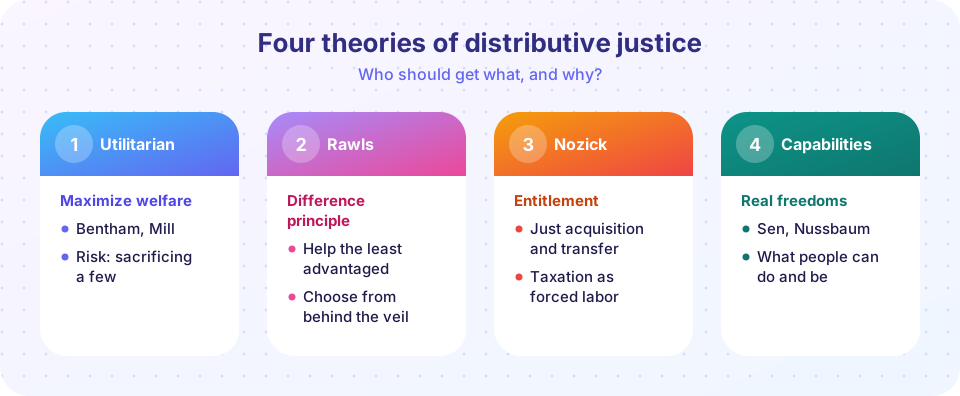
Jeremy Bentham and John Stuart Mill argued that the right policy maximizes overall well-being, counting each person equally. This has attractive features: it takes everyone's welfare seriously and it favors policies that actually help. But critics, including Rawls, point to a worry: adding up welfare can justify imposing a severe loss on a few if it creates enough benefit for many. It treats persons as places where welfare happens, not as individuals with claims of their own.
Rawls: justice as fairness
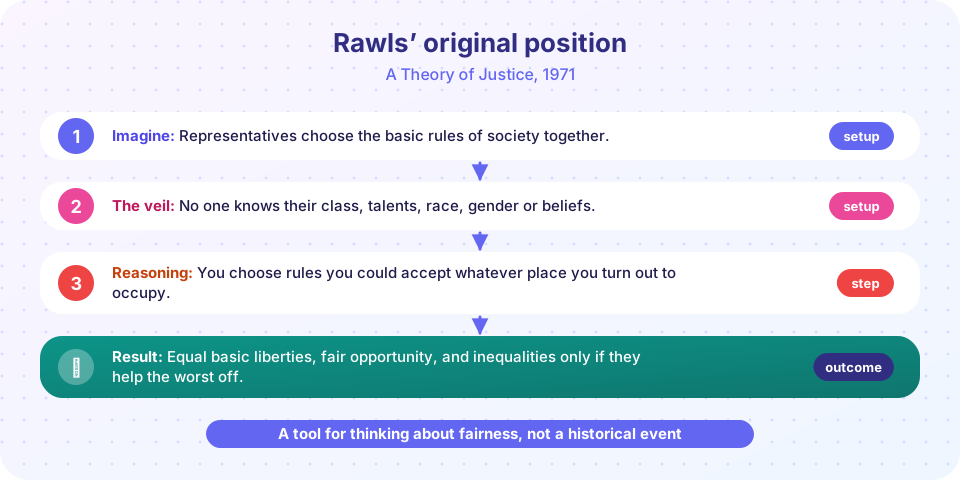
In A Theory of Justice (1971), John Rawls asked what principles free and equal people would choose for the basic structure of society if they were placed in an original position behind a veil of ignorance. They know general facts about society, economics and psychology, but not their own class, talents, sex, race, religion or even their conception of the good life. Since anyone might end up in any position, Rawls argued, they would choose cautious principles, roughly maximin reasoning about the worst-off position:
- Equal basic liberties for all (speech, conscience, vote, personal property, fair trial).
- Fair equality of opportunity, and the difference principle: social and economic inequalities are allowed only if they benefit the least advantaged.
The first principle has priority over the second: liberties cannot be traded for economic gains. Note that the difference principle does not require equality. A system in which talented people earn more is just if the extra incentives raise the position of the worst-off above what equality would give.
Rawls's critics disagree on several points. John Harsanyi argued that rational people behind the veil would maximize average utility, not the worst-case. Nozick and others object that the whole approach starts from the wrong place. Communitarians such as Michael Sandel say the veil depicts a strangely "unencumbered" self that does not exist, since our identities are tied up with communities. G. A. Cohen argued that if the talented need incentives to work for the common good, they are not really committed to justice.
Nozick: entitlement
In Anarchy, State, and Utopia (1974), Robert Nozick argued that justice concerns the history of how holdings arose, not a pattern at a given moment. If you acquired something justly (or received it by gift or fair trade from someone who held it justly), you are entitled to it. His Wilt Chamberlain example: start with any distribution you consider perfectly fair; suppose a million fans each freely pay a little extra to see the basketball star play. Now Chamberlain has much more than others, by voluntary transactions. If the starting distribution was just, and each step was voluntary, how can the result be unjust? Maintaining any pattern, Nozick said, requires continual interference with free choices. He concluded that only a minimal state (protecting against force, theft and fraud) is justified, and that taxing earnings for redistribution is comparable to forced labor.
Critics reply that the starting point is never just (many holdings come from conquest and slavery), that the example ignores the background institutions that make markets possible, and that large inequalities may undermine the equal standing citizens need.
Capabilities: justice as real freedoms
Amartya Sen and Martha Nussbaum shifted the question from "how much money?" to "what can people actually do and be?" Two people with the same income may have very different opportunities if one is disabled, lives far from a school, or faces discrimination. Their capabilities approach asks about substantive freedoms: to be healthy, to learn, to take part in community life. Nussbaum proposed a list of central capabilities; Sen resisted a fixed list, favoring public reasoning.
Measuring inequality
Economists use the Lorenz curve (the cumulative share of income held by the poorest x% of people) and the Gini coefficient (the area between the curve and the line of perfect equality, scaled from 0 to 1) to describe inequality. Measurement is neutral about whether a given inequality is just: that is what the theories above argue about.
Common misconceptions. (1) "Rawls wants everyone to have the same." He allows inequality if it benefits the worst-off. (2) "Nozick thinks the poor do not matter." He holds that rights restrict what may be done to people, and that charity is permitted; the dispute is about what justice requires. (3) "The veil of ignorance was an actual proposal." It is a device for thinking about fairness.
Try it
Press Run (or Ctrl + Enter) to see the result here.
Program input · what you'd type while the program runs
Type the answers before you press Run, one per line. Each time the program reads a line (with input()), it gets the next line from this box.
Check your understanding
Quick check · 5 questions
of 5 answered You scored / 5 · perfect!
-
1. What does the veil of ignorance do?
Not knowing whether you will be rich or poor motivates fair rules. -
2. What does Rawls's difference principle allow?
Unequal rewards are justified if they raise the position of the worst-off. -
3. What is the point of the Wilt Chamberlain example?
Nozick argued that maintaining a pattern requires continual interference. -
4. What does the capabilities approach emphasize?
Sen and Nussbaum look at substantive freedoms, not only resources. -
5. A Gini coefficient of 0 means
Zero means everyone has the same; values near 1 mean extreme concentration.
Summary
- Utilitarianism maximizes total welfare but may sacrifice individuals.
- Rawls: choose rules behind a veil; equal basic liberties, fair opportunity and the difference principle.
- Nozick: just history of acquisition and transfer; minimal state.
- Sen and Nussbaum: judge by real capabilities.
- Lorenz curves and Gini measure inequality; they do not say what is fair.
Next: Liberty and rights
Track your progress
Create a free account to tick off lessons and pick up where you left off on any device.
of Introduction to Philosophy lessons completed