


















Lesson 14 of 44 · Logic and Argument
Chapter 3 Review: Logic and Argument
Review validity, soundness, deduction, induction, abduction and common fallacies with a decision path, a recap table, a truth-table tool and a ten-question quiz.
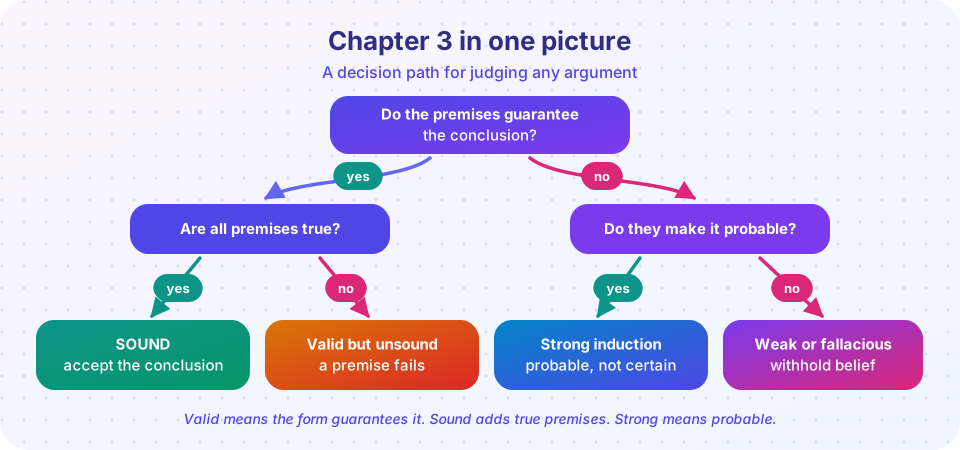
You now own a real toolkit for evaluating reasoning. This review puts the pieces on one page, in the order you would use them on a new argument, and then tests you. The picture below is worth memorizing: three questions take you from a raw argument to a verdict.
What you will learn
- A single decision path for judging arguments.
- A recap of the chapter's key terms and forms.
- Where to revisit each topic.
Recap table
| Idea | Summary | Lesson |
|---|---|---|
| Argument | Premises offered for a conclusion; not every "because" is an argument | Overview |
| History | Aristotle, Stoics, Boole (1854), Frege (1879), Gödel (1931) | Overview |
| Validity | Premises cannot all be true with a false conclusion | Arguments |
| Soundness | Valid with all premises true | Arguments |
| Valid forms | Modus ponens, modus tollens, disjunctive and hypothetical syllogism | Arguments |
| Invalid forms | Affirming the consequent, denying the antecedent | Arguments |
| Deduction | Certain if premises true | Deduction and Induction |
| Induction | Probable; judged strong or weak; cogent if premises true | Deduction and Induction |
| Abduction | Inference to the best explanation (Peirce) | Deduction and Induction |
| Hume's problem | What justifies assuming the future will resemble the past? | Deduction and Induction |
| Fallacies | Formal and informal; relevance, weak induction, presumption | Fallacies |
| Fallacy fallacy | A bad argument does not make its conclusion false | Fallacies |
A routine for any argument
- Find the conclusion and write the premises in standard form, adding suppressed premises.
- Test the link: if the premises were true, must the conclusion be true? If so, the argument is valid. If not, is it at least probable (strong) or does it commit a fallacy?
- Test the premises: are they true or at least plausible?
- Decide: accept, doubt, or ask for better reasons. Say exactly which step fails.
When you disagree with a conclusion, you must reject at least one premise or the validity of the step. "I just don't like the conclusion" is not an objection. Find which premise you would deny.
Common misconceptions
"Valid means true." Validity concerns form; truth concerns the world. Soundness needs both.
"Inductive arguments are weak by definition." They can be extremely strong. They are simply never certain.
"If I can name a fallacy, I have won." Naming a flaw shows one argument fails, not that its conclusion is false.
Try it
Press Run (or Ctrl + Enter) to see the result here.
Program input · what you'd type while the program runs
Type the answers before you press Run, one per line. Each time the program reads a line (with input()), it gets the next line from this box.
Press Run (or Ctrl + Enter) to see the console output here.
No output.
Check your understanding
Quick check · 10 questions
of 10 answered You scored / 10 · perfect!
-
1. An argument is sound when it is
Soundness requires validity together with all premises true. -
2. Which is a valid form?
Modus tollens is valid. The other two are affirming the consequent and denying the antecedent. -
3. Can a valid argument have a false conclusion?
Validity rules out true premises with a false conclusion, but a false premise can lead to a false conclusion in a valid argument. -
4. Every swan observed so far is white, so the next swan will be white. This is
It goes beyond the premises to a probable conclusion about an unobserved case. -
5. Which statement about abduction is correct?
Charles Sanders Peirce named abduction as inference to the best explanation. -
6. 'You cannot trust her study because she wears a funny hat' is
It attacks a personal feature of the author instead of the study. -
7. A false dilemma
It restricts the choices artificially, usually to favor one. -
8. The 'fallacy fallacy' is
A conclusion can be true even if the argument offered for it is poor. -
9. Why does correlation not prove causation?
Confounding variables and chance can create correlations without a direct causal link. -
10. Hume's problem of induction asks
Any attempt to justify induction seems to rely on induction itself.
Summary
- Judge arguments in order: conclusion and premises, validity or strength, truth of premises, verdict.
- Valid, sound, strong and cogent each answer a different question.
- Deduction guarantees; induction and abduction make conclusions probable.
- Fallacies are patterns that seem to support but do not; a bad argument does not refute its conclusion.
- Chapter 4 uses these tools on one of philosophy's deepest questions: what can we know?
Track your progress
Create a free account to tick off lessons and pick up where you left off on any device.
of Introduction to Philosophy lessons completed