


















Lesson 2 of 44 · Getting Started
How to Study Philosophy: Read, Map, Test, Write
A practical method for reading hard philosophy, reconstructing arguments in standard form, answering objections charitably and writing clear short essays.
Philosophy texts are not like novels or textbooks. A novel carries you along; a textbook hands you facts to memorize. A philosophical text puts a claim on the table and then argues for it, often in dense prose, and your job is to find out whether the argument works. That is a skill, and like any skill it has a method you can practice.
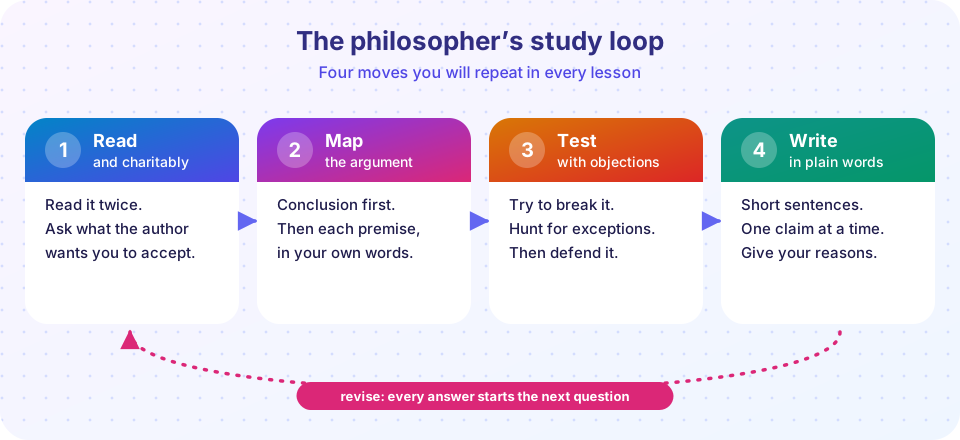
This lesson gives you a four-step routine: read, map, test, write. You will use it on every thinker in the course, from Socrates to modern debates about minds and justice.
What you will learn
- How to read a difficult passage in two passes.
- How to rewrite an argument in standard form, with numbered premises.
- How to give a view a charitable hearing before you criticize it.
- How to structure a short philosophical essay.
Key terms
- Premise: a claim offered as a reason.
- Conclusion: the claim the reasons are meant to support.
- Standard form: an argument written as numbered premises followed by a conclusion.
- Principle of charity: interpret others so that what they say is as reasonable as possible.
- Objection: a reason to think a premise is false or the conclusion does not follow.
Step 1: Read slowly, and twice
On the first pass, read for the topic: what is the question, and what answer does the author favor? Do not stop for hard words. On the second pass, read for the argument: underline the sentence that states the main conclusion, then underline the sentences that give reasons for it.
Philosophers often signal their reasoning with indicator words. Reason indicators such as because, since, for and given that introduce premises. Conclusion indicators such as therefore, so, thus and it follows that introduce conclusions. These words are clues, not guarantees: "since" can also mean "from a time", and some arguments have no indicator words at all.
Keep a small glossary. Words like "justified", "valid" and "substance" have special meanings in philosophy, and most confusion in an introductory course comes from reading them in their everyday sense.
Step 2: Map the argument
Mapping means rewriting the argument in your own words in standard form:
P1. Every human being is mortal.
P2. Socrates is a human being.
C.  Therefore, Socrates is mortal.
The rules are simple: one claim per line, complete sentences, no rhetoric, and the conclusion at the bottom. Real arguments have unstated assumptions (called suppressed premises). If an author says "Pain is bad, so we should reduce suffering", the suppressed premise might be "Whatever is bad should be reduced where we can." Writing it out lets you decide whether you accept it.
Here is a worked example in ordinary prose:
"You should not eat animals. After all, animals can suffer, and causing needless suffering is wrong."
Mapped:
P1. Animals can suffer.
P2. Causing needless suffering is wrong.
P3. (suppressed) Killing animals for food causes needless suffering.
C.  Therefore, we should not eat animals.
Notice what the mapping revealed. P3 carries much of the weight and is far from obvious: a critic might say eating meat is not needless. Whether you agree with the conclusion or not, you now know exactly where to aim. That is the point of mapping.
If you cannot map a passage, that is useful information. Either you have not understood it yet, or the passage is not really an argument (it may be an explanation, a description or a story).
Step 3: Test the argument
Two questions drive all evaluation:
- Do the premises, if true, really support the conclusion? (This is about the logic. Chapter 3 treats it in depth.)
- Are the premises true, or at least plausible?
A good objection targets one of these. You can deny a premise, you can show the conclusion does not follow, or you can give a counterexample: a case where the premises hold but the conclusion fails.
Before you criticize, apply the principle of charity. The American philosopher Donald Davidson helped make charity a standard idea in interpretation, and the philosopher Daniel Dennett popularized a four-step version, usually credited to the social psychologist Anatol Rapoport:
- Restate the other person's position so clearly that they would say "I wish I had put it that way."
- List any points of agreement.
- Mention anything you learned from them.
- Only then say what you want to say in reply.
The aim is not politeness for its own sake. If you attack a weak version of a view (a straw man, which you will meet again in the lesson on fallacies), you learn nothing even if you win.
Step 4: Write it down
A short philosophy essay of 600 to 1,000 words follows a plain pattern:
| Part | What it does |
|---|---|
| Introduction | States the question and your thesis (your answer) in two or three sentences. |
| Exposition | Presents the argument you will discuss, fairly and in standard form. |
| Evaluation | Gives your objection or your defense, with reasons. |
| Objection and reply | Raises the strongest reply to you and answers it. |
| Conclusion | Sums up what has been shown, and what has not. |
Good philosophical writing uses short sentences, defines key terms once, avoids jargon where plain words will do, and signposts its structure ("First... Second... I now turn to the objection that..."). Do not hide a weak step in a long sentence.
A worked example in discussion
Suppose a friend says, "Taxes are theft." Instead of arguing at once, map their claim:
P1. Taking someone's property without consent is theft.
P2. Taxes take people's property without their individual consent.
C.  Therefore, taxes are theft.
Now test. Is P1 true as stated? Many legal and political philosophers would distinguish theft from legitimate coercion authorized by a fair process. Is P2 true? Some say that living in a democracy involves a kind of consent, and others say it does not. You have turned a shouting match into a map of exactly where the disagreement lies. Chapter 8 returns to this question properly.
Common misconceptions
"A good essay takes a side and attacks the other side." The best essays present the opposing view at its strongest, then explain why they still prefer their own.
"If I can't refute it, it must be true." Failing to find a flaw may mean the argument is strong, or it may mean you have not looked hard enough. Hold the conclusion with confidence proportional to the evidence.
"Philosophy is about finding the one right answer." Sometimes it is. Often the progress is a clearer map of the options and what each costs.
Try it
Press Run (or Ctrl + Enter) to see the console output here.
No output.
Check your understanding
Quick check · 5 questions
of 5 answered You scored / 5 · perfect!
-
1. In standard form, where does the conclusion go?
Standard form lists the premises first and ends with the conclusion, so the support is visible before the claim it supports. -
2. Which word most often signals a premise?
'Because' introduces a reason. 'Therefore', 'thus' and 'hence' usually introduce a conclusion. -
3. What is a suppressed premise?
Arguments often rely on assumptions that are left unsaid. Writing them out lets you judge whether you accept them. -
4. Which of these follows the principle of charity?
Charity means giving a view its strongest reasonable reading first, so that your reply addresses the real position. -
5. What is a counterexample to an argument?
A counterexample shows that the premises do not guarantee the conclusion, since here is a case where they are true and the conclusion is false.
Summary
- Read twice: once for the topic, once for the argument.
- Map arguments in standard form, including suppressed premises.
- Test whether the premises support the conclusion and whether they are true; use counterexamples.
- Apply charity before criticism; avoid straw men.
- Write essays with a clear thesis, a fair exposition, an evaluation, and an objection with a reply.
Track your progress
Create a free account to tick off lessons and pick up where you left off on any device.
of Introduction to Philosophy lessons completed