


















Lesson 13 of 44 · Logic and Argument
Fallacies: Bad Reasoning That Looks Good
Learn the most common logical fallacies, from ad hominem and straw man to false dilemma and begging the question, with examples, fixes and a self-test.
A fallacy is a pattern of reasoning that seems persuasive but fails to support its conclusion. Some fallacies are errors we make innocently; others are used on purpose in advertising, politics and online arguments. Knowing their names helps, but the real skill is noticing the gap between what an argument offers and what it claims.
The Greek philosopher Aristotle catalogued the tricks of sophistical arguments in Sophistical Refutations over two thousand years ago, and the list has grown ever since. This lesson covers the dozen that you will meet most often.
What you will learn
- The difference between formal and informal fallacies.
- Twelve common fallacies, with examples and the question that exposes each.
- Why you should reconstruct an argument before calling it a fallacy.
- How to avoid the "fallacy fallacy".
Key terms
- Formal fallacy: an error in the logical form (such as affirming the consequent).
- Informal fallacy: an error in the content or context of the reasoning.
- Relevance: whether a premise actually bears on the conclusion.
- Burden of proof: the duty to give reasons that falls on the person making a claim.
Formal and informal fallacies
Formal fallacies are invalid forms, such as the two you met in lesson 2: affirming the consequent and denying the antecedent. You can detect them by looking at the structure alone.
Informal fallacies are not about logical form but about how premises relate to the conclusion in a particular context. They usually fall into three groups: fallacies of relevance (the premise is beside the point), of weak induction (the premise is too thin to support the conclusion) and of presumption (the argument assumes what it should prove).
Twelve common informal fallacies
| Fallacy | What it does | Example | Question that exposes it |
|---|---|---|---|
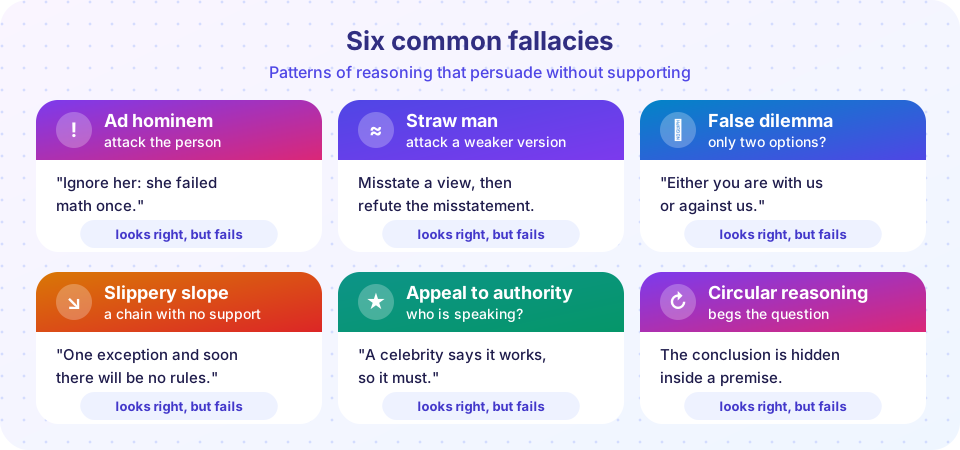
| Ad hominem | Attacks the person, not the argument | "Don't listen to her budget plan: she once went bankrupt." | Is the criticism about the reasons or about the speaker? |
| Straw man | Distorts a view, then attacks the distortion | "She wants fewer cars on the road, so she wants to ban all driving." | Is this what the person actually said? |
| False dilemma | Offers two options when more exist | "Either we cut all taxes or the economy collapses." | Are there other options? |
| Slippery slope | Claims a small step will inevitably lead to disaster without support | "If we allow one late homework, no one will do homework." | What evidence connects each step? |
| Appeal to authority | Cites an authority outside their expertise, or treats authority as proof | "A famous actor says this diet works." | Is the authority an expert in this field, and do experts agree? |
| Begging the question | Assumes the conclusion in a premise | "The book is true because it says it is the word of truth." | Does a premise already contain the conclusion? |
| Hasty generalization | Draws a broad claim from too few cases | "I met two rude tourists, so tourists are rude." | Is the sample large and representative? |
| Post hoc ergo propter hoc ("after this, therefore because of this") | Assumes that what came first caused what followed | "I wore my lucky socks and we won." | Is there a plausible mechanism or a control? |
| Appeal to popularity | Treats widespread belief as proof | "Millions of people believe it, so it is true." | Do many believers constitute evidence here? |
| Tu quoque ("you too") | Answers a criticism by pointing to the critic's faults | "You tell me to stop smoking, but you smoked." | Does the critic's behavior change whether the claim is true? |
| Red herring | Introduces an irrelevant topic to distract | "Yes, the factory pollutes, but think of the jobs it offers." | Does this answer the original issue? |
| Equivocation | Uses a word in two senses within one argument | "Laws need a lawmaker; nature has laws; so nature has a lawmaker." | Does the key word mean the same thing each time? |
A few notes help sharpen these.
Ad hominem is often confused with legitimate questions about credibility. If a witness has been proved to lie under oath, that is relevant to how much to trust the testimony. The fallacy arises when the personal attack is offered as a reason that the claim is false.
Appeal to authority is not always fallacious. Relying on a qualified expert in her field is reasonable. The fallacy is citing someone with no relevant expertise, or treating an authority as infallible when experts disagree.
Slippery slope arguments are sometimes legitimate if each step is supported by evidence of a causal chain. The fallacy lies in asserting the chain without support.
Equivocation in the lawmaker example: "law" in civil society means a rule laid down by someone, while "laws of nature" are regularities. The argument works only if the two senses are blurred.
The fallacy fallacy
Suppose someone says, "You are using a straw man, so your conclusion is false." This commits the fallacy fallacy, also called argumentum ad logicam: concluding that a claim is false just because the argument for it is bad. A flawed argument gives no support, but the conclusion might still be true. The correct reply is: "That argument does not show it, so I withhold judgment, or look for better reasons."
Before you label an argument a fallacy, put it into standard form (lesson 2) and apply the charity principle from chapter 1. Ask: "What is the strongest version of this argument?" Often what seems like a fallacy is an incomplete argument that can be repaired by adding a missing premise.
How to respond to a fallacy
- Name it kindly: "I think this jumps from one example to a general claim."
- Ask a question: "What would show that this is different?"
- Offer the repair: "A larger sample would make the argument stronger."
- Return to the claim: "Setting that aside, what is the evidence for the original point?"
Common misconceptions
"Any argument that is emotional is a fallacy." Emotion becomes a problem only when it replaces reasons. A warning about a real danger can be vivid and still be sound.
"Every slippery slope argument is fallacious." Some are strong, supported by evidence about causal links, such as how a small drift in standards can compound.
"Spotting a fallacy wins the debate." It identifies a flaw in one argument, not the truth about the topic.
Try it
Press Run (or Ctrl + Enter) to see the console output here.
No output.
Check your understanding
Quick check · 6 questions
of 6 answered You scored / 6 · perfect!
-
1. Which of these is an ad hominem?
The attack is on the person's history, not on the reasoning. -
2. A straw man argument
It replaces the opponent's real view with a weaker, easier target. -
3. 'Either you are with us or against us' is
It presents only two options when others might exist. -
4. Citing a qualified medical researcher about a medical question is
Appeal to authority is fallacious only when the source lacks relevant expertise or is treated as infallible. -
5. What is the 'fallacy fallacy'?
A bad argument gives no support, but the conclusion might still be true for other reasons. -
6. 'I wore my lucky socks and we won, so the socks made us win' is an example of
It assumes that because one event followed another, the first caused the second.
Summary
- A fallacy is a pattern of reasoning that appears to support a conclusion but does not.
- Formal fallacies are bad forms; informal fallacies fail by relevance, weak induction or presumption.
- Learn the key questions for twelve common fallacies, and reconstruct the argument charitably before labeling it.
- Avoid the fallacy fallacy: a bad argument does not make its conclusion false.
Next: Chapter 3 Review
Track your progress
Create a free account to tick off lessons and pick up where you left off on any device.
of Introduction to Philosophy lessons completed