


















Lesson 39 of 44 · Political and Social Philosophy
Chapter Review: Political and Social Philosophy
A recap of the social contract, theories of justice, liberty and rights, with a comparison grid, table and a nine-question chapter quiz.
This chapter asked how a state can be justified, what a fair distribution looks like, and how much liberty people should have. Here is the whole chapter as one map, then a quiz across the lessons.
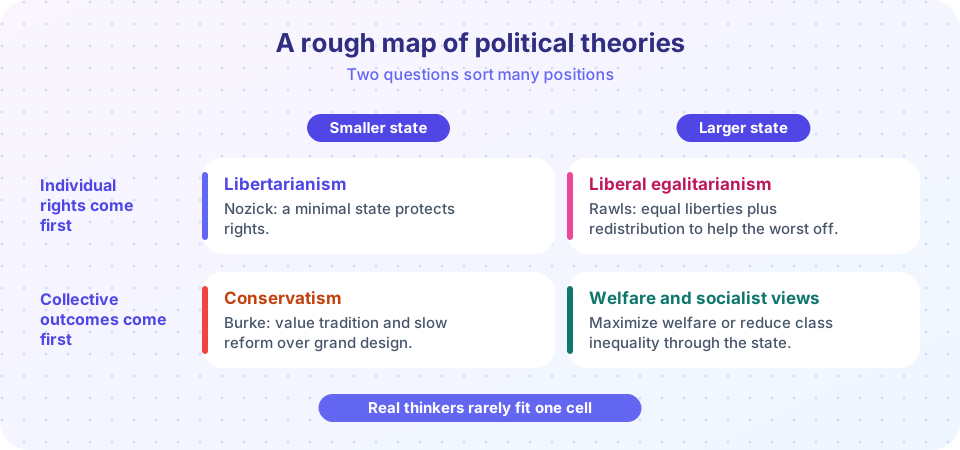
Recap table
| Topic | Key idea | Names | Main objection |
|---|---|---|---|
| Hobbes | Sovereign power ends the war of all against all | Hobbes | Gives dangerous power to rulers |
| Locke | Limited government protects natural rights | Locke | Property and consent assumptions |
| Rousseau | Citizens obey laws they make together | Rousseau | Risk to minorities |
| Contract critics | Nobody signed; the contract excluded groups | Hume, Pateman, Mills | Hypothetical consent may still test justice |
| Rawls | Choose behind the veil; difference principle | Rawls | Harsanyi, communitarians |
| Nozick | Just history of holdings; minimal state | Nozick | Starting point is not just |
| Capabilities | Judge by real freedoms | Sen, Nussbaum | Which capabilities, and who decides? |
| Berlin | Negative vs positive liberty | Berlin | Is the line sharp? |
| Mill | Harm principle | Mill | What counts as harm? |
| Rights | Claims that impose duties | Locke, Bentham, Hart, Raz | Conflicts and balancing |
Skills to take with you
- Find the principle. For any policy argument, ask which principle (welfare, fairness, liberty, rights) it relies on.
- Test with a case. Wilt Chamberlain, the veil of ignorance and the harm principle are all cases that expose a principle's consequences.
- Notice the facts. Many political disputes combine a disagreement over values with a disagreement about facts.
- Be charitable. State a view well enough that its supporters would recognize it before you criticize it.
When you read a political argument, try this: write one sentence stating the principle, and one stating a case where the principle gives an answer you find hard to accept. If you can do both, you are doing philosophy.
Try it
Press Run (or Ctrl + Enter) to see the console output here.
No output.
Chapter quiz
Quick check · 9 questions
of 9 answered You scored / 9 · perfect!
-
1. In Hobbes's state of nature, life is
Without a common power, fear and competition lead to conflict. -
2. What limits government in Locke's theory?
Authority comes from consent to protect rights. -
3. Rousseau's 'general will' refers to
It is aimed at the common good. -
4. In Rawls's original position, people choose principles
The veil hides talents, class and background. -
5. The difference principle says inequalities are acceptable if
It is Rawls's second principle's distinctive part. -
6. Nozick's Wilt Chamberlain example is meant to show that
He used it against end-state and patterned views of justice. -
7. Which of these is a negative liberty issue?
Censorship is interference; the others concern means and capacities. -
8. According to Mill, society may limit your liberty to prevent
The harm principle excludes paternalism and moralism. -
9. Which description fits a positive right?
Negative rights require refraining; positive rights require acting.
Summary
- Contract theories test authority by what free and equal people would accept; critics question consent and exclusion.
- Justice theories disagree on whether fairness is about welfare, worst-off position, history of holdings or real capabilities.
- Liberty has negative, positive and republican versions; Mill's harm principle limits coercion; rights are claims with correlative duties.
- Good political reasoning names its principle, tests it with cases and separates facts from values.
Track your progress
Create a free account to tick off lessons and pick up where you left off on any device.
of Introduction to Philosophy lessons completed