


















Lesson 30 of 44 · Religion and Meaning
Chapter overview: Religion and Meaning
A map of arguments about God, the problem of evil, and the meaning of life, taught as questions about reasons, not as a contest between believers and doubters.
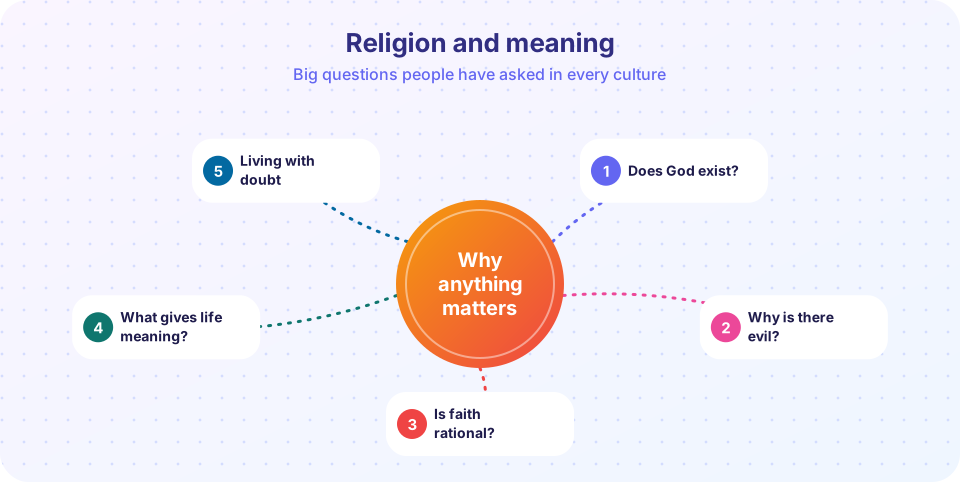
People in every culture have asked whether there is something beyond the visible world, why suffering exists, and what makes a life worth living. This chapter treats those questions the way philosophers do: by looking at the arguments. We do not tell you what to believe. We show how the best arguments on each side are built, where they are strongest, and where their critics press.
What you will learn
- The difference between philosophy of religion (examining arguments) and religious belief or practice itself.
- The main families of arguments about God and the main replies.
- The problem of evil and the best-known responses.
- Competing theories of what makes a life meaningful.
Key terms
- Theism: belief in a personal God. Atheism: lack of belief in God (or belief that none exists). Agnosticism: the view that we cannot know, or have not decided.
Philosophy of religion: the critical study of religious claims and the arguments about them.
Theodicy: an attempt to explain why a good God would permit evil.
Nihilism: the view that life has no meaning or value.
This is an educational overview of arguments from many traditions. It is not advice about what to believe, and it does not offer counseling. If questions about meaning feel heavy for personal reasons, talking with someone you trust or a qualified professional is a good idea.
Chapter slides
Questions people ask
Arguments about God
Lesson 2
The problem of evil
Lesson 3
Meaning of life
Lesson 4
How philosophers approach religion
Three habits are worth learning at the start.
- Separate the question from the person. An argument can be good or bad no matter what the speaker believes. Check the premises and the logic, not the identity of the speaker.
- Use the strongest version of each view. "Steel-manning" means stating the best form of the opposing argument before replying. It is the opposite of attacking a caricature.
- Notice the burden of proof. Who has to show what? Different thinkers set the default differently, and that choice often decides the outcome before any argument starts.
Philosophers of religion come from every background: devout believers, atheists and agnostics all do careful work. Judge their arguments on the page.
What each lesson covers
| Lesson | Question | Key names |
|---|---|---|
| Arguments about God's existence | Do reasons support belief in God? | Anselm, Aquinas, Paley, Pascal, Hume |
| The problem of evil | Can God and evil coexist? | Mackie, Plantinga, Rowe, Hick |
| The meaning of life | What makes life meaningful? | Camus, Nagel, Wolf, Frankl |
| Chapter review | Putting it together | all of the above |
Try it
Press Run (or Ctrl + Enter) to see the console output here.
No output.
Check your understanding
Quick check · 4 questions
of 4 answered You scored / 4 · perfect!
-
1. What does 'steel-manning' mean?
It is the opposite of a straw man and makes criticism fairer and more useful. -
2. What is a theodicy?
Theodicies respond to the problem of evil. -
3. Which describes agnosticism?
Agnostics suspend judgment. -
4. Philosophy of religion mainly aims to
It is a critical study, open to believers and non-believers alike.
Summary
- The chapter examines arguments about God, evil and meaning, without telling you what to believe.
- Good habits: separate argument from arguer, state the strongest version, watch the burden of proof.
- Next lessons: the arguments for and against God, the problem of evil, and the meaning of life.
Track your progress
Create a free account to tick off lessons and pick up where you left off on any device.
of Introduction to Philosophy lessons completed