


















Lesson 8 of 44 · What Is Philosophy
Philosophy Across Cultures
A tour of philosophical traditions in India, China, the Islamic world and Africa, with key thinkers, dates, main ideas and how the traditions overlapped in time.
Many introductory courses start with the Greeks and move straight through Europe to the present, as if philosophy had one home. In fact people in many societies asked the same large questions, often at the same time and often with strikingly different answers. Looking at these traditions does two things. It shows that no single culture owns reason, and it gives you a bigger menu of ideas to test your own views against.
This lesson is a tour, not a full history. For each tradition you will meet a few thinkers and ideas, with careful hedges where dates or authorship are uncertain.
What you will learn
- Landmark thinkers and ideas from India, China, the Islamic world and Africa.
- Which traditions were contemporaries.
- Why "Western philosophy" and "world philosophy" are rough labels.
- How to read an unfamiliar tradition fairly.
Key terms
- Tradition: a line of thinkers who read, criticize and extend each other's work.
- Dharma: in Indian thought, duty, law or the right order of things; its meaning varies by tradition.
- Dao (Tao): in Chinese thought, "the way", a path of life or of nature, understood differently by different schools.
- Ubuntu: a southern African ethical idea often summed up as "a person is a person through other persons".
India
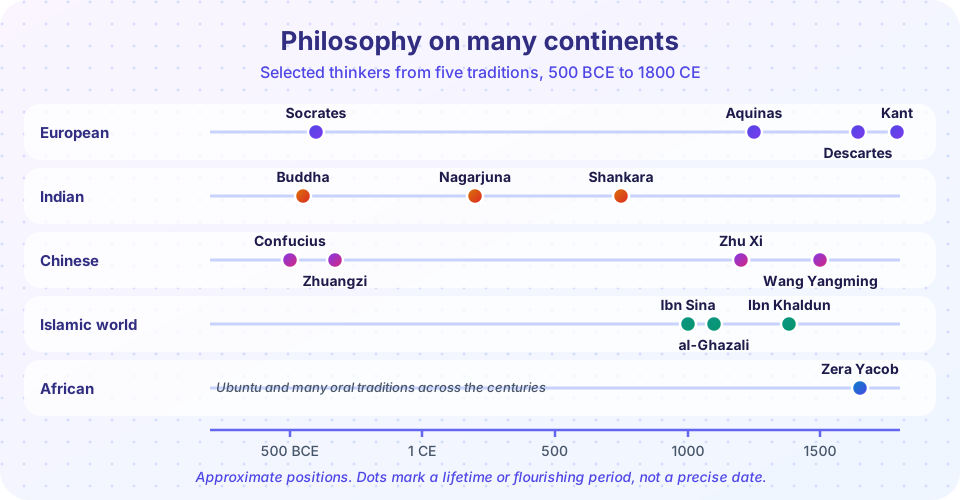
Indian philosophy is one of the oldest continuous traditions. Texts called the Upanishads (roughly 800 to 500 BCE) discuss the self (atman) and ultimate reality (Brahman). Around the fifth century BCE (the exact dates are debated) Siddhartha Gautama, the Buddha, taught that suffering arises from craving and that there is no permanent, unchanging self; this started Buddhist philosophy, which later split into many schools. The Jain tradition developed ideas of non-violence (ahimsa) and the many-sidedness of truth.
The six classical "schools" of Hindu philosophy include Nyaya, which developed rules of inference and debate (a rival to Aristotelian logic), and Vedanta. Nagarjuna (around the second century CE) founded the Madhyamaka school, arguing that things lack independent, intrinsic existence. Shankara (around the eighth century CE) taught Advaita ("non-dual") Vedanta, in which the individual self and Brahman are one. Indian thinkers wrote careful commentaries and replies, so the tradition is as much about argument as about mysticism.
China
Chinese philosophy flourished in the Spring and Autumn and Warring States periods (roughly 770 to 221 BCE), often called the era of the "hundred schools". Confucius (551 to 479 BCE) emphasized virtue, ritual and education; in the Analects he advises, in one of several versions of a golden rule, not to impose on others what you would not want yourself. Mozi (around 470 to 391 BCE) argued for impartial concern for all and was an early advocate of reasoning about consequences. Laozi (a figure of uncertain date) is traditionally credited with the Daodejing, and Zhuangzi (around the fourth century BCE) wrote playful, sceptical stories, such as dreaming of being a butterfly and wondering which is the dream. Han Feizi (died 233 BCE) argued for law and state power in the Legalist school.
In later centuries, Buddhism entered China from India, and Zhu Xi (1130 to 1200) systematized Neo-Confucianism, while Wang Yangming (1472 to 1529) argued that moral knowledge and action are inseparable.
The Islamic world
From the eighth century CE, scholars in Baghdad translated Greek works into Arabic, and philosophers built on them. Ibn Sina (Avicenna, 980 to 1037) wrote an encyclopedic philosophy and the famous "flying man" thought experiment: imagine a person created fully formed, floating in air, with no sensation of the body. Would he still be aware of himself? Ibn Sina thought so, and used it to argue that the self is not simply the body. Al-Ghazali (1058 to 1111) wrote The Incoherence of the Philosophers, criticizing parts of that philosophy, and Ibn Rushd (Averroes, 1126 to 1198) replied with The Incoherence of the Incoherence and wrote commentaries on Aristotle that were influential in medieval Europe. Ibn Khaldun (1332 to 1406) wrote the Muqaddimah (1377), a pioneering study of history and society. Related Jewish thinkers such as Maimonides (1138 to 1204) wrote in Arabic as well as Hebrew.
Africa
African philosophy includes oral traditions, written texts and modern academic work. Ubuntu thought, widespread in southern Africa, links personhood to community. In Ethiopia, the Hatata ("Inquiry"), written around 1667 and attributed to Zera Yacob (1599 to 1692), is a rationalist essay that argues from reason to the existence of a creator and criticizes religious intolerance; scholars have debated its authorship. In the twentieth century, philosophers such as Kwame Gyekye (Ghana) on Akan thought and H. Odera Oruka (Kenya) on "sage philosophy", which recorded the reasoned views of thoughtful elders, expanded the field. African philosophy also includes Egyptian wisdom texts from the third millennium BCE, such as the maxims of Ptahhotep, though how to place them in "philosophy" is debated.
Other traditions
Indigenous philosophies of the Americas, Australia and the Pacific often connect knowledge, land and community in ways that differ from standard Western categories. Many are oral traditions, which makes them harder to survey in textbooks but no less philosophical. Medieval Europe (Augustine, Anselm, Aquinas) and the Enlightenment (Descartes, Locke, Hume, Kant) form the usual "Western" story, which is one thread among many.
Reading an unfamiliar tradition fairly
- Avoid exoticizing: these thinkers argue, object and revise like any others.
- Avoid flattening: "Eastern philosophy" covers wildly different views, as "Western philosophy" does.
- Check the translation: key terms such as dao or dharma resist one-word translation.
- Look for shared problems: knowledge, the self, ethics and society appear in all.
Common misconceptions
"Eastern philosophy is religion, not philosophy." Some texts are religious, as are some Western ones. But Indian and Chinese schools also contain extended logic, epistemology and political argument.
"Philosophy started in Greece and then passed to everyone else." Traditions arose in several places, sometimes at similar times, and later exchanged ideas. Greek philosophy itself was preserved and developed in the Islamic world during the medieval centuries.
"The dates here are exact." Many are approximate or contested, especially for Laozi, the Buddha, Zhuangzi and early African sources.
Try it
Press Run (or Ctrl + Enter) to see the result here.
Program input · what you'd type while the program runs
Type the answers before you press Run, one per line. Each time the program reads a line (with input()), it gets the next line from this box.
Check your understanding
Quick check · 5 questions
of 5 answered You scored / 5 · perfect!
-
1. Which pair of thinkers were contemporaries, with overlapping lifespans?
Socrates (about 470 to 399 BCE) and Mozi (about 470 to 391 BCE) lived at the same time, while the other pairs lived centuries apart. -
2. Which text criticized the philosophers in the Islamic world and was answered by Ibn Rushd?
Al-Ghazali's Incoherence of the Philosophers drew a reply from Ibn Rushd, The Incoherence of the Incoherence. -
3. Ubuntu is best summarized as
Ubuntu links personhood to community and relationships. -
4. What was the Ibn Sina 'flying man' meant to show?
He imagined a person with no sensory input and argued that such a person would still be aware of himself, suggesting the self is not just the body. -
5. Why should dates for ancient figures like Laozi or the Buddha be treated cautiously?
Early sources are sparse, and scholars debate dates and sometimes authorship.
Summary
- Philosophical traditions arose in India, China, the Islamic world, Africa and elsewhere, often overlapping in time.
- Indian thinkers developed theories of the self, logic and non-violence; Chinese schools debated virtue, impartial care and law.
- Islamic philosophers preserved and extended Greek thought and debated reason and revelation.
- African philosophy includes Ubuntu, the Hatata and modern sage philosophy.
- Read each tradition fairly: avoid exoticizing, flattening and over-precise dates.
Next: Chapter 2 Review
Track your progress
Create a free account to tick off lessons and pick up where you left off on any device.
of Introduction to Philosophy lessons completed