


















Lesson 38 of 44 · Political and Social Philosophy
Liberty and Rights: How Free Should We Be?
Negative and positive liberty, Mill's harm principle, free speech, paternalism and the nature of rights, with exercises that test the ideas on real-world cases.
Almost everyone says they value freedom, yet people use the word to mean quite different things. A shopper with no money in a shop full of goods is free to buy anything and unable to buy anything. A person who follows an addiction is doing what they want but may feel enslaved. This lesson separates the meanings of liberty, explains the most influential rule for limiting it (Mill's harm principle), and asks what it means to have a right.
What you will learn
- The difference between negative and positive liberty, and Berlin's warning about the second.
- What the harm principle says and where it is hard to apply.
- The arguments for free speech and for and against paternalism.
- Basic ideas about rights: natural versus legal, claims versus liberties, and how rights conflict.
Key terms
- Negative liberty: freedom from interference by others.
Positive liberty: freedom to be your own master and to realize your goals.
Harm principle: the state may limit liberty only to prevent harm to others.
Paternalism: interfering with someone's choices for their own good.
Right: a claim that imposes duties on others, such as the state or other individuals.
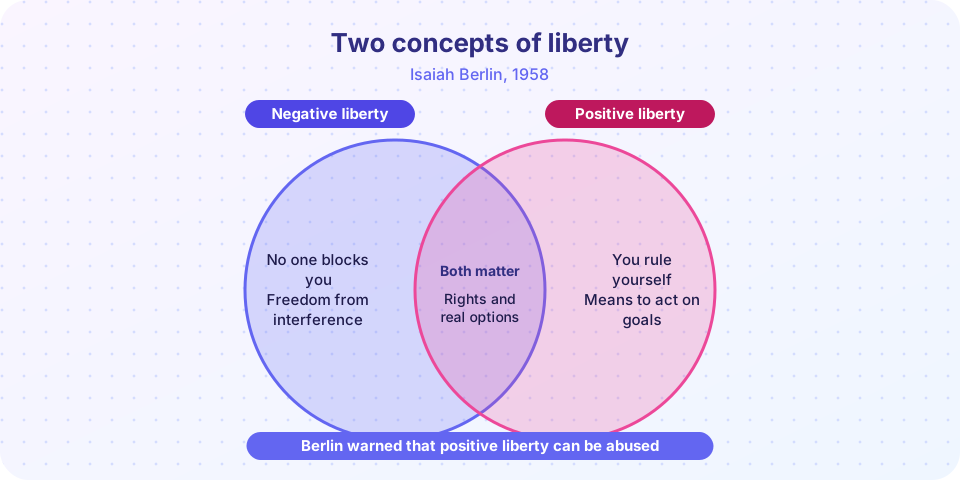
Two concepts of liberty
In his 1958 Oxford lecture "Two Concepts of Liberty", Isaiah Berlin made a distinction that has framed the debate ever since.
Negative liberty is the absence of interference: you are free to the extent that no one stops you from doing what you might do. A law forbidding travel, a censor, a locked door: these reduce negative liberty. Classical liberals such as Locke and Mill stress this kind.
Positive liberty is self-mastery: being the author of your own life, guided by your own reasons and not by compulsions, ignorance or others' domination. Defenders say it captures why an addict, or a person with no education or no means, is not fully free even if no one interferes.
Berlin respected both but feared the positive concept's political danger. If there is a "real" or "rational" self distinct from your actual desires, those in power may claim to know your true interests better than you do and force you to be free "for your own good". History offers many examples of oppression done in the name of liberation. Critics reply that the real danger is oppression, not the concept, and that without positive conditions (education, health, income) formal freedom is empty. A third idea, the republican conception associated with Philip Pettit, defines freedom as non-domination: even a kind master who never interferes leaves a slave unfree, because the master could.
Mill's harm principle
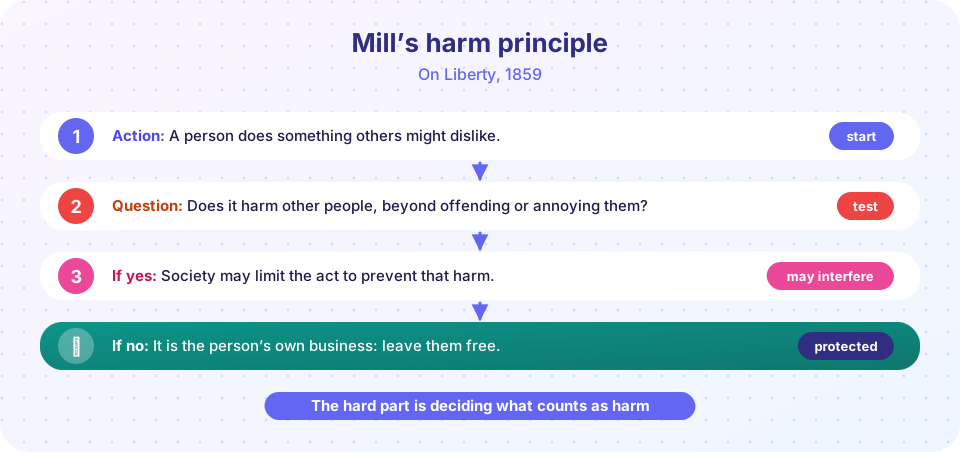
John Stuart Mill's On Liberty (1859) proposed a simple rule for the limits of social and legal control: the only purpose for which power can rightfully be exercised over a member of a community, against their will, is to prevent harm to others. A person's own good, physical or moral, is not a sufficient warrant. Within the zone of self-regarding conduct, Mill defended freedom of thought and opinion, freedom of tastes and pursuits ("experiments in living"), and freedom of association.
Free speech
Mill gave four arguments for free expression: the opinion silenced may be true (and we are fallible); even a false opinion may contain a part of the truth; if an accepted view is never challenged, it becomes dead dogma held as prejudice; and unchallenged beliefs lose their meaning and effect on conduct. Modern debate asks how far these arguments cover hate speech, incitement and misinformation. Many legal systems draw lines at direct incitement to violence or defamation; philosophers disagree about the rest.
Hard cases
- Offense. Is being offended a harm? Mill says no; Joel Feinberg's offense principle allows limiting conduct that causes serious, unavoidable offense (for example, flagrant public behavior).
- Paternalism. Seatbelt and helmet laws protect people from themselves. "Soft" paternalists say interference is fine when someone's choice is not fully informed or voluntary; "hard" paternalists defend interference even with fully informed choice. Mill rejected the second.
- Moralism. In the Hart-Devlin debate of the 1960s, Patrick Devlin argued that society may enforce its shared morality; H. L. A. Hart defended Mill's line.
- Harm to whom? Pollution, risks to future people, and psychological harm all stretch the notion of "harm".
Rights
A right is a claim that gives others duties. If you have a right to free speech, the state has a duty not to censor you. Philosophers distinguish:
- Natural rights (Locke): rights people have by nature, whatever the law says. Jeremy Bentham called them "nonsense upon stilts", meaning that only legal rights are real. Human rights, as in the United Nations Universal Declaration of 1948, are today's common vocabulary for what everyone is entitled to simply as a person.
- Negative and positive rights. Negative rights require others to refrain (do not interfere with my speech). Positive rights require them to act (provide education). Some philosophers say the line is blurry, since protecting even negative rights requires courts and police.
- Will theory and interest theory. On the will theory (Hart), a right gives its holder control over a duty owed to them. On the interest theory (Joseph Raz), a right protects a vital interest, such as an infant's interest in care, even if the holder cannot waive it.
- Rights conflict. Free speech and privacy, liberty and safety, property and equality. Theories differ on whether rights are absolute "trumps" (Dworkin) or must be balanced.
Common misconceptions. (1) "Freedom means being able to do whatever you want." Even the strongest defenders of liberty accept limits to prevent harm. (2) "Positive liberty always leads to tyranny." Berlin warned of a risk; many states promote education and health without coercing people's goals. (3) "A right is a legal rule." Many views treat rights as moral claims that laws should respect.
Try it
Press Run (or Ctrl + Enter) to see the console output here.
No output.
Check your understanding
Quick check · 5 questions
of 5 answered You scored / 5 · perfect!
-
1. What is negative liberty?
Negative here means absence of interference, not 'bad'. -
2. What was Berlin's worry about positive liberty?
He warned about the 'real self' idea being used to justify oppression. -
3. What does Mill's harm principle say?
A person's own good is not a sufficient reason for coercion, in Mill's view. -
4. Why does Mill defend freedom of speech even for false opinions?
Those are his main arguments. -
5. What distinguishes a negative right from a positive right?
Free speech is usually a negative right; education a positive one.
Summary
- Negative liberty is non-interference; positive liberty is self-mastery; republicans add non-domination.
- Mill's harm principle limits coercion to preventing harm to others; the key question is what counts as harm.
- Free speech has strong epistemic defenses, and its limits are debated.
- Rights are claims imposing duties; they can be natural or legal, negative or positive, and they conflict.
Track your progress
Create a free account to tick off lessons and pick up where you left off on any device.
of Introduction to Philosophy lessons completed