


















Lesson 3 of 44 · Getting Started
Thought Experiments and Intuitions
See how philosophers use imagined cases such as the ship of Theseus and the trolley problem to test ideas, and learn why intuitions are useful but fallible evidence.
Scientists run experiments in laboratories. Philosophers often cannot: you cannot weigh free will on a scale or test fairness with a microscope. What philosophers can do is imagine a carefully built situation and ask what we should say about it. This is a thought experiment. Done well, it isolates one factor, removes distractions and makes a hidden assumption visible.
Thought experiments are not unique to philosophy. Galileo imagined dropping a heavy and a light stone tied together to argue that heavier objects do not fall faster, and Einstein imagined riding alongside a beam of light. In philosophy they are everywhere: you will meet them in every chapter of this course.
What you will learn
- What a thought experiment is and how it is built.
- Three classic examples: the ship of Theseus, the trolley problem and the ring of Gyges.
- Why intuitions are treated as evidence, and why they can mislead.
- How reflective equilibrium balances cases and principles.
Key terms
- Thought experiment: an imagined case used to test a claim or reveal an assumption.
- Intuition: an immediate sense that something is true, without explicit reasoning.
- Principle: a general rule meant to explain many particular verdicts.
- Counterexample: a case that shows a proposed rule gives the wrong answer.
- Reflective equilibrium: a stable fit between your principles and your judgments about cases, reached by adjusting both.
Example 1: the ship of Theseus
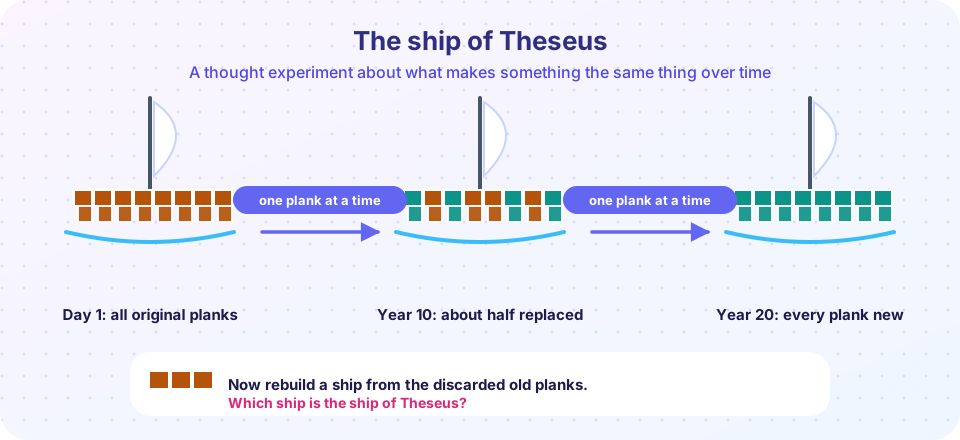
The Greek writer Plutarch (around 46 to 120 CE) tells of the ship in which the hero Theseus sailed home from Crete. The Athenians preserved it for centuries, replacing rotting planks with new timber, until philosophers asked whether it was still the same ship. In the seventeenth century Thomas Hobbes added a twist: suppose someone collected the discarded planks and rebuilt a ship from them. Now there seem to be two candidates.
The puzzle forces a question about identity over time: what makes something one and the same thing as it changes? Three tempting answers each have a cost.
| Answer | Reasoning | Problem |
|---|---|---|
| Same material means same ship | The identity of a thing is its stuff | Then the rebuilt ship is the original, and the ship in the harbor is not |
| Same continuous history means same ship | The ship changed gradually, so it stayed one ship | Then a ship can lose all its original parts and still be it, and the old-plank ship is a mere copy |
| It depends on how we use the word | "Same ship" is partly a matter of convention | Some find this too easy a way out |
The same puzzle returns in chapter 6, when we ask what makes you the same person over a lifetime in which almost every cell of your body is replaced. It also resembles an ancient riddle about vagueness (the sorites paradox, from the Greek word for "heap"): one grain of sand is not a heap, adding one grain never turns a non-heap into a heap, yet a million grains clearly make one.
Example 2: the trolley problem
In 1967 the British philosopher Philippa Foot described a driver of a runaway tram who can steer onto a side track, killing one person instead of five. In 1976 Judith Jarvis Thomson added variants. In the best-known one, the footbridge case, you can stop the trolley only by pushing a large stranger off a bridge in its path. The numbers are the same, five saved for one lost, but many people who accept diverting the trolley refuse to push the stranger.
Why the difference? Philosophers have proposed several explanations:
- The doctrine of double effect: it can be permissible to bring about a harm as a foreseen side effect, but not to use a person as a means to your goal. Pushing uses the stranger's body as a tool.
- Rights-based views: persons have claims that may not be overridden merely to maximize benefit.
- Consequentialism: in both cases the outcome is better if five survive, so the apparent difference is a feeling to be explained away, not a reason.
- Psychological accounts: pushing a person with your hands triggers a stronger emotional reaction than pulling a lever. Whether that reaction tracks something morally real is itself disputed.
Notice what the experiment did. It made us separate two features, the number of lives and the way harm is caused, that normally come together. The cases are cartoonish on purpose. Their value is not as guidance for engineers but as a tool for testing moral principles. The Ethics track studies such principles in depth.
Example 3: the ring of Gyges
In Plato's Republic (around 375 BCE), Glaucon tells of a shepherd who finds a ring that makes him invisible. If you could do anything with no chance of being caught, he asks, would you still act justly? Glaucon's challenge to Socrates is whether justice is worth having for its own sake, or only for its reputation and rewards. The imagined invisibility strips away the usual incentives, so the question "why be just?" cannot hide.
Why intuitions matter, and when to doubt them
Thought experiments depend on our intuitions, our first reactions to the cases. Philosophers treat intuitions as a kind of evidence, much as a scientist treats an observation: not infallible, but not to be discarded either. If a theory implies that pushing the stranger is fine and almost everyone finds that monstrous, the theory carries a heavy burden.
Yet intuitions can mislead. They may reflect upbringing, cultural habit or framing effects (the same case described in different words can draw different verdicts). A line of work called experimental philosophy tests this by surveying people. Early studies by Jonathan Weinberg, Shaun Nichols and Stephen Stich (2001) reported that intuitions about certain knowledge cases varied across groups; later attempts to replicate such results gave mixed findings, so the extent of variation is still debated. A very large online experiment called the Moral Machine (Awad and colleagues, 2018), which asked people worldwide to choose who a self-driving car should spare, found that some preferences were widely shared and others differed by region. Surveys cannot settle what is right, but they remind us that "obvious" is a psychological report, not a proof.
Reflective equilibrium
How should you proceed when principles and intuitions clash? The American philosopher John Rawls, in A Theory of Justice (1971), described a method he called reflective equilibrium. You start with your considered judgments about cases and a tentative principle. If the principle gives a verdict you find unacceptable, you can revise the principle or revise the judgment. You go back and forth until they fit together and you can explain why. The result is never final; new cases can disturb it.
When you meet a thought experiment, answer in three steps. First write your honest verdict. Second ask what principle would explain it. Third look for a variant of the case where that principle gives a verdict you reject.
Common misconceptions
"Thought experiments must be realistic to count." Their job is to isolate a factor, so they are often unrealistic on purpose. The real objection to a case is that it smuggles in something distracting, not that it could never happen.
"If most people feel it, it must be morally correct." Widespread feelings are evidence, not proof. Many once-common moral views have been rejected after reflection.
"There is one correct answer to the ship of Theseus." Careful philosophers disagree, and the disagreement is what makes the case valuable.
Try it
Press Run (or Ctrl + Enter) to see the result here.
Program input · what you'd type while the program runs
Type the answers before you press Run, one per line. Each time the program reads a line (with input()), it gets the next line from this box.
Check your understanding
Quick check · 5 questions
of 5 answered You scored / 5 · perfect!
-
1. What is the main job of a thought experiment in philosophy?
Thought experiments are built so that one feature stands out, letting us test whether a principle or definition gives the right verdict. -
2. In the ship of Theseus puzzle, what is the extra twist added by Thomas Hobbes?
Hobbes imagined collecting the old planks and rebuilding a ship, which gives two rival candidates for being the original. -
3. The footbridge case differs from the switch case mainly because
In both cases one dies and five live. In the footbridge case the person's body is the means of stopping the trolley, which many people judge to matter. -
4. What does reflective equilibrium describe?
Rawls's method involves going back and forth between principles and case judgments, revising either, until they cohere. -
5. Why do some philosophers distrust intuitions?
Intuitions are evidence but fallible. They may be shaped by upbringing or wording, so they need to be tested and balanced against principles.
Summary
- A thought experiment tests ideas by imagining a case that isolates one factor.
- The ship of Theseus (Plutarch, Hobbes) raises the puzzle of identity over time and previews the sorites paradox.
- The trolley problem (Foot, Thomson) separates numbers of lives from the way harm is caused.
- The ring of Gyges (Plato) asks whether we value justice for itself or for its rewards.
- Intuitions are fallible evidence; reflective equilibrium balances them against principles.
Next: Chapter 1 Review
Track your progress
Create a free account to tick off lessons and pick up where you left off on any device.
of Introduction to Philosophy lessons completed