


















Lesson 29 of 44 · Free Will and Personal Identity
Chapter Review: Free Will and Personal Identity
A recap of determinism, the four free will positions, compatibilist ideas and theories of personal identity, with a comparison table and a nine-question quiz.
This chapter asked two linked questions: are we free in the way that responsibility requires? and what makes you the same person over time? Here is the whole chapter on one page, followed by a quiz that mixes all three lessons.
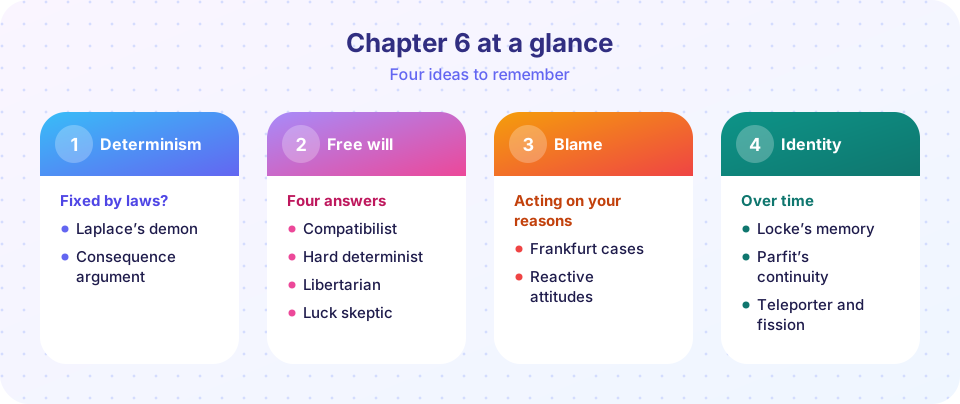
Recap table
| Topic | Key idea | Names | Main objection |
|---|---|---|---|
| Determinism | Laws plus the past fix the future | Laplace | Quantum physics may include chance |
| Consequence argument | Acts are not up to us if determinism holds | van Inwagen | What counts as "up to us"? |
| Libertarianism | Some choices are undetermined | Kane, Chisholm | Luck objection |
| Hard determinism | No free will | d'Holbach, Pereboom | Seems to undermine ordinary life |
| Compatibilism | Freedom is acting on your own reasons | Hume, Frankfurt, Dennett | Manipulation argument |
| Reactive attitudes | Blame is part of human relationships | P. F. Strawson | Does tradition justify them? |
| Body/animal view | Same organism | Olson | Brain-transplant intuitions |
| Memory view | Same consciousness | Locke | Reid's transitivity objection |
| Continuity | Overlapping chains | Parfit | Is a copy really you? |
| Bundle view | No single self | Hume | Explaining the unity of experience |
Connecting the two halves
The two topics meet at responsibility. To blame someone you need an agent who acted freely enough and the same agent now facing the consequences. Parfit's view has a striking consequence here: if what matters is degrees of connectedness, then responsibility may weaken as the connections between the person who acted and the person now before the court weaken. Others reply that practical identity (the legal and moral person) must be sturdier than metaphysical identity.
A good way to study this chapter: for each position, write one example that supports it and one that threatens it (Jones for compatibilism; the general for memory theories). If you can do that, you understand the position.
Try it
Chapter quiz
Quick check · 9 questions
of 9 answered You scored / 9 · perfect!
-
1. Who imagined an intellect that could predict the future from complete knowledge of the present?
Laplace's demon is the classic statement of determinism. -
2. Which is NOT one of the four positions on determinism and free will in this chapter?
Solipsism is about whether other minds exist; the four positions are compatibilism, hard determinism, libertarianism and luck skepticism. -
3. What does the luck objection say about libertarianism?
Undetermined events happen without being controlled by the agent. -
4. What do Frankfurt cases suggest?
Jones acts on his own and seems responsible though he could not have done otherwise. -
5. What is Strawson's key point in 'Freedom and Resentment'?
He shifted the focus from metaphysics to the practice of holding people responsible. -
6. Locke's theory of personal identity appeals to
Locke tied identity to how far consciousness extends back. -
7. Reid's brave officer case is meant to show that
The general is the officer, and the officer is the boy, but the general is not the boy by the memory test. -
8. In Parfit's view, what is the difference between connectedness and continuity?
That distinction lets Parfit handle the transitivity problem. -
9. What does Hume's bundle theory say about the self?
Hume found only particular perceptions when he looked inward.
Summary
- Determinism and the consequence argument set up the free will problem; four positions respond.
- Compatibilists rely on Hume, Frankfurt, Strawson and reasons-responsiveness.
- Identity theories (body, soul, continuity, bundle) are tested by Ship of Theseus, brave-officer and teleporter cases.
- Responsibility needs both a free agent and a persisting person.
Track your progress
Create a free account to tick off lessons and pick up where you left off on any device.
of Introduction to Philosophy lessons completed