


















Lesson 5 of 44 · What Is Philosophy
What Is Philosophy? The Big Picture
A clear introduction to what philosophy is: the meaning of the word, how it differs from science and religion, its branches, and why people still study it.
Ask ten people what philosophy is and you will get ten answers, which is fitting, because the question "what is philosophy?" is itself a philosophical one. Still, a working picture is possible. Philosophy is the careful, reasoned investigation of the most general questions about reality, knowledge, value and how to live. It is less a body of facts than an activity: asking questions, defining terms, building arguments and testing them against objections.
This chapter gives you the map. You will meet the main branches, the ancient Greek thinker Socrates who shaped the method, and the many traditions around the world that practiced philosophy independently.
What you will learn
- What the word "philosophy" means and where it comes from.
- How philosophy differs from, and overlaps with, science and religion.
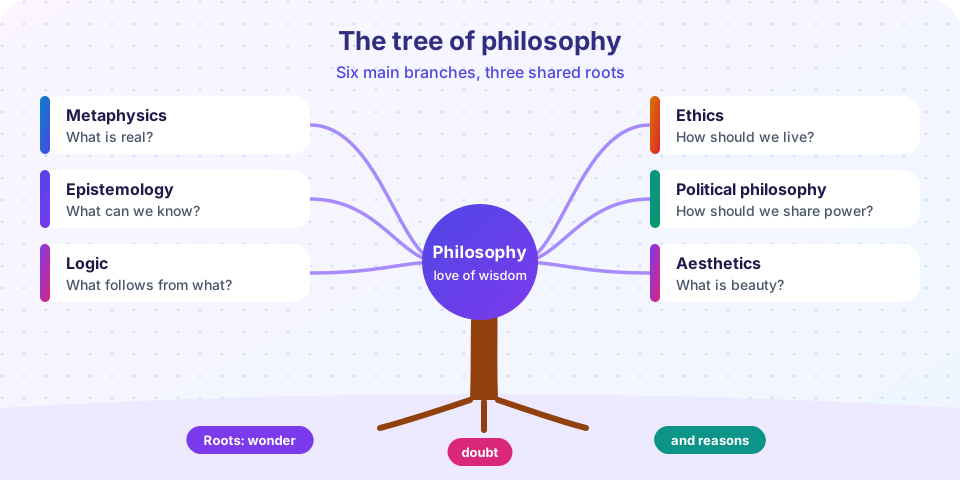
- The six main branches at a glance.
- What the lessons in this chapter cover.
Key terms
- Philosophy: from the Greek philosophia, "love of wisdom".
- Branch: a main area of philosophy with its own questions, such as ethics.
- Conceptual question: a question about what our ideas mean and how they fit together.
- Normative question: a question about what ought to be, not what is.
The word and its history
The word comes from two Greek words, philos (loving, friend of) and sophia (wisdom). Ancient writers credited the thinker Pythagoras (sixth century BCE) with first calling himself a "lover of wisdom" instead of a wise man, though historians doubt the story is literally true. What matters is the attitude it expresses: wisdom is something you pursue, not something you possess.
For most of history, philosophy was the home of every kind of systematic inquiry. Physics was "natural philosophy": Isaac Newton's great book of 1687 is titled Mathematical Principles of Natural Philosophy. Over the following centuries one field after another (physics, chemistry, biology, psychology, economics, linguistics) developed its own methods, instruments and journals and left the philosophy department. A vestige remains in the degree name: a doctorate in physics is still a "Doctor of Philosophy".
How philosophy differs from science
Science mostly answers questions by observation and experiment. Philosophy mostly works on questions that cannot be settled that way, or that must be clarified before an experiment can even be designed. Compare:
| Question | Mainly settled by |
|---|---|
| How fast does light travel in a vacuum? | Measurement (science) |
| What exactly counts as "alive"? | Conceptual analysis, informed by biology |
| Is it ever right to break a promise? | Moral argument |
| What is a good explanation? | Philosophy of science |
The border is blurry, and good philosophers use scientific results all the time. When we ask whether a machine could be conscious, what neuroscientists have learned matters; but science alone does not tell us what consciousness is. In the philosophy of mind, evidence and argument work together.
How philosophy differs from religion
Religions typically combine beliefs, rituals, communities and moral practices, and many rest on revelation or tradition. Philosophy, as a method, rests on reasons that anyone can examine, whatever their background. This does not make the two opposites: many great philosophers were deeply religious (Augustine, al-Ghazali, Maimonides, Aquinas), and others were skeptics or atheists. Philosophy of religion, covered in chapter 7, examines religious claims by argument without presupposing that they are true or false.
The six branches
What is real?
How do we reason?
How should we live?
Lesson 2 of this chapter looks at each branch in turn.
Many other fields are "philosophy of" something: philosophy of mind, of language, of science, of mathematics, of law and of religion. They apply the same methods to one subject.
Why study it?
The honest answer is that the questions matter and you already have answers to them: about what you owe other people, what you can know, what makes a life go well. Philosophy lets you examine those answers instead of inheriting them unexamined. It also trains transferable habits: reading closely, stating a position precisely, finding hidden assumptions and discussing disagreements without insult. Whether these habits help in a given career is for you to judge, but they are the habits of any careful thinker.
What is in this chapter
- The branches of philosophy: six areas and their questions.
- Socrates and the Socratic method: the questioner of Athens, and how cross-examination works.
- Philosophy across cultures: thinkers from Europe, India, China, the Islamic world and Africa.
- Chapter 2 review: a recap and a ten-question quiz.
Common misconceptions
"Philosophy has made no progress in 2,500 years." Progress often looks like a field splitting off (as physics and psychology did) or a debate being sharpened so that bad answers are ruled out. Logic, for instance, advanced enormously from Aristotle to Frege and Gödel.
"Philosophy means a calm, wise attitude to life." That is one meaning of the word in everyday speech, but the academic subject is about argument, not temperament.
"Philosophy is a Western invention." Systematic philosophical traditions arose independently in India, China, the Islamic world, Africa and elsewhere. Lesson 3 gives a tour.
Try it
Press Run (or Ctrl + Enter) to see the console output here.
No output.
Check your understanding
Quick check · 5 questions
of 5 answered You scored / 5 · perfect!
-
1. The word 'philosophy' literally means
It comes from the Greek philos (loving) and sophia (wisdom). -
2. Why is a physics doctorate called a 'Doctor of Philosophy'?
Physics and other sciences grew out of what used to be called natural philosophy, and the degree name preserved that history. -
3. Which question is mainly philosophical rather than scientific?
It asks what we ought to do, a normative question that is argued about with moral reasons. -
4. Which pair of branches asks 'what is real?' and 'what can we know?'
Metaphysics studies the nature of reality, and epistemology studies knowledge and justification. -
5. Philosophy as a method differs from religion in that it
Philosophical arguments aim to be assessable by anyone. Many philosophers were religious, and philosophy of religion studies religious claims without presupposing them.
Summary
- Philosophy is the reasoned study of general questions about reality, knowledge, value and how to live.
- It overlaps with science but works mainly on conceptual and normative questions.
- The six main branches are metaphysics, epistemology, logic, ethics, political philosophy and aesthetics.
- Philosophy arose in many cultures, not only in ancient Greece.
Track your progress
Create a free account to tick off lessons and pick up where you left off on any device.
of Introduction to Philosophy lessons completed