


















Lesson 15 of 44 · Knowledge and Skepticism
Knowledge and Skepticism: The Big Picture
An introduction to epistemology: the kinds of knowing, the main sources of knowledge, why skeptics doubt them, and what each lesson in chapter 4 covers.
You know your name, the capital of France, how to ride a bicycle and that two plus two is four. But what exactly is this thing called knowing, and how is it different from merely believing? Could you be wrong about everything you take for granted, as a character in a film might be? Epistemology, from the Greek episteme (knowledge), is the branch of philosophy that tries to answer these questions.
This chapter is where the tools of chapter 3 meet a big problem. You will study what knowledge is, where it comes from, and the arguments of skeptics who say we know much less than we think. Skeptical arguments are fun, but they have a serious purpose: they show what any theory of knowledge must be able to withstand.
What you will learn
- The three kinds of "knowing" and which one epistemology studies.
- The main sources of knowledge.
- What a skeptic claims and why the challenge is serious.
- What the lessons in this chapter cover.
Key terms
- Epistemology: the philosophical study of knowledge, belief and justification.
- Propositional knowledge: knowing that something is the case.
- Justification: having good reasons or evidence for a belief.
- Skepticism: the view that knowledge (in some area) is impossible or much more limited than we think.
- Certainty: a state in which doubt is impossible or unreasonable.
Three kinds of knowing
English uses "know" for several things:
| Kind | Example | Name |
|---|---|---|
| Knowing that | "I know that Paris is the capital of France." | Propositional knowledge |
| Knowing how | "I know how to swim." | Practical knowledge (an ability) |
| Knowing someone or something | "I know Maria. I know this town." | Knowledge by acquaintance |
Epistemologists mostly study the first, propositional knowledge, since it can be true or false, shared in words and evaluated for evidence. Philosophers still debate how the kinds are related. The British philosopher Gilbert Ryle argued in The Concept of Mind (1949) that knowing how is not just a matter of knowing facts, and some have argued the reverse.
Where might knowledge come from?
Sources of knowledge
What a skeptic asks
Lesson 4 explores these arguments.
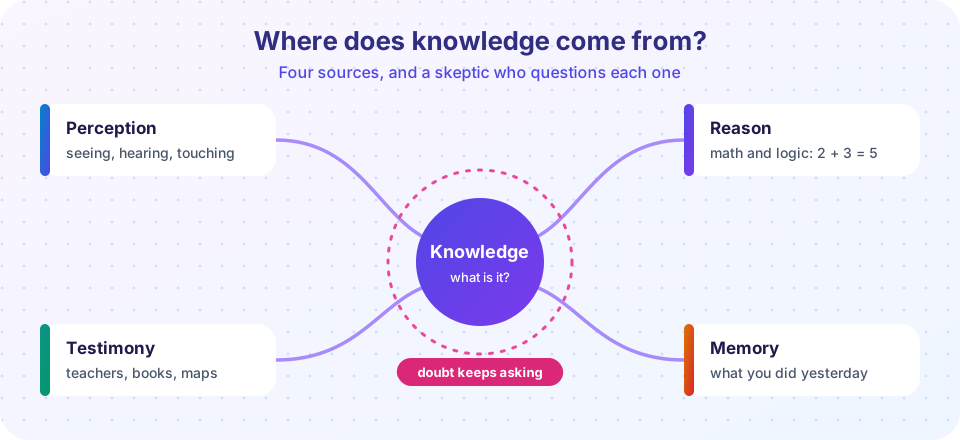
Most of what you know comes from testimony: you have never measured the distance to the Moon, yet you know roughly how far it is because you trust teachers, books and scientists. Perception gives you a view of your surroundings, memory carries yesterday's knowledge into today, and reason lets you work out that no number is both even and odd. Some philosophers add introspection (awareness of your own mind) as a further source.
Two great traditions disagree about which source matters most. Rationalists such as Descartes held that reason can give knowledge independent of experience; empiricists such as Locke and Hume held that all knowledge of the world rests on experience. Lesson 3 describes the debate.
The skeptic's challenge
A skeptic (the older spelling is sceptic) asks: how do you know any of this? Your senses sometimes mislead you. You have dreamed things that felt real. A clever enough illusion could, in principle, produce exactly the experiences you are having now. If you cannot rule out such possibilities, perhaps you do not really know that you have hands, or that there is a world outside your mind.
Skepticism comes in different strengths. Global skepticism says we know nothing. Local skepticism doubts knowledge in one area, such as ethics or the past. Mitigated skepticism, associated with Hume, accepts that certainty is rare but holds that careful, modest belief is reasonable. Few philosophers believe the strongest skeptical claim; the interest is in what the argument teaches about knowledge.
What is in this chapter
- Knowledge as justified true belief: the classic definition and the Gettier problem.
- Rationalism versus empiricism: two sources and Kant's synthesis.
- Skepticism and Descartes: dreams, demons, vats and replies.
- Chapter 4 review: a recap and a ten-question quiz.
Common misconceptions
"To know something you must be 100% certain." Many epistemologists think knowledge requires good evidence but not absolute certainty. If certainty were required, we would know almost nothing.
"Skeptics believe nothing exists." Skeptics question whether we can know; they do not need to claim that things do not exist.
"Believing something strongly is the same as knowing it." Plenty of confident beliefs are false. Knowledge needs truth and something more.
Try it
Press Run (or Ctrl + Enter) to see the result here.
Program input · what you'd type while the program runs
Type the answers before you press Run, one per line. Each time the program reads a line (with input()), it gets the next line from this box.
Check your understanding
Quick check · 5 questions
of 5 answered You scored / 5 · perfect!
-
1. Which kind of knowledge do epistemologists mostly study?
Propositional knowledge can be true or false and be justified by evidence, so it is the central target of epistemology. -
2. The word 'epistemology' comes from the Greek word for
Episteme means knowledge. -
3. Which source of knowledge supplies most of what you know about distant places and past events?
We rely on teachers, books, maps and experts for most of what we know beyond our own experience. -
4. Global skepticism says that
Local skeptics doubt knowledge in one area; global skeptics doubt it altogether. -
5. Why take skeptical arguments seriously if few people believe their conclusion?
The value of a skeptical argument is in testing our assumptions about evidence, justification and certainty.
Summary
- Epistemology studies knowledge, belief and justification; it mainly concerns knowing that.
- Knowledge may come from perception, reason, testimony, memory and introspection.
- Rationalists stress reason; empiricists stress experience.
- Skeptics question whether we can know; their arguments test our theories.
- This chapter covers the definition of knowledge, the sources debate and Descartes' doubt.
Track your progress
Create a free account to tick off lessons and pick up where you left off on any device.
of Introduction to Philosophy lessons completed