


















Lesson 40 of 44 · Projects and Practice
Project: Map an Argument
A hands-on project: reconstruct a philosophical argument in standard form, find the hidden premise, test validity with code and write the best objection.
Reading about philosophy is not the same as doing it. Philosophers do something very particular with a text: they reconstruct its argument as a numbered list of premises and a conclusion, test it, and then try to break it. In this project you will do that on a real argument from this chapter, with a small program to check the logic. By the end you will have a method you can apply to any essay, speech or conversation.
What you will learn
- How to put an argument into standard form and find the hidden premise.
- How to check validity mechanically, and why validity is not enough.
- How to write the strongest objection and the best reply.
- A rubric for judging your own argument map.
Key terms
- Standard form: numbered premises followed by a conclusion.
Hidden (suppressed) premise: an assumption the argument needs but does not state.
Objection: a reason to doubt a premise, the inference, or the conclusion.
Steel-man: the strongest version of a view, stated fairly.
For the vocabulary of arguments, see Premises and conclusions, Deduction and induction and Fallacies. Here we put those tools to work on the arguments from the last chapters.
Step 1: choose a passage
Pick a short argument. The project uses Robert Nozick's Wilt Chamberlain argument (see Justice and fairness). In plain words: suppose you think some distribution of money is perfectly fair. A million fans each voluntarily pay a small extra amount to watch a famous basketball star, so he ends up far richer than others. Nozick says this new distribution must be fair too, since it came from a fair start by free steps, so a fair society cannot require any particular pattern.
Step 2: write it in standard form
- The initial distribution D1 is just. (assumption for the example)
- People freely choose to transfer some of their holdings to Chamberlain, producing D2. (a fact in the example)
- (hidden premise) If a just distribution changes only through voluntary transfers, the new distribution is just.
- So D2 is just.
- D2 is unequal in a way that violates every strict pattern (for instance, equality). (a fact in the example)
- So a distribution can be just while violating a given pattern, and no required pattern can be part of justice.
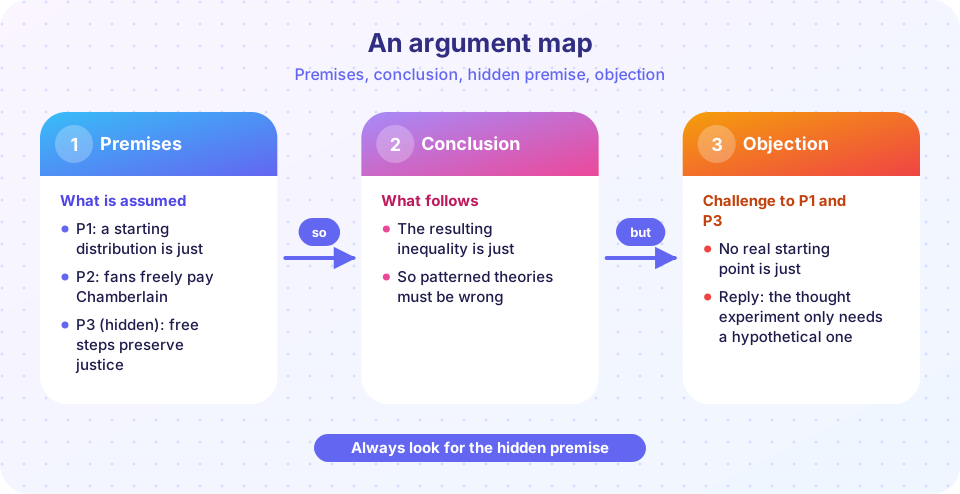
Notice the hidden premise (3). Nozick states it only implicitly, yet the whole argument depends on it. Finding such premises is often the most valuable part of the exercise.
Step 3: check the logic
Is the inference from the premises to the conclusion valid? Here you can use code. The program below encodes a simplified propositional version and tests every combination of truth values.
Step 4: object and reply
Ask three questions of every premise: Is it true? Is it needed? Is it clear? For the Chamberlain argument, the usual objections are:
- Premise 1: Is any actual starting distribution just? Real holdings are shaped by conquest, theft and inequality of opportunity. Reply: the argument needs only a hypothetical just start, which defenders can define as whatever pattern the critic favors.
- Premise 3: Do voluntary transfers always preserve justice? Reply from critics: transfers happen within institutions (property law, markets) that are themselves open to moral assessment. Large inequalities might also give some people power over others and weaken fair opportunity.
Common mistakes. (1) Summarizing the topic instead of listing premises: if there is no "so", it is not yet an argument. (2) Attacking the speaker instead of a premise. (3) Missing the hidden premise. (4) Treating "valid" as "true": a valid argument with a false premise is unsound.
Rubric
| Criterion | Weak | Strong |
|---|---|---|
| Reconstruction | Paraphrase only | Numbered premises and a clear conclusion |
| Hidden premises | None found | At least one found and stated |
| Validity check | Not tested | Tested, with reasoning |
| Objections | Complaints about the author | Specific objection to a named premise |
| Reply | None | A fair reply, and a note on how much it helps |
Try it
Press Run (or Ctrl + Enter) to see the result here.
Program input · what you'd type while the program runs
Type the answers before you press Run, one per line. Each time the program reads a line (with input()), it gets the next line from this box.
Your turn
Choose one argument from this chapter and produce an argument map with five parts: (1) one-paragraph plain-language summary; (2) numbered premises and conclusion; (3) the hidden premise; (4) the strongest objection; (5) the best reply and your own verdict in two sentences. Good candidates: Descartes's argument for dualism, the consequence argument, the kalam argument, Rawls's choice behind the veil.
Check your understanding
Quick check · 4 questions
of 4 answered You scored / 4 · perfect!
-
1. What is a hidden premise?
Making it explicit often shows where the argument is weakest. -
2. Which is the first step in mapping an argument?
You must know what the argument is before you can evaluate it. -
3. In the truth-table check, what does an invalid argument have?
That is the definition of invalidity. -
4. Why is validity not enough?
Soundness needs valid form and true premises.
Summary
- Reconstruct an argument as numbered premises plus a conclusion.
- Look for the hidden premise; test validity mechanically; then evaluate the premises.
- Write a specific objection to a named premise and a fair reply.
- Use the rubric to judge your own map.
Next: Lab: Thought experiments
Track your progress
Create a free account to tick off lessons and pick up where you left off on any device.
of Introduction to Philosophy lessons completed