


















Lesson 17 of 44 · Knowledge and Skepticism
Rationalism vs Empiricism: Reason or Experience?
Compare rationalists such as Descartes and Leibniz with empiricists such as Locke and Hume, learn a priori and a posteriori knowledge, and see how Kant combined them.
Where does knowledge come from: the mind's own resources or the senses? In early modern Europe (roughly the seventeenth and eighteenth centuries) this became the central dispute in the theory of knowledge. One camp, the rationalists, believed that reason can discover important truths independent of experience. The other, the empiricists, held that experience is the ultimate source of all our ideas and our knowledge of the world.
Neither side was foolish. Their quarrel makes sense of everything from how we learn mathematics to how a baby learns a language, and the great philosopher Immanuel Kant spent a decade working out a response that shaped all later philosophy.
What you will learn
- The difference between a priori and a posteriori knowledge, and analytic and synthetic truths.
- The main claims of rationalists and empiricists.
- Hume's famous fork and what it implies.
- How Kant's "synthetic a priori" tries to bridge the divide.
Key terms
- A priori: knowable independently of particular experience (for example, "Every bachelor is unmarried").
- A posteriori: knowable only through experience ("Water boils at a lower temperature on a mountain").
- Innate idea: an idea present in the mind from birth, not acquired by experience.
- Analytic: true by the meaning of its terms.
- Synthetic: true or false depending on how the world is, not merely meaning.
Two distinctions
Before the debate, two distinctions help.
- A priori / a posteriori concerns how a claim can be known. You do not need a survey to know that no bachelor is married; you do need evidence to know that most bachelors in your country are under 40.
- Analytic / synthetic concerns what makes a claim true. "Every triangle has three sides" is true by meaning (analytic). "The Eiffel Tower is 330 meters tall" depends on facts (synthetic).
Many philosophers have thought analytic truths are a priori and synthetic truths a posteriori. The interesting question is whether there are synthetic a priori truths: claims about the world that can be known by reason alone. Rationalists say yes; strict empiricists say no.
Rationalism
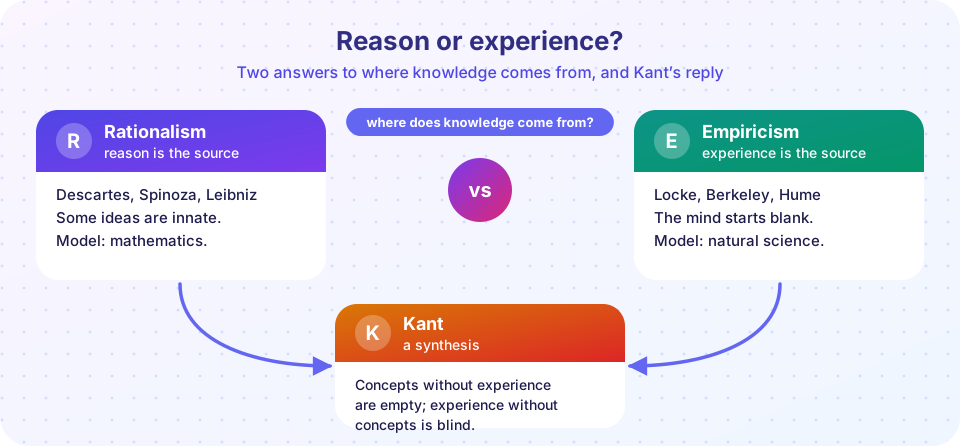
The leading rationalists were René Descartes (1596 to 1650), Baruch Spinoza (1632 to 1677) and Gottfried Wilhelm Leibniz (1646 to 1716). They shared three attitudes:
- Reason is a source of knowledge that does not depend on the senses. Mathematics is the model: you do not discover that 7 + 5 = 12 by counting pebbles but by understanding.
- Some ideas are innate. Descartes argued that our idea of a perfect being, or of a triangle, could not be derived from imperfect, approximately triangular things we perceive. Leibniz said the mind is like a block of marble with veins already in it that shape what can be carved.
- The senses are unreliable. In his famous wax example, Descartes noted that a piece of wax changes in color, shape and smell when melted, yet we still recognize it as the same wax. What stays constant is grasped by the intellect, not the senses.
Empiricism
The leading empiricists were John Locke (1632 to 1704), George Berkeley (1685 to 1753) and David Hume (1711 to 1776). Their slogan, in a medieval form, was that nothing is in the intellect that was not first in the senses.
- The mind starts as a blank slate. In An Essay Concerning Human Understanding (1689), Locke compared the mind to white paper (a tabula rasa) on which experience writes. Ideas come either from sensation (seeing, touching) or from reflection on our own mental operations.
- No innate ideas. If ideas of God or of logical principles were innate, said Locke, infants and people in all cultures would share them. They do not.
- Experience sets the limits. Berkeley pushed this far: for physical things, "to be is to be perceived" (esse est percipi, 1710). Hume pushed further.
Hume's fork
In An Enquiry Concerning Human Understanding (1748), Hume divided all objects of reasoning into two kinds. Relations of ideas (mathematics, logic) can be known by thought and are certain, because denying them is a contradiction. Matters of fact (what the world is like) depend on experience, and their opposite is always conceivable. If a book contains neither kind of reasoning, he said, "commit it then to the flames". This is dramatic language, and he meant it as a sharp test of metaphysical claims.
Hume used the fork against causation and induction. We never see causation, only one event following another repeatedly; and our expectation that the future will resemble the past is not a relation of ideas. This is the problem of induction from lesson 3 of chapter 3, now as a cornerstone of empiricism.
Kant's synthesis
Immanuel Kant (1724 to 1804) wrote that reading Hume interrupted his "dogmatic slumber". In the Critique of Pure Reason (1781) he argued that both sides were half right. Knowledge needs both content from the senses and structure supplied by the mind. In his words, thoughts without content are empty and intuitions without concepts are blind.
Kant argued that space, time and categories such as causation are not features we read off the world but forms of experience the mind brings. This makes synthetic a priori knowledge possible: we can know in advance that every event in our experience will have a cause and that geometry will describe space as we experience it, because these are conditions of experience itself. The price is that we only know the world as it appears to us, not "things in themselves".
The debate today
Cognitive science has revived the dispute in new form. Noam Chomsky (1957 onward) argued that children learn language so fast, from limited data, that they must be born with a structured capacity for it (an innate "universal grammar"). Critics reply that statistical learning from rich input can do more than he allows. Studies of infants suggest that humans may have some basic number and object sense from early in life, though the interpretation of these studies is debated. The modern consensus is usually a blend: evolution has built structure into our minds, and experience fills it in.
Common misconceptions
"Rationalists ignored evidence." Descartes did experiments and Leibniz made discoveries in physics and calculus. The disagreement was about the source and justification of certain kinds of knowledge.
"Empiricists denied reasoning." Hume accepted mathematics and logic, but said they give no information about matters of fact by themselves.
"A priori means innate." A priori concerns how a claim is justified; innate concerns how an idea is acquired. They are different distinctions.
"Kant sided with one camp." He tried to show that both pure thought and experience are indispensable.
Try it
Press Run (or Ctrl + Enter) to see the result here.
Program input · what you'd type while the program runs
Type the answers before you press Run, one per line. Each time the program reads a line (with input()), it gets the next line from this box.
Check your understanding
Quick check · 6 questions
of 6 answered You scored / 6 · perfect!
-
1. A priori knowledge is knowledge that
A priori describes how a claim is justified, not how the idea is acquired. -
2. Which of these philosophers was an empiricist?
Locke, with Berkeley and Hume, is one of the British empiricists. -
3. What is Hume's fork?
In his Enquiry, Hume separated what can be known by pure thought (and is certain) from what depends on experience. -
4. Locke's 'tabula rasa' means that
Locke compared the mind at birth to blank paper on which experience writes. -
5. Kant argued that
Kant's synthesis says that we need sensory content and mental concepts: thoughts without content are empty, intuitions without concepts are blind. -
6. Which claim is typically classed as a posteriori?
It depends on how the world is and so needs observation.
Summary
- A priori and a posteriori describe how claims are known; analytic and synthetic describe what makes them true.
- Rationalists (Descartes, Spinoza, Leibniz) stressed reason and innate ideas; empiricists (Locke, Berkeley, Hume) stressed experience.
- Hume's fork separates relations of ideas from matters of fact and raises problems for causation and induction.
- Kant's synthesis holds that experience supplies content and the mind supplies structure.
- Modern cognitive science treats the nature versus nurture debate as a mix of both.
Next: Skepticism and Descartes
Track your progress
Create a free account to tick off lessons and pick up where you left off on any device.
of Introduction to Philosophy lessons completed