


















Lesson 20 of 44 · Mind and Reality
Chapter overview: Mind and Reality
A map of the big questions about mind, matter and reality: dualism, physicalism, functionalism and the hard problem of consciousness.
You are reading this sentence, and something is happening in you while you do. Light hits your eyes, neurons fire, and you also experience words on a screen, a faint sense of curiosity, perhaps a slight itch. Is the experience just the neurons? Is it something extra? Could a machine ever have it? This chapter is about those questions, and about the older question behind them: what is reality actually made of?
Philosophers call this area metaphysics (what exists and what it is like) and the philosophy of mind (what minds are and how they relate to bodies). It is one of the most active parts of philosophy today because it touches neuroscience, artificial intelligence and medicine.
What you will learn
- Why the relationship between mind and body counts as a real philosophical problem and not just a scientific one.
- The main families of answers: dualism, physicalism, functionalism, idealism and a few in-between views.
- What the "hard problem" of consciousness is and why people disagree about it.
- How to tell a good objection from a mere complaint, using examples from this chapter.
Key terms
- Metaphysics: the study of what exists and what its basic nature is.
Mind-body problem: the puzzle of how mental things (thoughts, feelings, experiences) relate to physical things (brains, bodies).
Monism / dualism: the view that there is one basic kind of stuff, or two.
Consciousness: the fact that there is something it is like to be you, from the inside.
The big picture
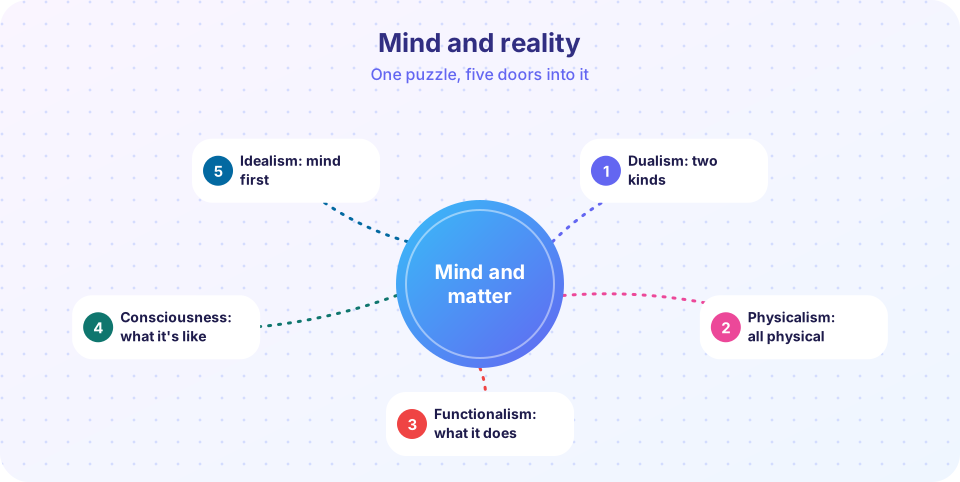
Every view in this chapter answers one question: how many kinds of things are there, and where do minds fit?
One puzzle, many answers
Dualism
Lesson 2
Physicalism
Lesson 3
Consciousness
Lesson 4
Idealism
What is reality made of?
Three ancient-sounding positions are still alive today.
- Materialism or physicalism. Everything that exists is physical, or depends on the physical. Minds exist, but they are brain processes (or something that physics can in principle explain).
- Idealism. Everything that exists is mental or depends on minds. George Berkeley (1685-1753) argued that a tree is nothing but a bundle of ideas in minds, held steady by God's mind. Immanuel Kant offered a milder cousin: we only ever know the world as it appears to us, never "things in themselves".
- Dualism. Both exist and neither reduces to the other. René Descartes (1596-1650) is the best-known defender.
There are also hybrids. Neutral monism says the basic stuff is neither mental nor physical but something that shows up as both. Panpsychism says that mentality is a basic feature of matter itself. You will meet both again in the lesson on consciousness.
Philosophers rarely ask "Which view is right?" first. They ask "Which view has the fewest costs?" Every position in this chapter pays a price somewhere, and learning to see the price is the real skill.
The simulation question
A modern twist on appearance and reality is Nick Bostrom's simulation argument (2003). It does not say we live in a simulation. It says that at least one of three things must be true: almost no civilizations reach the stage of running detailed simulations of minds; almost none of those that do are interested in running them; or we are very likely in a simulation. The argument depends on assumptions (for example, that simulated minds could be conscious), and many philosophers challenge those assumptions. That is exactly why it is a good exercise: it forces you to say what you think minds need in order to exist.
What each lesson covers
| Lesson | Question | Key names |
|---|---|---|
| Dualism and the mind-body problem | Are minds a separate kind of thing? | Descartes, Princess Elisabeth, Jackson |
| Physicalism and functionalism | Is the mind what the brain does? | Place, Smart, Putnam, Searle |
| Consciousness and the hard problem | Why does anything feel like anything? | Nagel, Chalmers, Dennett |
| Chapter review | Putting the views side by side | all of the above |
Try it
The widget below is a small navigator, not a test: choose the question that bothers you most and it tells you where to start.
Check your understanding
Quick check · 4 questions
of 4 answered You scored / 4 · perfect!
-
1. Which pair of terms describes how many basic kinds of stuff a view says there are?
Monism says one kind of stuff, dualism says two. The other pairs describe reasoning styles or other debates. -
2. Who argued that to be is to be perceived?
George Berkeley defended idealism: ordinary objects are collections of ideas in minds. -
3. What does Bostrom's simulation argument actually claim?
It is a trilemma, not a proof that we are simulated. It also assumes simulated minds could be conscious. -
4. Which view says mentality is a basic feature of matter itself?
Panpsychism holds that mind-like properties are fundamental and widespread.
Summary
- The mind-body problem asks how mental things relate to physical things.
- Main answers: dualism (two kinds), physicalism (one, physical), idealism (one, mental), plus hybrids.
- Each view has costs; good philosophy means finding them.
- The simulation argument is a trilemma that relies on contested assumptions.
Track your progress
Create a free account to tick off lessons and pick up where you left off on any device.
of Introduction to Philosophy lessons completed