


















Lesson 31 of 44 · Religion and Meaning
Arguments About God's Existence
The ontological, cosmological and design arguments, Pascal's wager, and the main replies, explained with their strongest versions and their weak joints.
Few topics are discussed with more heat and less structure than the existence of God. Philosophers try to supply structure. They separate the arguments into families, write each one as a list of premises leading to a conclusion, and ask whether it is valid (the conclusion follows) and sound (the premises are also true). This lesson goes through the classic families, with the strongest reply to each. The aim is to see what each argument accomplishes, not to settle the question for you.
What you will learn
- The four main families: ontological, cosmological, design, and Pascal's wager.
- How to test an argument for validity and then for soundness.
- The classic replies: Gaunilo and Kant, the infinite regress question, Hume and Darwin, many gods.
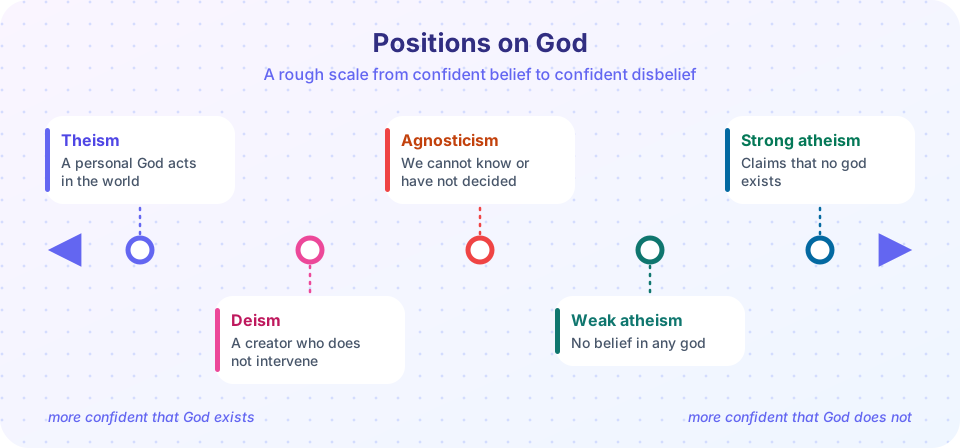
- The range of positions: theism, deism, agnosticism and atheism.
Key terms
- Valid: if the premises were true, the conclusion would have to be true.
Sound: valid, and the premises are in fact true.
Contingent: something that exists but might not have existed.
A priori / a posteriori: knowable by reasoning alone / knowable only from experience.
Fine-tuning: the claim that physical constants fall within a narrow range compatible with life.
The ontological argument
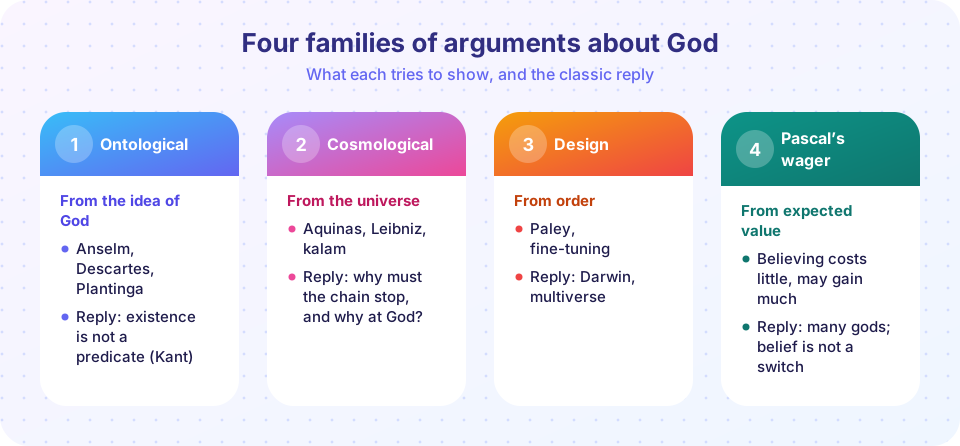
Anselm of Canterbury (11th century) defined God as "that than which nothing greater can be conceived". Even the person who denies God has this idea in mind. But something that exists in reality is greater than something that exists only in the mind. So if God existed only in the mind, we could conceive something greater (a God who exists in reality), a contradiction. So God exists. The argument is a priori: it uses no observations.
The monk Gaunilo replied at once with a parody: replace God with "the greatest conceivable island". The same reasoning seems to prove that a perfect island exists, which is absurd. Defenders say that the island has no maximum, since it can always be improved, but a maximally great being does. Immanuel Kant later argued that existence is not a property that makes a thing greater, but a statement that the concept has an instance: a hundred real coins contain no more coin-concept than a hundred possible coins. In the 1970s Alvin Plantinga offered a modal version using possible worlds: if a maximally great being is possible, it exists in some world, and being maximally great means existing in all worlds, so it exists in ours. Critics reply that the argument works only if we grant the crucial premise that such a being is possible; a parallel argument starting from the possibility of its non-existence runs the other way.
The cosmological arguments
These start from a feature of the universe and reason back to a cause. Thomas Aquinas's "Five Ways" (13th century) include arguments from motion and from causes: nothing causes itself, a chain of causes cannot go back forever, so there must be a first cause. The contingency version (from Leibniz) says: everything contingent needs an explanation; the whole universe is contingent; so it has an explanation outside itself. The kalam argument (developed by medieval Islamic thinkers such as al-Ghazali, and revived by William Lane Craig) states:
- Whatever begins to exist has a cause.
- The universe began to exist.
- Therefore the universe has a cause.
Critics raise several points. Why can't the chain of causes just go back without end, or the universe be a brute fact? Even if there is a first cause, why call it God, with intelligence and goodness? Is premise one true of the universe as a whole, or only of things inside it? Bertrand Russell and others pointed out that moving from "every event has a cause" to "the universe as a whole has a cause" may commit a fallacy of composition. Physics adds complications about what "beginning" means at the origin of time.
Design arguments
William Paley (1802) imagined finding a watch on a heath: its parts are arranged for a purpose, so it must have had a maker. Living things display far more intricate design, so they must have a designer. David Hume had already raised objections in his Dialogues Concerning Natural Religion (published after his death in 1779): analogies between a watch and the universe are weak; a designer might be limited, one of many, or even flawed. Charles Darwin's On the Origin of Species (1859) then offered a natural explanation of apparent design in living things, which many take to undercut Paley's central examples.
Today's version is the fine-tuning argument: the laws and constants of physics seem to lie in a narrow range that allows complex life. Replies include the anthropic principle (we could only observe a universe compatible with observers), a possible multiverse, and doubts about whether we can meaningfully assign probabilities to different values of constants. Defenders reply that a multiverse is itself an unevidenced speculation. All sides agree on what is at stake: whether the order we find calls for explanation, and what kind.
Pascal's wager
Blaise Pascal (Pensées, 1670) argued that reason cannot decide whether God exists, but we must "wager". If you believe and God exists, you gain an infinite reward; if you believe and God does not exist, you lose a little; if you do not believe and God exists, you lose greatly; if you do not believe and God does not exist, you gain a little. Whatever small probability you assign, the infinite payoff makes belief the rational bet.
Objections include the many gods problem (which God? a rival deity might punish believers in the wrong one), the point that belief is not something you can choose by decision, and puzzles about reasoning with infinite values. It is mostly discussed as an example of decision theory, not as a proof.
Beyond the classic arguments
Some philosophers argue that arguments are the wrong place to look. Religious experience (William James) is offered as direct evidence. Reformed epistemology (Alvin Plantinga) argues that belief in God may be properly basic, rational without needing argument, as belief in other minds may be. On the other side, divine hiddenness (J. L. Schellenberg, 1993) argues that if a loving God existed, reasonable non-belief would not occur, but it does. Many traditions also emphasize practice and community, not proof.
Common misconceptions. (1) "An argument for God's existence only matters if it persuades everyone." Arguments can be good tools even when they do not convince. (2) "Atheism is a belief without reasons, and theism needs a proof." Both sides can have arguments; where the burden lies is itself debated. (3) "Science has disproved God." Science studies natural causes; whether it bears on God is a philosophical question, with serious thinkers on both sides.
Try it
Press Run (or Ctrl + Enter) to see the result here.
Program input · what you'd type while the program runs
Type the answers before you press Run, one per line. Each time the program reads a line (with input()), it gets the next line from this box.
Check your understanding
Quick check · 5 questions
of 5 answered You scored / 5 · perfect!
-
1. What is the difference between a valid and a sound argument?
Validity concerns the form of the reasoning; soundness adds the truth of the premises. -
2. What was Gaunilo's reply to Anselm?
He used the island to suggest the argument form proves too much. -
3. What is the kalam argument's second premise?
Whatever begins to exist has a cause; the universe began to exist; so it has a cause. -
4. What does the anthropic principle say in reply to fine-tuning?
Observers can only find themselves in life-permitting conditions. -
5. What is the many-gods objection to Pascal's wager?
A rival deity cancels the advantage of believing in the original one.
Summary
- Four families: ontological (a priori), cosmological (from the universe), design (from order), Pascal's wager (from payoffs).
- Each has well-known replies; testing for validity and then soundness is the standard method.
- Alternatives include religious experience, reformed epistemology and the hiddenness argument.
- Positions range from theism to agnosticism to atheism; the arguments are tools for thinking, not scoreboards.
Next: The problem of evil
Track your progress
Create a free account to tick off lessons and pick up where you left off on any device.
of Introduction to Philosophy lessons completed