


















Lesson 42 of 44 · Projects and Practice
Glossary of Philosophy Terms
A plain-language glossary of fifty key philosophy terms from logic, knowledge, mind, free will, religion, meaning and political philosophy, with flash cards.
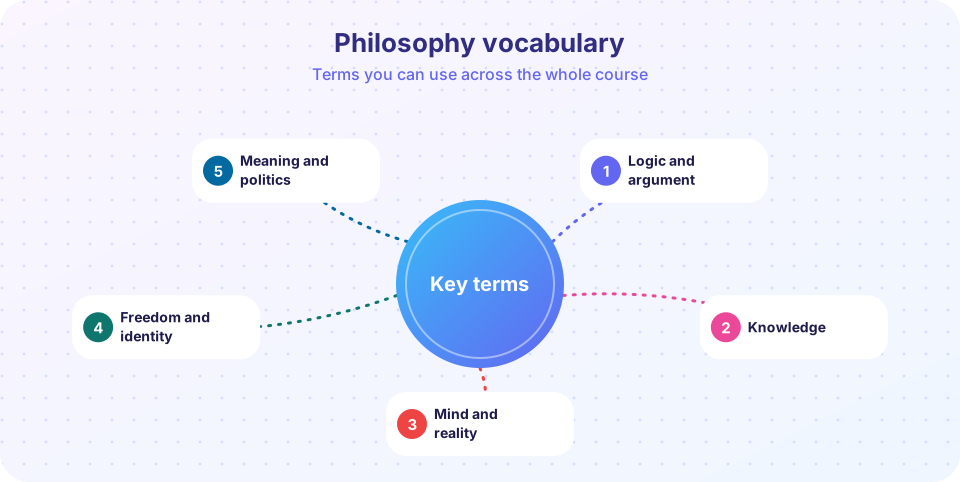
Philosophy has a reputation for difficult vocabulary, but most of its terms are precise tools. A term of art names a distinction that matters, and once you have it, you can use it in everyday thinking. This glossary collects fifty terms from the whole course in plain language, grouped by area, with links to the lessons where the second half of the course treats them. Use it for revision and for the flash cards at the end.
What you will learn
- The meaning of fifty key terms, each in one or two sentences.
- How terms connect across areas (for example, "valid" and "sound" return in the philosophy of religion).
- How to use flash cards for active recall.
Logic and argument
| Term | Meaning |
|---|---|
| Argument | A set of statements (premises) offered as reasons for another statement (the conclusion). |
| Premise | A statement offered in support of a conclusion. |
| Conclusion | The statement an argument tries to establish. |
| Valid | An argument is valid if the conclusion must be true whenever the premises are true. |
| Sound | A valid argument with true premises. |
| Deductive / inductive | Deduction guarantees its conclusion if valid; induction makes it probable. |
| Fallacy | A common pattern of bad reasoning. |
| Hidden premise | An unstated assumption an argument depends on. |
| Counterexample | A case where the premises are true and the conclusion false, showing invalidity. |
| Steel-man | The strongest fair version of an opposing view. |
Knowledge
| Term | Meaning |
|---|---|
| Epistemology | The study of knowledge and justified belief. |
| A priori / a posteriori | Known by reasoning alone / known through experience. |
| Rationalism / empiricism | Knowledge comes chiefly from reason / from sense experience. |
| Justified true belief | The traditional analysis of knowledge; challenged by Gettier cases. |
| Skepticism | The view that knowledge (in some area) is impossible or less certain than we think. |
| Gettier case | A case of justified true belief that does not seem to be knowledge. |
Mind and reality
| Term | Meaning |
|---|---|
| Metaphysics | The study of what exists and its basic nature. |
| Dualism | Mind and body are two distinct kinds of thing (or have two kinds of property). |
| Monism | Reality is made of one kind of stuff. |
| Physicalism | Everything that exists is physical or fixed by the physical. |
| Functionalism | A mental state is defined by its causal role. |
| Multiple realizability | The same mental state can be realized in different physical systems. |
| Idealism | Reality is fundamentally mental. |
| Qualia | The felt qualities of experience. |
| Consciousness | The fact that there is something it is like to be a subject. |
| Hard problem | Why physical processes give rise to experience at all. |
| Epiphenomenalism | Experience is caused by the brain but causes nothing. |
| Panpsychism | Mentality is a basic feature of matter. |
Freedom and identity
| Term | Meaning |
|---|---|
| Determinism | The laws plus the past fix a single future. |
| Compatibilism | Free will is compatible with determinism. |
| Incompatibilism | Free will and determinism cannot both hold. |
| Libertarianism (free will) | Determinism is false and we have free will. |
| Hard determinism | Determinism is true, so no one has free will. |
| Moral responsibility | Being a fitting target for praise or blame. |
| Reactive attitudes | Emotions such as resentment and gratitude directed at agents. |
| Personal identity | What makes a person at one time the same as a person at another. |
| Psychological continuity | A chain of overlapping memories, intentions and character traits. |
| Bundle theory | The self is a collection of experiences, not a separate thing. |
Religion, meaning and politics
| Term | Meaning |
|---|---|
| Theism, atheism, agnosticism | Belief that God exists / lack of that belief / the view that it cannot be known or is undecided. |
| Ontological argument | An argument from the concept of God to God's existence. |
| Cosmological argument | An argument from the existence of the universe to a first cause or explanation. |
| Theodicy | An attempt to explain why a good God permits evil. |
| Problem of evil | The challenge that suffering poses to belief in an all-good, all-powerful God. |
| Nihilism | The view that nothing has meaning or value. |
| The absurd | The clash between our need for meaning and an unresponsive universe (Camus). |
| Social contract | An agreement (often imagined) that is supposed to justify political authority. |
| Legitimacy | The right of a state to rule. |
| Distributive justice | What makes a distribution of goods fair. |
| Veil of ignorance | Rawls's device that hides your place in society so you choose impartially. |
| Negative / positive liberty | Freedom from interference / freedom to be self-governing and to achieve goals. |
| Harm principle | Coercion is justified only to prevent harm to others (Mill). |
| Right | A claim that imposes duties on others. |
Do not memorize definitions alone. For each term, add an example and a non-example in your own words. If you can do both, you understand it.
Try it
Press Run (or Ctrl + Enter) to see the result here.
Program input · what you'd type while the program runs
Type the answers before you press Run, one per line. Each time the program reads a line (with input()), it gets the next line from this box.
Check your understanding
Quick check · 4 questions
of 4 answered You scored / 4 · perfect!
-
1. What is a sound argument?
Soundness adds true premises to validity. -
2. Which term names the view that the same mental state can exist in different physical systems?
It is the main point of functionalism against identity theory. -
3. What does 'theodicy' refer to?
It responds to the problem of evil. -
4. Which pair matches negative and positive liberty correctly?
Berlin's two concepts are about the absence of interference and the presence of self-mastery.
Summary
- A glossary term is a tool: know its meaning, an example and a non-example.
- Terms recur across areas: valid and sound in religion, determinism in freedom and identity.
- Use flash cards for active recall, not rereading.
Next: Philosophy cheat sheet
Track your progress
Create a free account to tick off lessons and pick up where you left off on any device.
of Introduction to Philosophy lessons completed