


















Lesson 16 of 44 · Knowledge and Skepticism
Knowledge as Justified True Belief, and the Gettier Problem
Test the classic definition of knowledge as justified true belief, see why Gettier cases break it, and compare the main replies: no false lemmas, reliabilism and more.
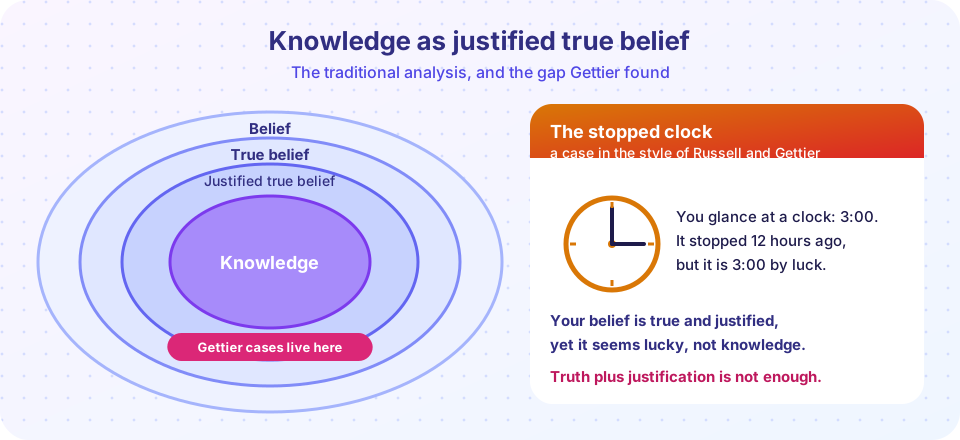
What would it take for you to know that your bus leaves at eight? First, you have to believe it. Second, it has to be true: you cannot know something false. Third, it seems you need good reasons, since a lucky guess that happens to be right is not knowledge. Put the three together and you get the oldest and most natural definition of knowledge: justified true belief.
For about two thousand years this definition seemed nearly right. Then, in 1963, a three-page article showed that it can be satisfied by cases that no one wants to call knowledge. Epistemologists have been arguing about the fix ever since, which makes this one of the most instructive stories in modern philosophy.
What you will learn
- The three conditions of the traditional analysis and why each seems necessary.
- Gettier's challenge and a few classic cases.
- Main replies: no false lemmas, causal and reliabilist theories, virtue and knowledge-first views.
- How to judge a proposed definition with counterexamples.
Key terms
- Belief: taking something to be true.
- Truth: here, a belief is true when things are as it says they are.
- Justification: having good reasons or evidence for a belief.
- Gettier case: a case of justified true belief that seems not to be knowledge.
- Epistemic luck: when a belief is true only by accident, despite good reasons.
The traditional analysis
An analysis of knowledge says: a person S knows that p if and only if
- p is true (the truth condition),
- S believes that p (the belief condition), and
- S is justified in believing that p (the justification condition).
Why each part? Consider what happens when one is missing.
| Missing part | Example | Why it is not knowledge |
|---|---|---|
| Truth | You are sure the museum opens at nine, but it opens at ten. | You cannot know what is false; you merely believed it. |
| Belief | Your friend tells you the exam is on Friday, but you do not believe her, and it is on Friday. | You do not accept it, so you do not know it. |
| Justification | You guess that the next coin toss will be heads, and it is. | A lucky guess is not knowledge. |
The idea goes back to Plato. In the Theaetetus (about 369 BCE) Socrates and a young mathematician consider "true belief with an account" and conclude, as many early dialogues do, without a final answer. In the Meno, Socrates compares true opinions to the statues of Daedalus, which run away unless tied down: an explanation or reason is what ties a true belief down.
Gettier's challenge
In 1963 the American philosopher Edmund Gettier published "Is Justified True Belief Knowledge?" in the journal Analysis. He gave cases in which someone has a justified true belief that is true by accident. Here is a case in the spirit of his first one, in our own words.
Smith and Jones have both applied for a job. Smith has strong evidence that Jones will get it (the manager told him so) and he has just counted ten coins in Jones's pocket. So Smith reasonably believes, "The man who will get the job has ten coins in his pocket." As it turns out, the manager changes his mind and Smith himself gets the job, and Smith happens to have ten coins in his pocket. Smith's belief is true, and it was justified. But did Smith know it? Most people say no: his belief is true by luck, because the evidence he had (about Jones) had nothing to do with the fact that made it true (about himself).
The stopped clock
A simpler case is often credited to Bertrand Russell (1948). You walk into a room and look at a clock that reads 3:00. You believe it is 3:00, and in fact it is. But the clock stopped exactly twelve hours ago. Your belief is true and justified (clocks usually work), yet it seems a matter of luck rather than knowledge.
Fake barns
In 1976 Alvin Goldman described Henry, who drives through a district full of fake barn facades and happens to look at the one real barn. He truly believes "That is a barn", with excellent visual evidence. Many say he does not know, since he could so easily have been looking at a fake. The case suggests that the problem is not just false inference: his evidence seems fine, but his environment makes success lucky.
Responses to Gettier
Epistemologists have tried several repairs. None has won universal agreement.
- Add a fourth condition. The first idea was to require that the justification not depend on any false belief (the "no false lemmas" condition). In the Smith case, his reasoning used a false step ("Jones will get the job"), so he fails the new condition. But there are Gettier-style cases without any false step, such as fake barns.
- Causal theories. Goldman (1967) said knowledge requires that the fact causes your belief in the right way. The stopped-clock case fails because the time did not cause your belief. But what about knowledge of the future or of mathematics?
- Reliabilism. Knowledge is true belief produced by a reliable process (Goldman, 1979), one that tends to produce true beliefs. The fake barn case is challenging again: is perception in that district reliable?
- Tracking or safety conditions. Robert Nozick (1981) proposed that if the claim were false, you would not believe it. Others favor safety: in nearby possible situations where you believe it, it is true.
- Virtue epistemology. Ernest Sosa and Linda Zagzebski say knowledge is true belief that comes from the believer's intellectual virtues or skill, so that the truth is creditable to the person, not luck.
- Knowledge first. Timothy Williamson (2000) suggests we should not analyze knowledge at all. Knowledge is a basic state, and belief and justification are to be understood in terms of it.
Many philosophers now think no neat definition of knowledge will work and that the method matters more: proposals are tested by counterexamples, and each teaches us which conditions are in play.
How justification itself might work
A different question is how beliefs get justified. Foundationalists say some beliefs (basic ones, such as "I am in pain" or perceptual experiences) are justified without needing support from other beliefs, and all others rest on them. Coherentists say beliefs are justified by fitting together in a web. The ancient skeptic Agrippa (reported by Sextus Empiricus) posed the regress problem: if every belief needs a reason, the chain of reasons must go on forever, loop around, or stop at an unsupported belief. Each option has defenders and critics.
Common misconceptions
"Gettier showed that we cannot know anything." No. He showed that a definition was incomplete, not that knowledge is impossible.
"A Gettier case needs a trick or a deceiver." Many involve nothing but ordinary bad luck.
"If you are justified and right, you obviously know." The stopped clock shows how you can be justified and right and still not know, because the success is accidental.
"Philosophers all agree on the fix." They do not; the debate about the nature of knowledge is still open.
Try it
Press Run (or Ctrl + Enter) to see the result here.
Program input · what you'd type while the program runs
Type the answers before you press Run, one per line. Each time the program reads a line (with input()), it gets the next line from this box.
Check your understanding
Quick check · 6 questions
of 6 answered You scored / 6 · perfect!
-
1. What are the three conditions in the traditional analysis of knowledge?
Knowledge was analyzed as justified true belief. -
2. Why is a lucky guess that turns out true not knowledge?
A lucky guess has truth and belief, but lacks justification. -
3. Who published 'Is Justified True Belief Knowledge?' in 1963?
Gettier's short paper in the journal Analysis introduced the cases that bear his name. -
4. In the stopped-clock case, why do many deny that you know the time?
The clock's reading is not connected in the right way to the actual time, so the truth of the belief is accidental. -
5. Reliabilism says knowledge is
Goldman's reliabilism links knowledge to belief-forming processes that tend to yield true beliefs. -
6. Which is the best summary of the Gettier literature?
Gettier cases challenge sufficiency; many fixes have been proposed but none has won consensus.
Summary
- The traditional analysis defines knowledge as justified true belief: truth, belief and justification.
- Gettier (1963) described cases of justified true belief that are true by luck, so JTB seems insufficient.
- Replies include no false lemmas, causal theories, reliabilism, tracking and safety, virtue epistemology and knowledge-first.
- Foundationalism and coherentism disagree about how justification is structured, as the regress problem shows.
- Proposals are tested by counterexamples; the debate is open.
Track your progress
Create a free account to tick off lessons and pick up where you left off on any device.
of Introduction to Philosophy lessons completed