


















Lesson 1 of 44 · Getting Started
Course Map: Your Route Through Philosophy
Who this philosophy course is for, what you need to start, how the nine chapters fit together, and how to study so that the ideas actually stick.
Philosophy is the practice of asking the biggest questions we can and then trying to answer them with reasons instead of with force, fashion or habit. What is real? What can we know? What should we do? Is there a self, a god, a fair society? You already hold views on all of these. This course helps you examine those views, repair them and, where they survive, defend them.
You do not need any background. If you can read a paragraph and care about a good answer, you are ready. Every term is defined the first time it appears, every thinker is introduced with the dates and the idea that made them matter, and every lesson ends with a short quiz so you can check yourself before moving on.
What you will learn
- Who this course is written for and what you need before you start.
- How the nine chapters build on each other.
- The four study habits that make philosophy easier.
- How this course treats contested questions fairly.
Key terms
- Argument: a set of reasons (premises) offered in support of a claim (the conclusion).
- Thought experiment: an imagined situation built to test an idea.
- Charity: reading another person's view in its strongest, most sensible form before you criticize it.
- Position: a considered answer to a question, together with the reasons for it.
Who this course is for
The course follows the shared core of what students meet in an introductory philosophy class in many countries: the first year of a university degree, the philosophy options in the International Baccalaureate, and the critical-thinking units of many school systems. You do not have to be enrolled anywhere. Curious adults, older school students and anyone preparing for a degree will find the same material.
There are no prerequisites. A little patience helps, because philosophy rewards slow reading. A single paragraph can take five minutes if it is doing its job.
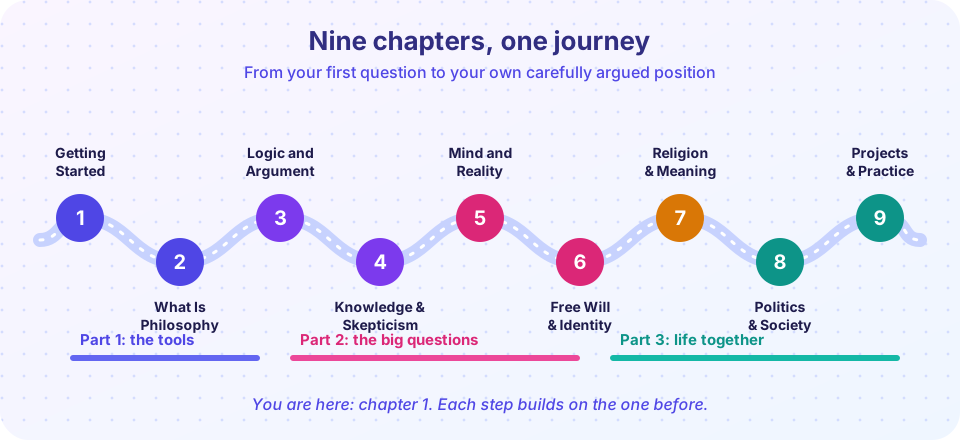
The nine chapters
Part 1: the tools
- Getting Started
- What Is Philosophy
- Logic and Argument
- Knowledge
Part 2: the big questions
- Mind and Reality
- Free Will and Identity
- Religion and Meaning
Part 3: life together
- Politics and Society
- Projects and Practice
Each chapter opens with an overview and closes with a review quiz.
Chapters 1 to 4 give you the tools: how to read, argue and doubt well. Chapters 5 to 7 use those tools on the big questions about minds, freedom, selves and meaning. Chapters 8 and 9 turn to life together and to your own projects. You can jump ahead if a topic grabs you, but the logic lessons in chapter 3 will make everything after them clearer.
Four study habits
- Read twice. The first pass finds the topic; the second finds the argument.
- Write the argument in your own words. If you cannot state the conclusion and the reasons in three sentences, you have not yet understood it. The next lesson shows how.
- Look for the best objection. Philosophers improve ideas by attacking them. Treat objections as a gift, not an insult.
- Revise your view out loud or on paper. Talk to a friend, or write a paragraph. Ideas that stay in your head stay vague.
How this course treats disagreement
Philosophy has famous answers, but few of them are settled. When thinkers disagree, you will see the best case for each side, with the names of the people who made it, and you will be told where the disagreement still stands. Where a question has a clear answer (for example, whether an argument is logically valid), we say so. The course will never tell you what to conclude about contested moral, political or religious questions. It will show you how to reason about them.
Keep a "question notebook". Each time a lesson makes you say "but what about...?", write it down. By the end of the course you will have a personal list of questions worth pursuing.
Common misconceptions
"Philosophy is just opinions, so every answer is as good as any other." Opinions differ, but reasons can be strong or weak. A view that survives the best objections is better supported than one that collapses at the first challenge.
"You need to memorize dead thinkers." Names are useful handles, but the real skill is reasoning. This course teaches both, and the quizzes test understanding, not trivia.
Try it
Press Run (or Ctrl + Enter) to see the console output here.
No output.
Check your understanding
Quick check · 4 questions
of 4 answered You scored / 4 · perfect!
-
1. What does it mean to read an argument charitably?
Charity means giving the author the best reasonable reading, so that your criticism hits the real view and not a weak imitation. -
2. Which chapters make up the 'tools' part of the course?
Chapters 1 to 4 (getting started, what philosophy is, logic, and knowledge) give you the methods used in the rest of the course. -
3. Why does the course show several sides of contested questions?
Some questions are still open. The goal is for you to reason well about them, not to inherit a conclusion. -
4. A friend says 'philosophy is just opinions'. What is the best reply?
What separates a strong view from a weak one is how well it stands up to arguments and objections.
Summary
- The course needs no prior knowledge and covers the common core of introductory philosophy.
- Chapters 1-4 teach the tools, 5-7 the big questions, 8-9 life together and your own projects.
- Good habits: read twice, restate the argument, seek objections, revise aloud or in writing.
- Contested questions are presented fairly, with the reasons on each side.
Next: How to Study Philosophy
Track your progress
Create a free account to tick off lessons and pick up where you left off on any device.
of Introduction to Philosophy lessons completed