


















Lesson 19 of 44 · Knowledge and Skepticism
Chapter 4 Review: Knowledge and Skepticism
Review the Gettier problem, the debate between rationalists and empiricists, Kant's synthesis and skeptical arguments with a recap table, a tool and a ten-question quiz.
You have followed philosophy's most famous question, "what can we know?", from the simple definition of knowledge as justified true belief to the stairs of doubt that lead to Descartes' cogito. This review gathers the chapter into one picture, shows where each idea lives in the lessons and then tests you. Notice how often you use chapter 3: skeptical arguments are valid-or-not arguments, and replies to them are premises you can accept or reject.
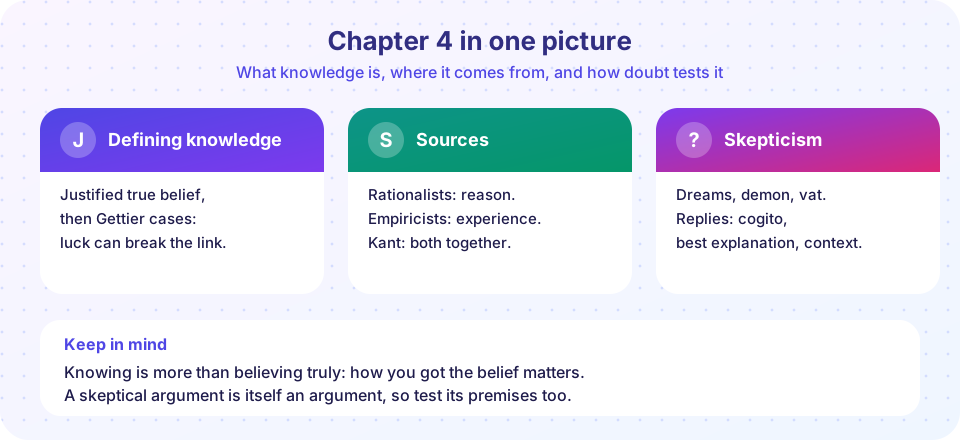
What you will learn
- A recap of the chapter in one table.
- How the three main lessons connect.
- Where to go next in the course.
Recap table
| Idea | Summary | Lesson |
|---|---|---|
| Kinds of knowing | Knowing that, knowing how, acquaintance | Overview |
| Sources | Perception, reason, testimony, memory, introspection | Overview |
| JTB | Knowledge = justified true belief | Justified True Belief |
| Gettier problem | Justified true belief that is true by luck (1963) | Justified True Belief |
| Replies to Gettier | No false lemmas, causal, reliabilism, safety, virtue, knowledge-first | Justified True Belief |
| A priori / a posteriori | How a claim can be known | Rationalism vs Empiricism |
| Analytic / synthetic | What makes a claim true | Rationalism vs Empiricism |
| Rationalism / empiricism | Reason vs experience as the source | Rationalism vs Empiricism |
| Kant's synthesis | Experience gives content, the mind gives structure | Rationalism vs Empiricism |
| Method of doubt | Senses, dreams, evil demon, cogito | Skepticism and Descartes |
| Replies to skepticism | Moore, Putnam, contextualism, best explanation, denying closure | Skepticism and Descartes |
How the pieces fit
Start with the definition: knowledge needs truth, belief and justification, plus something that rules out luck. Then ask where justification comes from: reason, experience or both? Finally test the whole thing with the skeptic, who asks whether any of our evidence can rule out a scenario in which we are fooled. Notice the pattern: a proposal, a counterexample, a repair. That is the same cycle you practiced in chapter 1, from thought experiments to reflective equilibrium.
Try writing a three-sentence answer to "Do I know that I am awake?" that mentions one idea from each of the chapter's three lessons. If you can, you have the chapter.
Common misconceptions
"Gettier proved we know nothing." He showed that a particular definition was inadequate.
"Rationalists and empiricists disagreed about whether to use evidence." They disagreed about the sources and justification of certain kinds of knowledge.
"The cogito shows I have a body." It shows only that a thinking thing exists.
Try it
Press Run (or Ctrl + Enter) to see the console output here.
No output.
Check your understanding
Quick check · 10 questions
of 10 answered You scored / 10 · perfect!
-
1. A Gettier case is
Gettier cases show that justification and truth together can still leave the belief accidentally true. -
2. Which condition is part of the traditional analysis of knowledge?
The traditional analysis requires truth, belief and justification. -
3. Rationalists such as Descartes and Leibniz held that
Rationalism stresses reason and innate ideas, with mathematics as the model. -
4. Hume's fork divides objects of reasoning into
Relations of ideas are known by thought and are certain; matters of fact depend on experience. -
5. Which statement is a priori?
It is true by the meaning of its terms and needs no survey. -
6. In Descartes' method of doubt, which step comes after the dream argument?
The order is senses, dreams, evil demon, then the cogito. -
7. Kant claimed that
He argued that experience supplies content and the mind supplies concepts and forms. -
8. The closure-based skeptical argument is valid. How can one resist it?
A valid argument forces you to accept the conclusion only if you accept the premises, so replies target a premise. -
9. Which philosopher argued that a brain in a vat could not meaningfully think 'I am a brain in a vat'?
Putnam's semantic externalist reply says the words of a vat-brain would not refer to real vats. -
10. Why does the Bayesian demonstration suggest the skeptic's challenge is hard to answer with evidence alone?
When likelihoods are equal, the posterior equals the prior, so the answer depends on prior plausibility such as simplicity.
Summary
- The traditional analysis (justified true belief) faces Gettier cases of lucky justified true belief; no repair is universally accepted.
- Rationalists stress reason and innate ideas; empiricists stress experience; Kant combines them.
- Descartes' doubt moves from the senses to dreams to the evil demon to the cogito.
- Replies to skepticism include Moore's common sense, Putnam's semantic argument, contextualism and best-explanation reasoning.
- Chapters 5 to 9 apply these tools to minds, freedom, religion, politics and your own projects.
Track your progress
Create a free account to tick off lessons and pick up where you left off on any device.
of Introduction to Philosophy lessons completed