


















Lesson 10 of 44 · Logic and Argument
Logic and Argument: The Big Picture
Get the big picture of logic: what an argument is, how reasoning can go right or wrong, a short history from Aristotle to computers, and what chapter 3 covers.
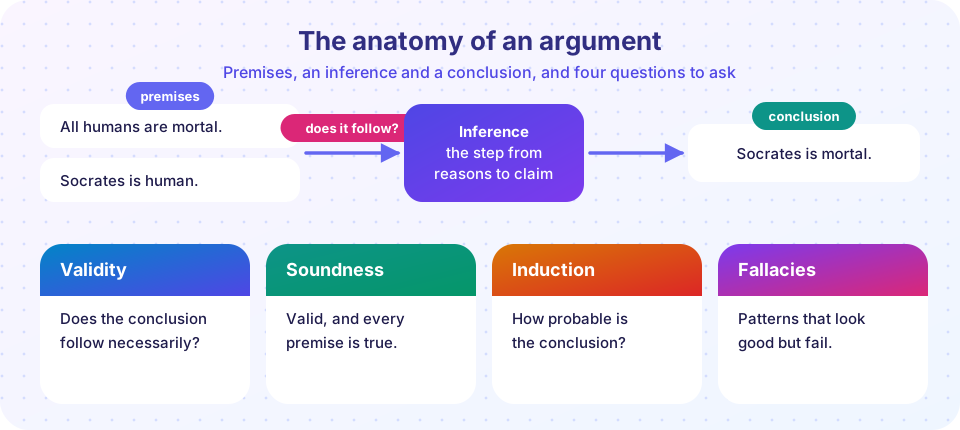
Every time you say "because", "so" or "therefore", you are making an argument. Logic is the study of when such moves are good. It does not tell you what to believe about the world; it tells you what follows from what, and how reasons can support a claim strongly, weakly or not at all. If philosophy is the search for reasoned answers, logic is the quality control.
In this chapter you will learn to spot arguments, test them for validity and soundness, tell deduction from induction and recognize the fallacies that fool even smart people. These tools work on political speeches, advertisements, scientific papers and your own thinking.
What you will learn
- What logic studies, and what it does not.
- The parts of an argument and how to tell an argument from an explanation.
- A short history of logic from ancient times to computers.
- What each lesson in this chapter covers.
Key terms
- Logic: the study of correct reasoning.
- Argument: premises offered in support of a conclusion.
- Inference: the step of reasoning from premises to conclusion.
- Formal logic: logic that studies the form of arguments with symbols.
- Informal logic: the study of everyday arguments in natural language, including fallacies.
What logic is for
Imagine two people who disagree about a policy. One says, "The data show it works, so we should adopt it." The other replies, "That economist is paid by the industry, so ignore her." The first is giving an argument; the second is attacking the person instead of the evidence. Logic gives names and tests for exactly this kind of difference. It helps you ask:
- What is being claimed? (the conclusion)
- What reasons are offered? (the premises)
- Does the conclusion follow from the premises? (validity or strength)
- Are the premises true? (soundness)
Logic is neutral about topic. The same tests apply to arguments about physics, law, ethics or football.
A very short history
- Around 350 BCE, Aristotle wrote the Prior Analytics, the first systematic study of reasoning. His syllogisms (like "All humans are mortal; Socrates is human; so Socrates is mortal") were studied for two thousand years.
- Third century BCE: the Stoics, notably Chrysippus, developed logic of whole sentences ("if... then", "either... or"), the ancestor of propositional logic. Indian logicians of the Nyaya school and Chinese Mohist thinkers independently studied inference and debate, and Islamic logicians such as Ibn Sina refined Aristotle's work.
- 1854: George Boole published The Laws of Thought, showing that logic can be treated like algebra with the values true and false.
- 1879: Gottlob Frege invented a symbolic language that could express quantifiers ("for all", "there exists"), the foundation of modern logic.
- 1931: Kurt Gödel proved that any consistent formal system strong enough for arithmetic contains true statements it cannot prove, one of the deepest results in logic.
- Twentieth century onward: logic became the basis of computer science. The true/false values you see in programs are Boole's legacy.
Deductive, inductive and informal
This chapter's lessons follow three layers of reasoning:
- Deductive arguments aim to make the conclusion certain given the premises.
- Inductive arguments aim to make the conclusion probable.
- Informal fallacies are common patterns that persuade without really supporting.
Chapter 3 at a glance
Kinds of reasoning
Watch out for fallacies
Lesson 4 gives a full tour.
Arguments are not everything
Not every passage with "because" is an argument. Compare:
- Argument: "You should wear a helmet, because helmets reduce serious head injuries." (The "because" gives a reason to accept the claim.)
- Explanation: "The window broke because a ball hit it." (The claim is already accepted, and the "because" says why it happened.)
- Description or story: "She walked to the shop. It was raining." (No reason is offered for any claim.)
The question to ask: is the author trying to convince me of something? If yes, look for the conclusion and the reasons.
Where this chapter goes
- Arguments, premises and conclusions: validity, soundness and standard forms.
- Deduction and induction: certainty versus probability.
- Fallacies: patterns of bad reasoning.
- Chapter 3 review: a decision path and quiz.
Common misconceptions
"Logic tells you the truth." It tells you whether the reasoning is good. A valid argument can have false premises and a false conclusion.
"Being logical means being unemotional." Logic is about the relation between reasons and conclusions. Emotions can motivate good reasoning too; trouble arises only when feelings stand in for reasons.
"If an argument has a fallacy, its conclusion is false." A fallacious argument fails to support its conclusion, but the conclusion might still be true for other reasons.
Try it
Press Run (or Ctrl + Enter) to see the result here.
Program input · what you'd type while the program runs
Type the answers before you press Run, one per line. Each time the program reads a line (with input()), it gets the next line from this box.
Check your understanding
Quick check · 5 questions
of 5 answered You scored / 5 · perfect!
-
1. Logic mainly studies
Logic evaluates the relation between premises and conclusion, not the truth of the topic itself. -
2. Which passage is an argument?
It states a claim (you should apologize) and gives a reason in support. The first is an explanation, the third a description. -
3. Who wrote 'The Laws of Thought' (1854), treating logic like algebra?
Boole's work lies behind the true and false values used in computing. -
4. What did Frege's 1879 Begriffsschrift add?
Frege's notation made it possible to express complex generality and founded modern logic. -
5. A fallacious argument's conclusion is
A fallacy is a flaw in the reasoning, so the conclusion may still be true, but not for the reasons offered.
Summary
- Logic studies how reasons support conclusions; it is neutral about the topic.
- Every argument has premises, an inference and a conclusion; explanations and descriptions are not arguments.
- Key landmarks: Aristotle, the Stoics, Boole, Frege and Gödel.
- The chapter covers validity and soundness, deduction and induction, and fallacies.
Track your progress
Create a free account to tick off lessons and pick up where you left off on any device.
of Introduction to Philosophy lessons completed